At a glance
| Detail | |
|---|---|
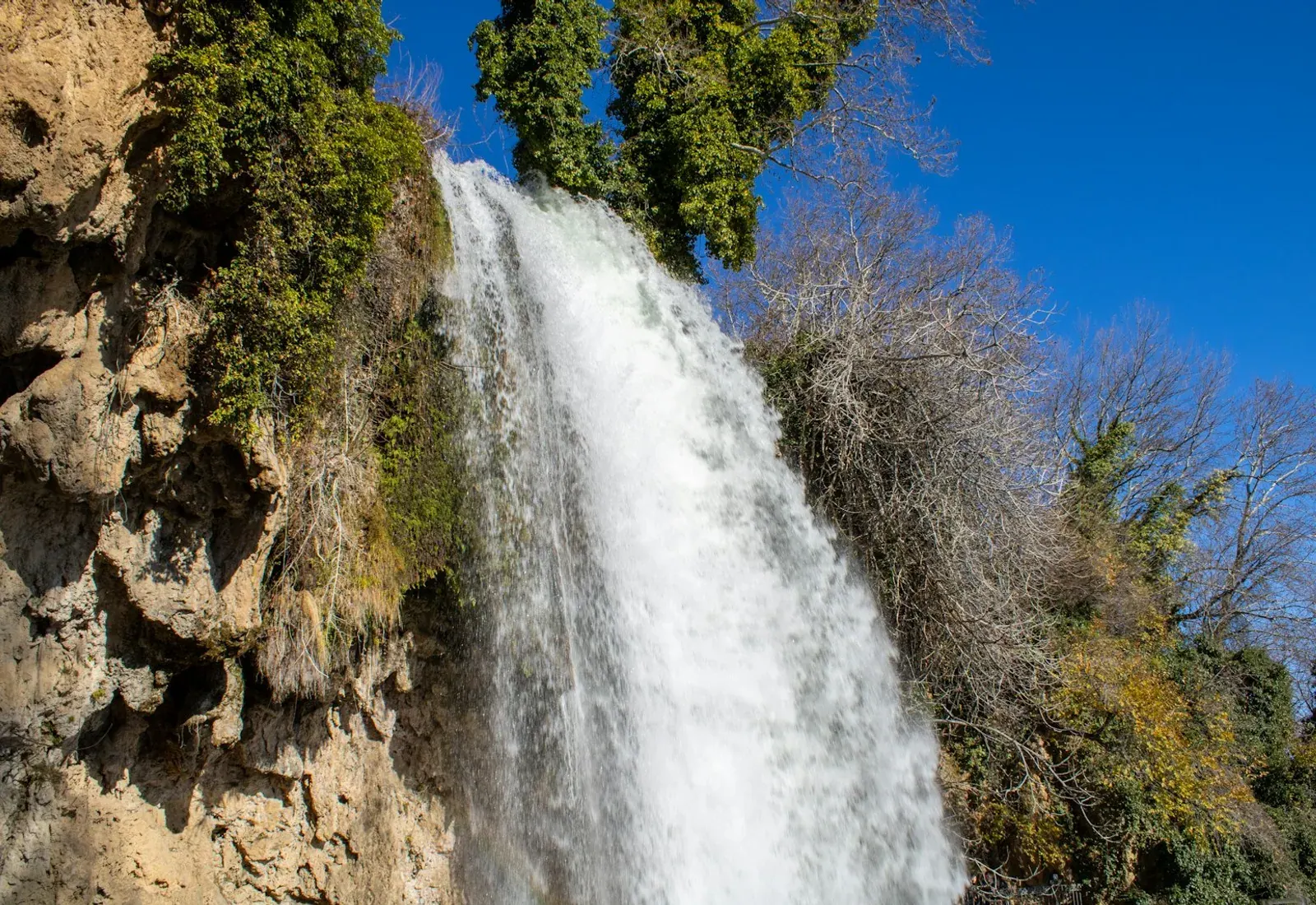
| What it is | The "city of water" — cascades crowned by the 70 m Karanos falls (tallest in mainland Greece) |
| From Thessaloniki | ≈90 km · ~1.5 h by car; direct trains on the Thessaloniki–Florina line |
| See | Karanos & Lamda falls (a path runs behind into a cave), ~a dozen cascades |
| Also | Varosi old quarter, the open-air Water Museum & watermills |
| Best time | Spring for the fullest flow; pleasant year-round |
| Best for | Waterfalls, nature, families, an easy day trip |
| Add-on | Pozar thermal springs (~40 min north) |
Greece's city of water
Edessa is built on a natural balcony where the Edessaios river, fed by the Agra–Nisi wetlands upstream, tips over the edge of the plateau in a series of waterfalls before dropping to the plain below. The town has made the most of it: a green park threaded with streams and bridges leads to Karanos, which at about 70 metres is the tallest waterfall in mainland Greece. Beside it a twin cascade known as the Lamda splits into two ribbons. A short path runs behind the curtain of water into a small cave, and viewpoints look out over the plain toward Mount Vermio.
There are around a dozen cascades in all, four of them easy to reach, which makes Edessa one of the most relaxed and family-friendly day trips from the city.
How the falls were born
The waterfalls are surprisingly recent. Until the end of the 14th century the Edessaios pooled quietly to the west of town; a strong earthquake shifted the ground, the river changed course and cut straight through the city, and the cascades were born where it spilled off the cliff. So the "city of water" is really a town that grew around a natural accident — one it has been harnessing with mills and channels ever since.
How to do it from Thessaloniki
By car it is about 90 km / 1.5 hours via the Egnatia motorway and the Veria–Edessa road. Edessa is also on the Thessaloniki–Florina railway, so you can skip the driving entirely and arrive by train within walking distance of the falls.
Beyond the falls
Above the cascades sits Varosi, the town's old quarter of restored stone-and-timber mansions, churches and quiet lanes with views back over the water — built on the acropolis of ancient Edessa, a station on the Roman Via Egnatia that linked the city to Thessaloniki. A stone-paved stretch of that road still runs down through the plain below the park to the ancient city. Down by the falls, the open-air Water Museum and old hemp watermills explain how the town harnessed its rivers. With a car, the Pozar thermal springs about 40 minutes north make a natural add-on for a longer day.