Most people glance at the Rotunda's huge brick drum from the Kamara and assume it's just another ruin to photograph from outside. It isn't — it's one of the oldest great domes still standing anywhere, and the gold mosaics hidden up inside its cupola are among the most important early-Christian art in the world. The building has been a Roman hall, a church and a mosque in turn, and reading those layers is half the pleasure. Here's what it is, what to look for, and how to visit.
Visiting the Rotunda: at a glance
We'd put the Rotunda in the city's top three monuments, and unlike many it takes only half an hour — so there's no excuse to skip it. The essentials:
| Detail | |
|---|---|
| Built | ≈306 AD, by the emperor Galerius |
| Also known as | Church of Agios Georgios (Greek: Ροτόντα) |
| Entry | €10 (reduced €5; free for under-18s & EU under-25s) · €15 combined 3-day ticket |
| Hours | Summer 08:00–20:00 · winter 08:30–15:30 |
| Time needed | 30–45 minutes |
| Rating | 4.6 (6,451 reviews) |
| Status | UNESCO World Heritage (Paleochristian & Byzantine Monuments) |
It sits a couple of minutes uphill from the Arch of Galerius, at the top of a short pedestrian street, so it pairs naturally with the Roman sites around it.
What is the Rotunda of Thessaloniki?
The Rotunda is a colossal cylindrical Roman building from around 306 AD, raised as part of the palace complex of the emperor Galerius — probably intended as his mausoleum or a temple. Its brick dome is about 24.5 metres in diameter and the interior soars nearly 30 metres to the crown, making it one of the largest and best-preserved domed structures to survive from antiquity, in the same league as Rome's Pantheon. Walking in, the first thing that hits you is the sheer volume of empty space under that dome; the second is the gold glinting high above. It has stood, in one use or another, for some seventeen centuries.
The mosaics: why the Rotunda matters
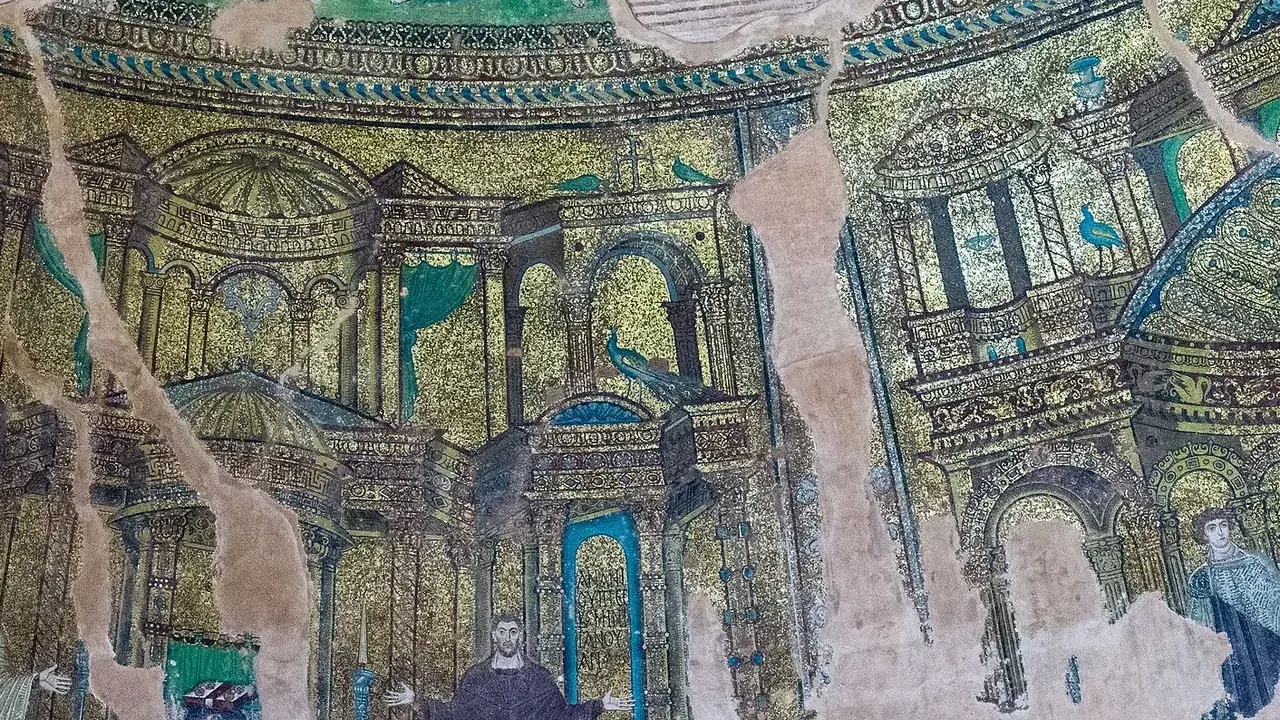
The reason to go inside is the mosaics lining the dome. When the building was turned into a Christian church in the late 4th century, its cupola was sheathed in gold-ground mosaic — saints standing before elaborate fantasy architecture, set against a shimmering field of gold. Only part of the original scheme survives, but what remains is breathtaking and, crucially, among the earliest monumental Christian mosaics anywhere, predating the famous cycles of Ravenna. Go at midday, when daylight climbs high enough to light the upper register, and bring a zoom or just patience — the detail rewards a long look upward. This is the single most underrated sight in the city.
From temple to church to mosque
The Rotunda's biography is the history of Thessaloniki in one building:
- Roman (c. 306): built by Galerius as a monumental hall — mausoleum or temple — linked by a colonnaded avenue to his palace and the Arch of Galerius.
- Early Christian (late 4th c.): converted into a church and decorated with the gold dome mosaics — it is the oldest of Thessaloniki's churches, and today bears the name the Church of Agios Georgios (taken from a nearby chapel), still used for the odd Orthodox service.
- Ottoman (1591): turned into a mosque; its minaret still stands outside — the only surviving Ottoman minaret in Thessaloniki, and reason enough to walk around the exterior.
- Modern: now a monument and occasional Greek Orthodox church (dedicated to Agios Georgios), open to visitors and part of the city's UNESCO listing.
Each conversion left a mark, which is why the place feels layered rather than frozen — Roman shell, Christian ceiling, Ottoman spire.
Tickets, hours and how to visit
Entry is €10 (reduced €5; free for under-18s and EU under-25s) — the fee was raised in the recent Greek state-monument revision, so some older guides still quote €6 — and the €15 combined three-day ticket that also covers the White Tower, the Archaeological and Byzantine Culture museums is worth it if you're doing the monument circuit. Like all Greek state monuments, the Rotunda also has free-admission days: 6 March, 18 April, 18 May, the last weekend of September and 28 October, plus the first and third Sunday of each month from November to March. Opening hours are roughly 08:00–20:00 in summer and 08:30–15:30 in winter, and it is usually closed on Tuesdays (note the two big neighbouring museums are open daily in summer, so don't assume they all keep the same day off); it also closes on certain public holidays, so check before a special trip, especially on a Tuesday. Entry is step-free at ground level. Allow 30–45 minutes — longer if the light is good and you linger on the dome.
What's nearby
The Rotunda anchors a tight Roman cluster you can walk in an hour: down the pedestrian street to the Arch of Galerius (the "Kamara", the city's everyday meeting point), and on to the Palace of Galerius ruins toward Navarinou Square. It's also a short walk from Aristotelous Square and the White Tower, and the pink Atatürk's House museum sits just uphill behind the Turkish consulate. Our Roman Thessaloniki guide sets the Rotunda in the emperor Galerius's complex, and the Byzantine & UNESCO monuments guide puts it in the story of the city's churches.
How it fits a trip
The Rotunda slots into any first day in the city — it's central, quick, and visually unforgettable, so it earns its place even on a tight schedule. Both our 2-day and longer itineraries route through the Kamara–Rotunda pairing on the Roman-monuments leg. Combine it with the two big museums on the same combined ticket and you've covered the spine of ancient and Byzantine Thessaloniki in half a day.
Frequently Asked Questions
What is the Rotunda of Thessaloniki?
It's a colossal Roman domed building from around 306 AD, built by the emperor Galerius as a mausoleum or temple, later converted into a church and then a mosque. Its dome holds some of the earliest and finest early-Christian gold mosaics in the world, and it is part of the city's UNESCO World Heritage listing.
How much does the Rotunda cost to visit?
Entry is €10 (reduced €5), and free for under-18s and EU citizens under 25; the fee was raised in the recent Greek state-monument revision, so some older guides still quote €6. As a state monument it's also free to enter on Greece's national free-admission days — 6 March, 18 April, 18 May, the last weekend of September and 28 October, plus the first and third Sunday of each month from November to March. A €15 combined three-day ticket also covers the White Tower, the Archaeological Museum and the Museum of Byzantine Culture, which is good value if you plan to visit the city's main monuments and museums.
Why does the Rotunda have a minaret?
The Rotunda was used as a mosque during Ottoman rule, when the minaret was added. It is the only Ottoman minaret still standing in Thessaloniki, having survived after the building returned to use as a Christian monument. It stands just outside the rotunda and is best seen from the surrounding square.
How long do you need at the Rotunda?
About 30 to 45 minutes is enough to take in the vast dome, study the surviving gold mosaics in the cupola, and walk around the exterior to see the minaret. Visit around midday, when daylight reaches highest into the dome and lights up the upper band of mosaics best.