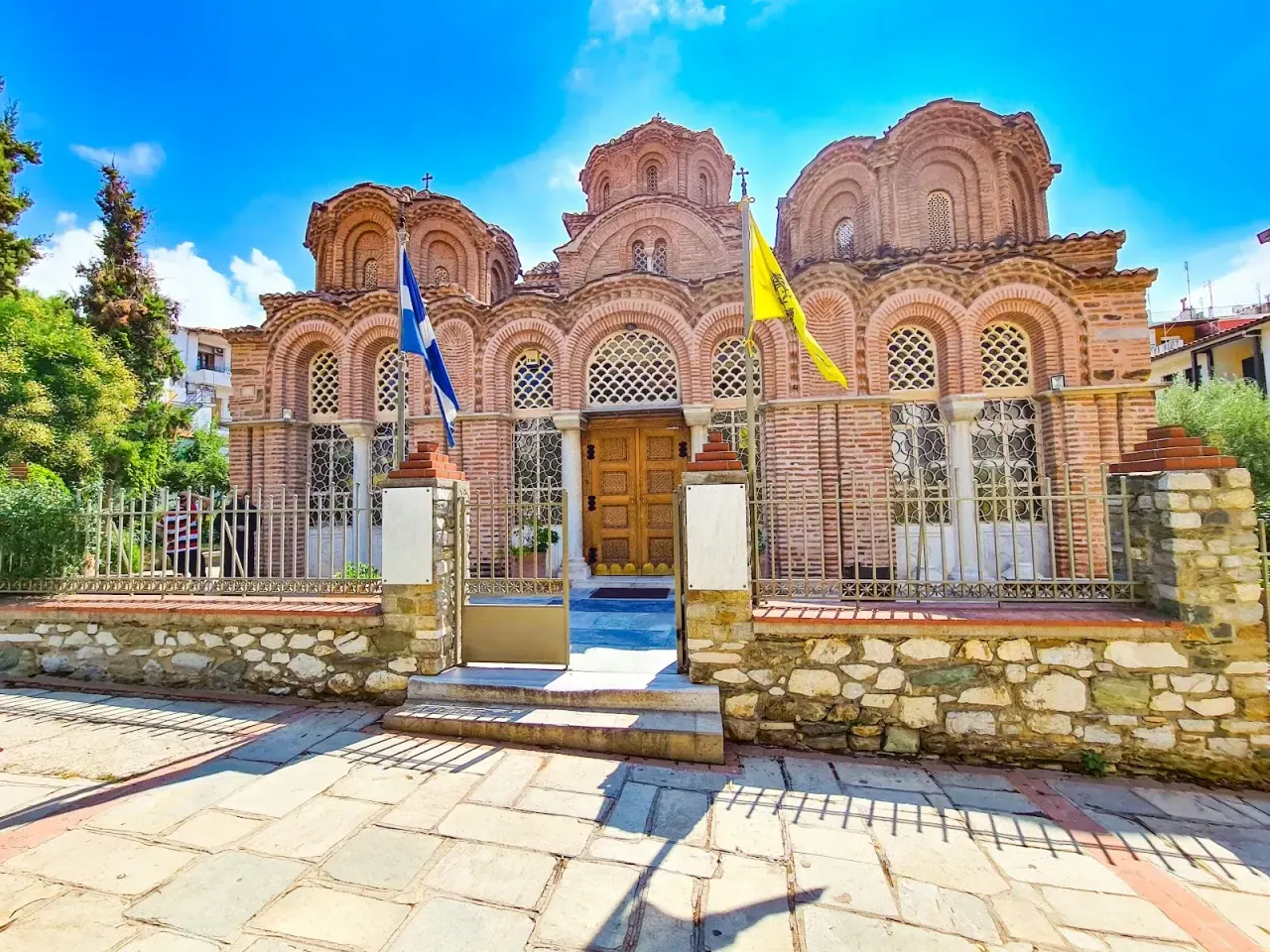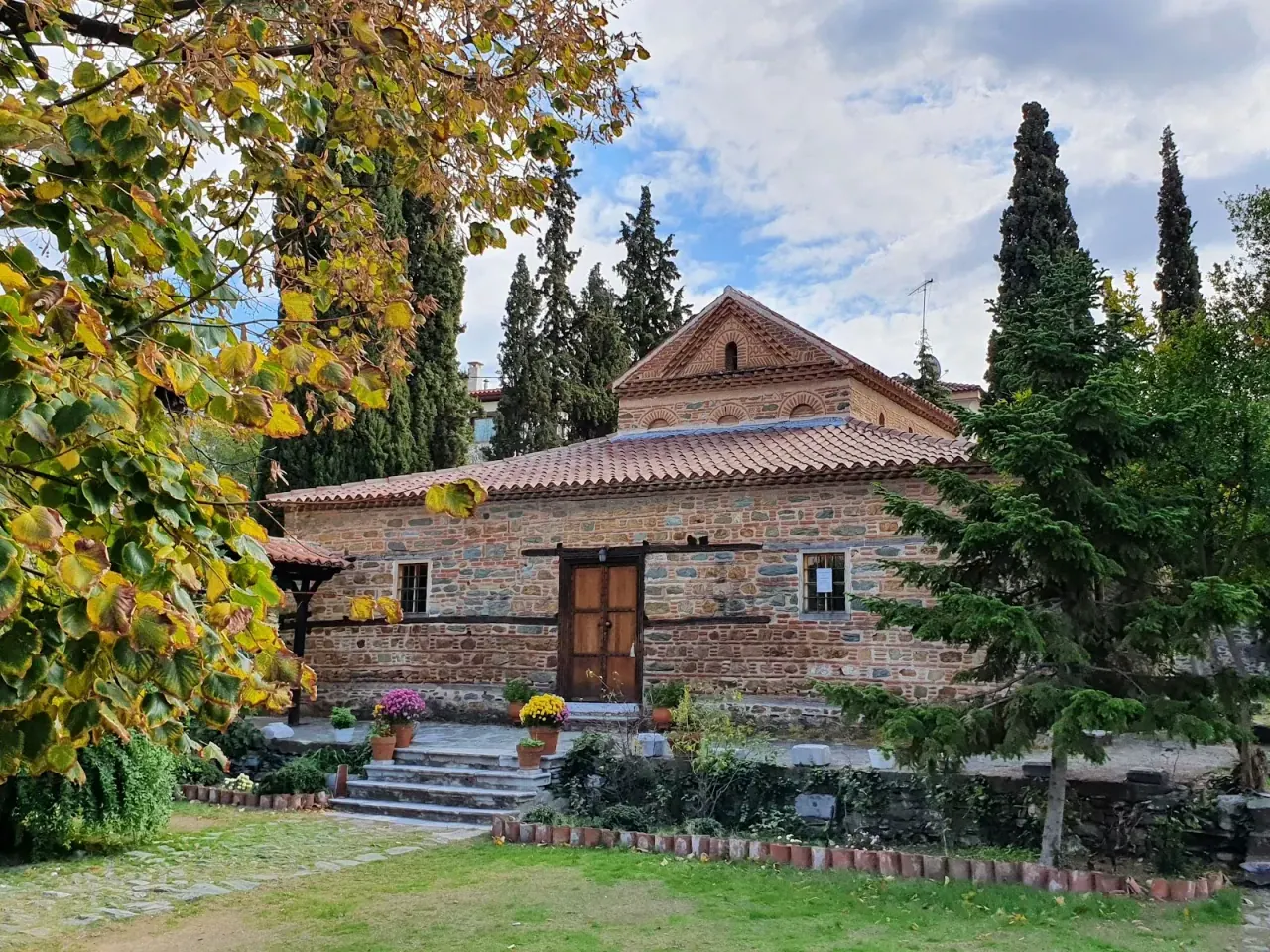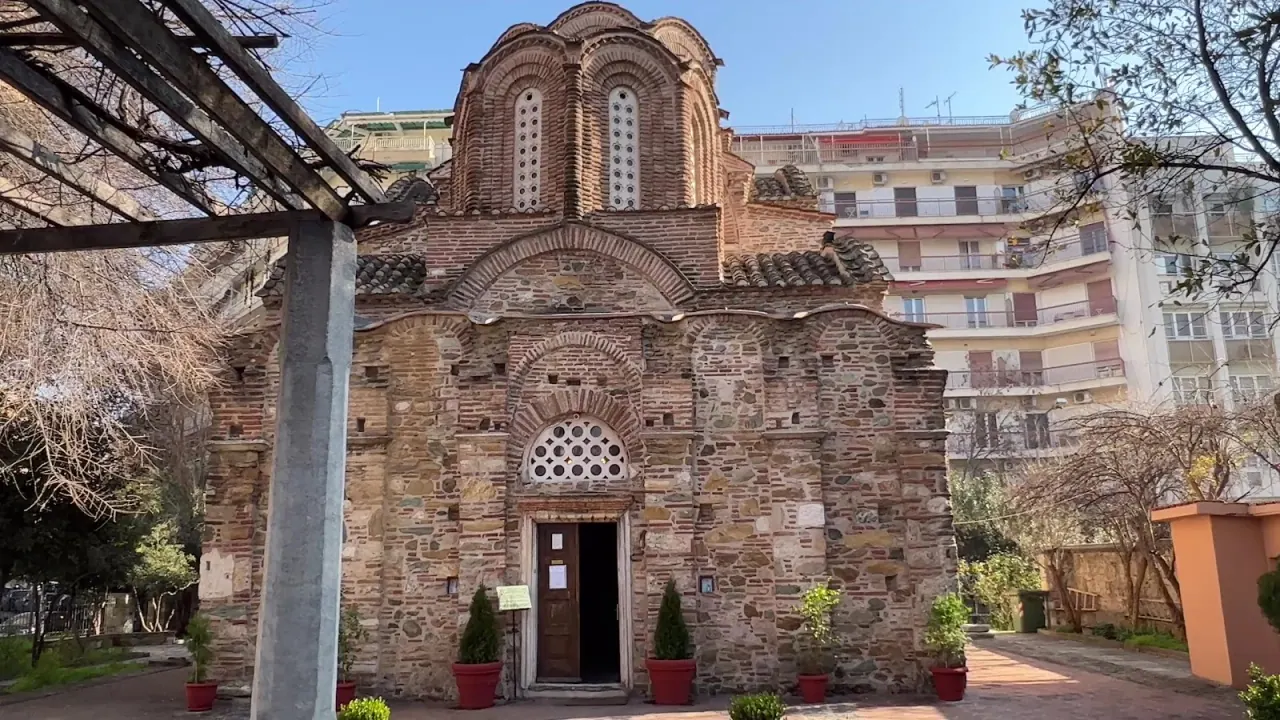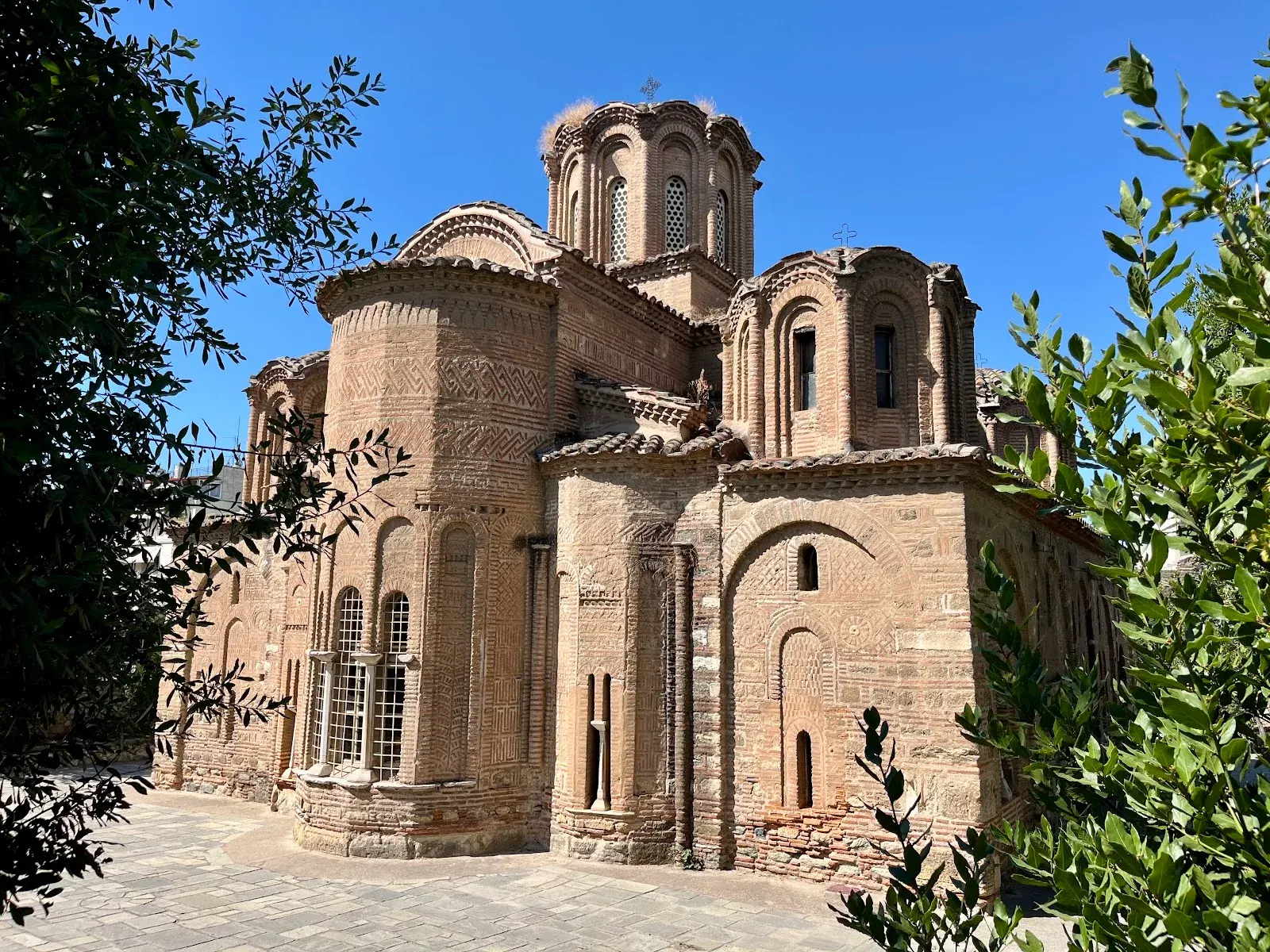
On the quiet western edge of the old town stands a five-domed brick church that most visitors walk straight past — and shouldn't. The Church of the Holy Apostles (Agioi Apostoloi) is a jewel box of the last great age of Byzantine art: its outside is a masterclass in decorative brickwork, and hidden inside are some of the last Byzantine mosaics ever made. Here's what it is and how to see it.
What it is
The Holy Apostles is a five-domed cross-in-square church of the early 14th century, wrapped in a U-shaped ambulatory with small domes at its corners — a refined, "Constantinopolitan" plan of the Palaiologan revival, the Byzantine Empire's final artistic flourish. It was founded in the 1310s by Niphon I, Patriarch of Constantinople (in office 1310–1314), whose monogram is worked into the brickwork and whose name survives in an inscription over the door; the building was finished in the years that followed. It's one of the fifteen Paleochristian and Byzantine monuments of the city on the UNESCO World Heritage list.
The brickwork — the reason to look
Even from the street the exterior stops you: the apses and walls are covered in dazzling decorative brickwork — meanders, recessed arches, dog-tooth courses and geometric bands laid out across the red brick like embroidery. It's some of the finest ornamental masonry in the whole Byzantine world, and the clearest thing to appreciate even if the church is shut. Walk right around it.
The mosaics — the last of their kind
Inside is the real treasure. The upper walls carry mosaics of the Palaiologan renaissance, refined and Constantinopolitan in style — and important out of all proportion to their size, because they are among the very last Byzantine mosaics ever created, and the last of their kind surviving in Thessaloniki. Frescoes complete the lower walls and narthex; both are so close in quality to the capital's work that scholars think they may have been made by a workshop from Constantinople — perhaps the same hands that decorated the celebrated Chora church there. Under Ottoman rule the church became the Soğuk Su ("Cold Water") Mosque, and the mosaics were plastered over — which, as so often, is exactly why they survived.
How to visit
- Where: at Olympou and Irinis in the western old town, about a 12–15 minute walk west of Aristotelous Square.
- Cost: free — a working Orthodox church, open to visitors by day.
- When: morning or later afternoon; like most working churches it can close for a few hours around midday, and it's quiet during services.
- Dress: modestly, and be discreet inside; even when the doors are locked, the brickwork alone rewards the walk.
It's a natural addition to a tour of the city's Byzantine monuments, and pairs with a walk up into Ano Poli nearby; the Museum of Byzantine Culture sets its mosaics in context, and its later life as a mosque is part of the story of Ottoman Thessaloniki. One of the quieter free things to do in the city.
Frequently Asked Questions
What is the Church of the Holy Apostles in Thessaloniki?
It's an early-14th-century Byzantine church in the western old town — a five-domed cross-in-square building of the Palaiologan era, one of the city's fifteen UNESCO-listed Paleochristian and Byzantine monuments. It's famous for its dazzling decorative brickwork outside and its rare, high-quality mosaics inside.
Why is the Holy Apostles church important?
For two things: its exterior is some of the finest ornamental brickwork in the Byzantine world, and its interior mosaics are among the last Byzantine mosaics ever made — the last of their kind in Thessaloniki — so close to the capital's art that they may be the work of a Constantinople workshop. It was founded by Niphon I, Patriarch of Constantinople, in the 1310s.
Can you visit the Holy Apostles church, and is it free?
Yes — it's a working Orthodox church with free entry, open to visitors during the day (it often closes for a few hours at midday and is quieter during services). Dress modestly. Even if it's locked, the extraordinary brickwork on the outside makes the short walk worthwhile.
Why was it called the Cold Water Mosque?
Under Ottoman rule the church was converted into a mosque and named Soğuk Su Camii — the "Cold Water Mosque." During that period its Byzantine mosaics were plastered over, which is largely why they have survived to be seen again today.