Everyone in Thessaloniki knows it simply as the Kamara — "the arch" — and it's the city's natural meeting point, the place people say they'll wait. But the Arch of Galerius is also one of the great survivals of Roman Thessaloniki: a triumphal monument from around 300 AD whose carved piers still tell the story of an emperor's war. Here's what it is, what to look for in the stone, and how to see it.
Who built it, and why
The arch was raised by the emperor Galerius, one of the four rulers of the Roman Tetrarchy, to celebrate his victory over the Sasanian Persians at the end of the 3rd century — the campaign against the Persian king Narseh that culminated in the Battle of Satala and the capture of the Sasanian capital Ctesiphon in 298 AD. Built around 298–303 AD and dedicated in 303, it straddled the Via Egnatia, the great Roman road running through the city, so that everyone passing along it walked beneath the emperor's triumph.
The reliefs: a war carved in marble
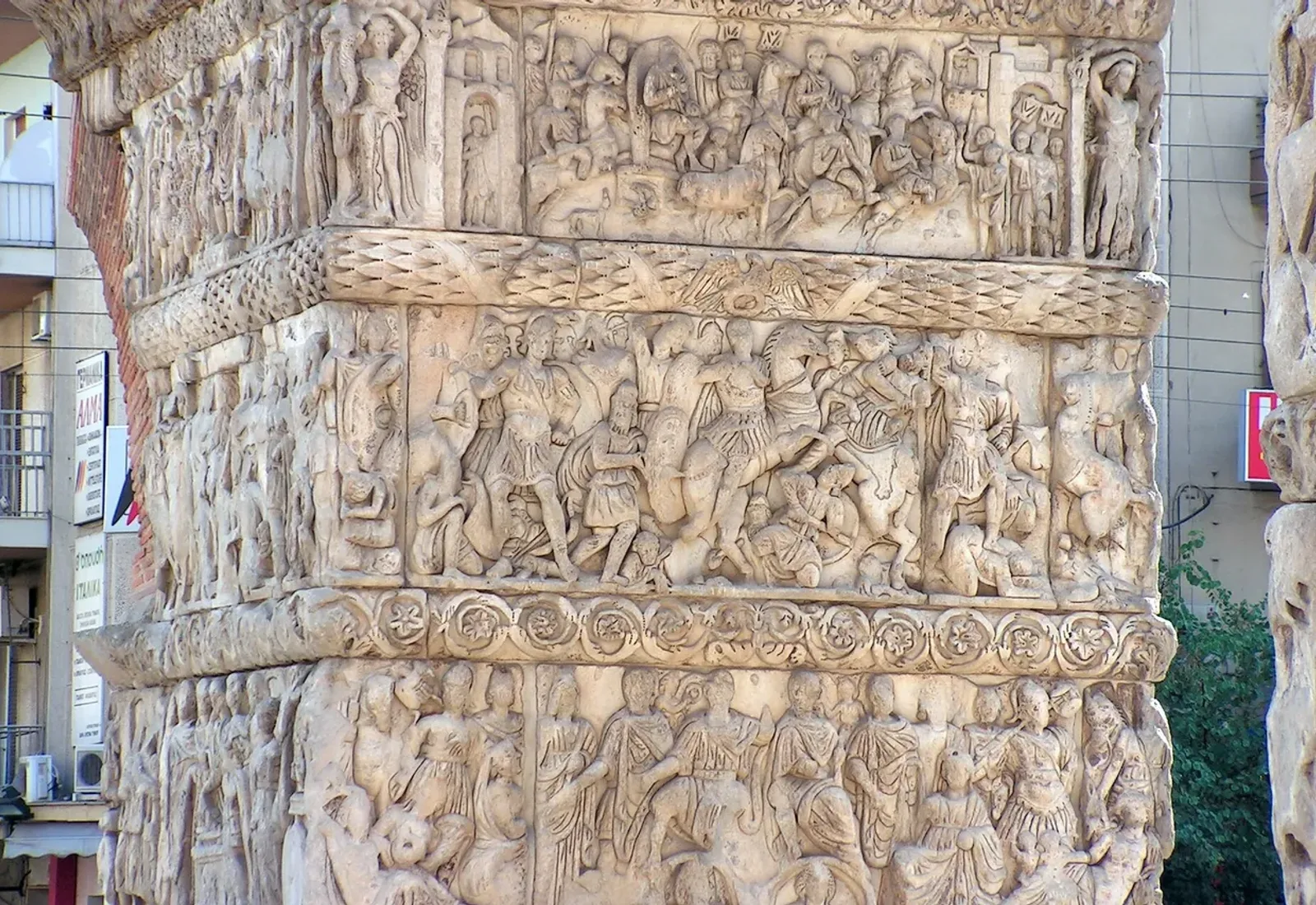
What makes the Kamara extraordinary is the carving. The surviving piers are wrapped in bands of marble relief showing the Persian campaign — ranks of Roman soldiers, cavalry charges, the emperor at the centre of the action, and the submission of the defeated. Stand close and read them band by band, bottom to top: it's Roman state propaganda in stone, one of the most complete triumphal narratives to survive anywhere. (The brick core you see was originally faced entirely in this carved marble.)
An eight-pillared gate, now a fragment
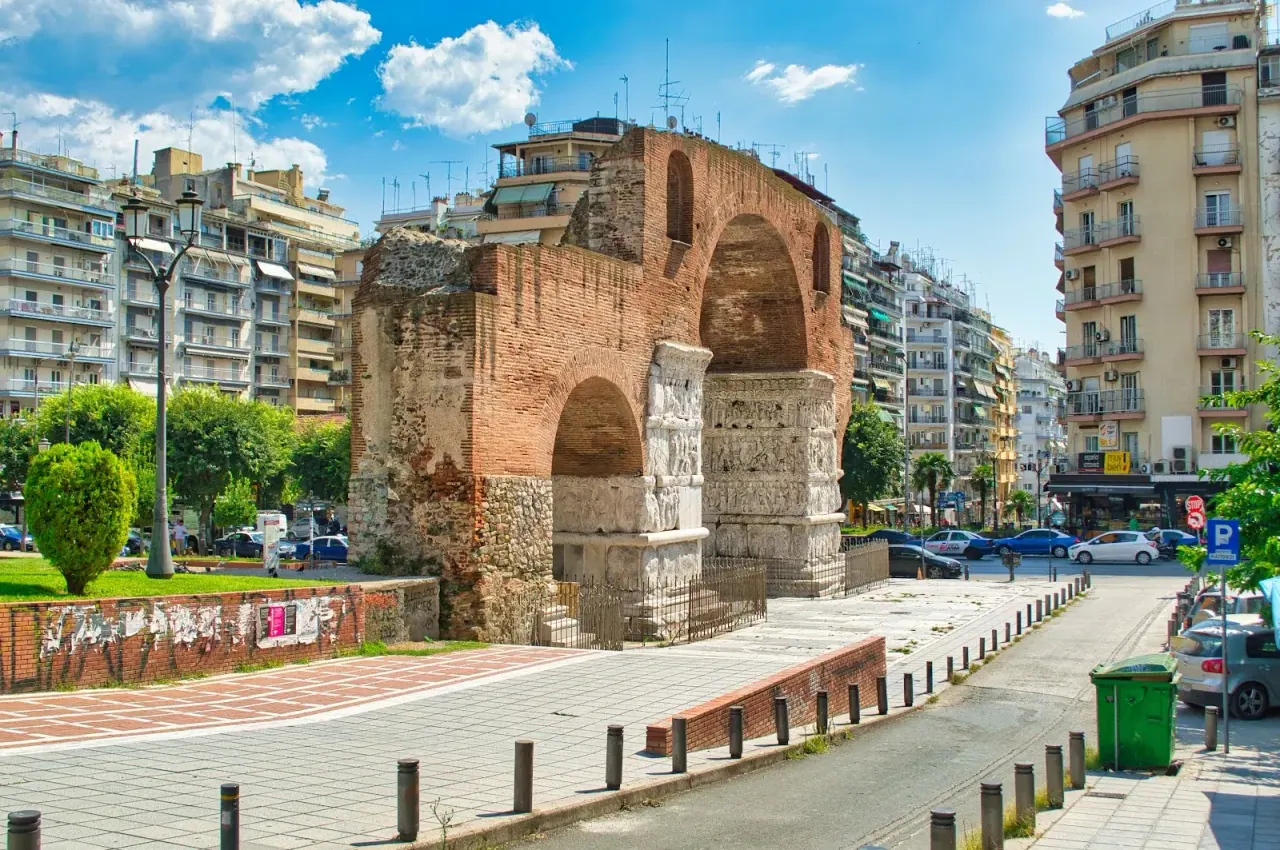
The Kamara you see is only a piece of the original monument. It was built as an octopylon — eight massive piers in two rows of four, carrying a triple archway across the junction of the Via Egnatia and the avenue running north to the Rotunda, the central opening wider and higher than the two flanking it. Only three of those eight piers survive today; the entire eastern side and one of the western piers are long gone. Each surviving pier carries four vertically stacked registers of relief separated by elaborate moldings — which is why the arch reads as a grand fragment rather than a complete gateway.
Part of a grander complex
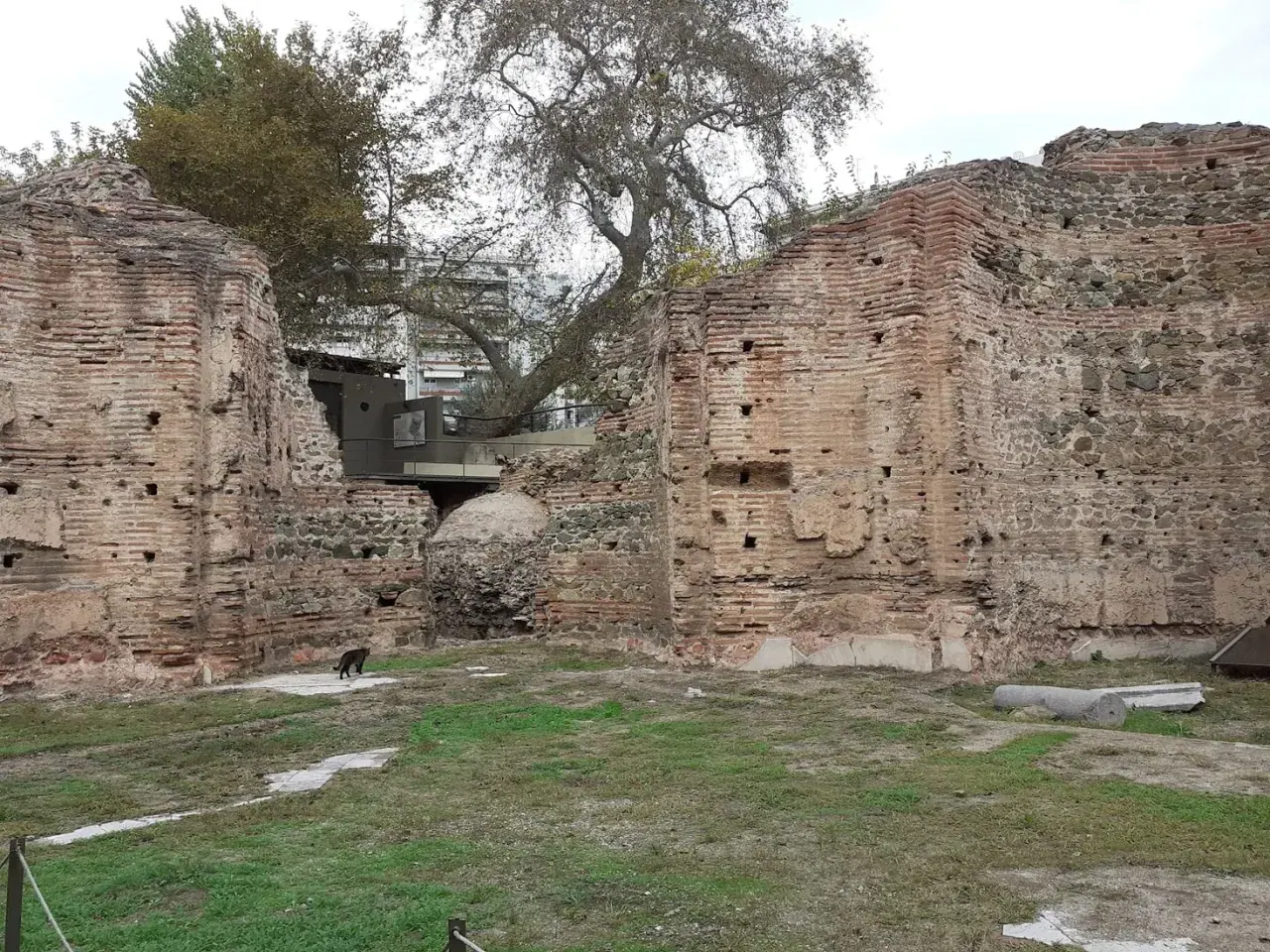
The arch never stood alone. It was the hinge of a monumental complex Galerius laid out across this corner of the city, linking his palace to the south with the great domed Rotunda to the north — his intended mausoleum — along a processional avenue. Walk the short line between the arch and the Rotunda and you're tracing the emperor's own ceremonial route; the two are best visited together on the city's Roman and Byzantine trail.
How to visit
The Kamara stands in the open on Egnatia, in the middle of the modern city, and it's free and always open — you can walk right up to it at any hour. It sits by the Kamara stop on the metro and is an easy few minutes' walk from Aristotelous Square, the Rotunda and the small Byzantine church of Agios Panteleimon in its leafy courtyard, so it slots neatly into any walk through the centre (see our things to do and free things to do guides), and it's the emblem of our Roman Thessaloniki guide to the emperor Galerius's complex. Come back after dark, when it's lit and the crowds thin.
Frequently Asked Questions
What is the Kamara in Thessaloniki?
Kamara ("the arch") is the local name for the Arch of Galerius, a Roman triumphal arch built around 298–303 AD in the centre of Thessaloniki. It's the city's best-known meeting point and one of its major Roman monuments, famous for the carved marble reliefs on its piers.
What do the reliefs on the Arch of Galerius show?
They depict the emperor Galerius's military campaign against the Sasanian Persians — battle scenes, cavalry, the emperor, and the submission of the defeated — carved in bands of marble around the piers. It's one of the most complete Roman triumphal narratives still surviving.
Is the Arch of Galerius free to visit?
Yes. The arch stands in the open on Egnatia and is free to visit at any time, day or night. It's a short walk from Aristotelous Square and pairs naturally with the nearby Rotunda.
Why does the Arch of Galerius look incomplete?
Because only three of its original eight piers survive. It was built as an octopylon — an eight-pillared triple gateway spanning the Via Egnatia and the avenue toward the Rotunda — but the entire eastern side and one western pier were lost over the centuries, leaving the marble-carved section you see today.
How is the Arch of Galerius connected to the Rotunda?
Both were part of a single monumental complex built by Galerius: the arch linked his palace to the Rotunda — his intended mausoleum — along a processional avenue. The two monuments are a short walk apart and are usually visited together.