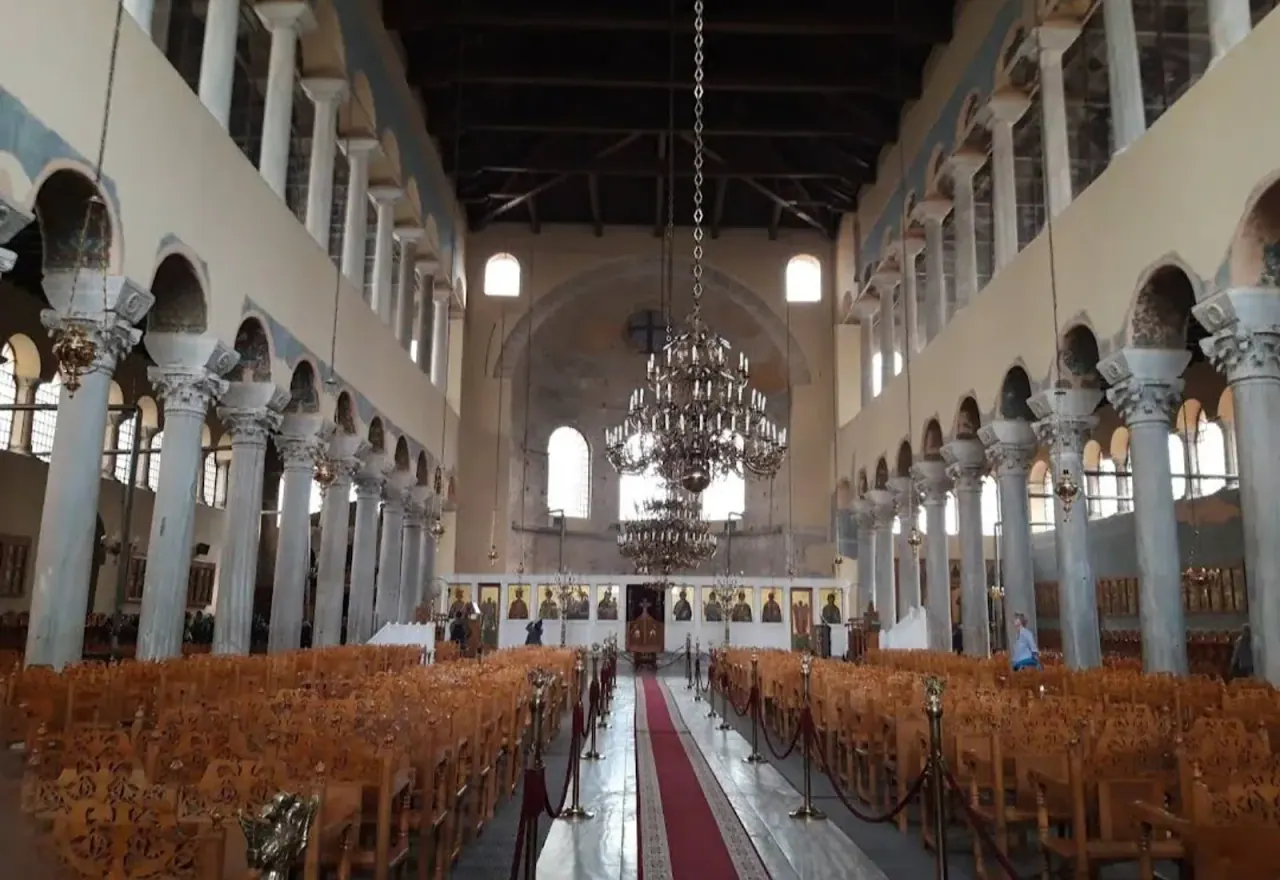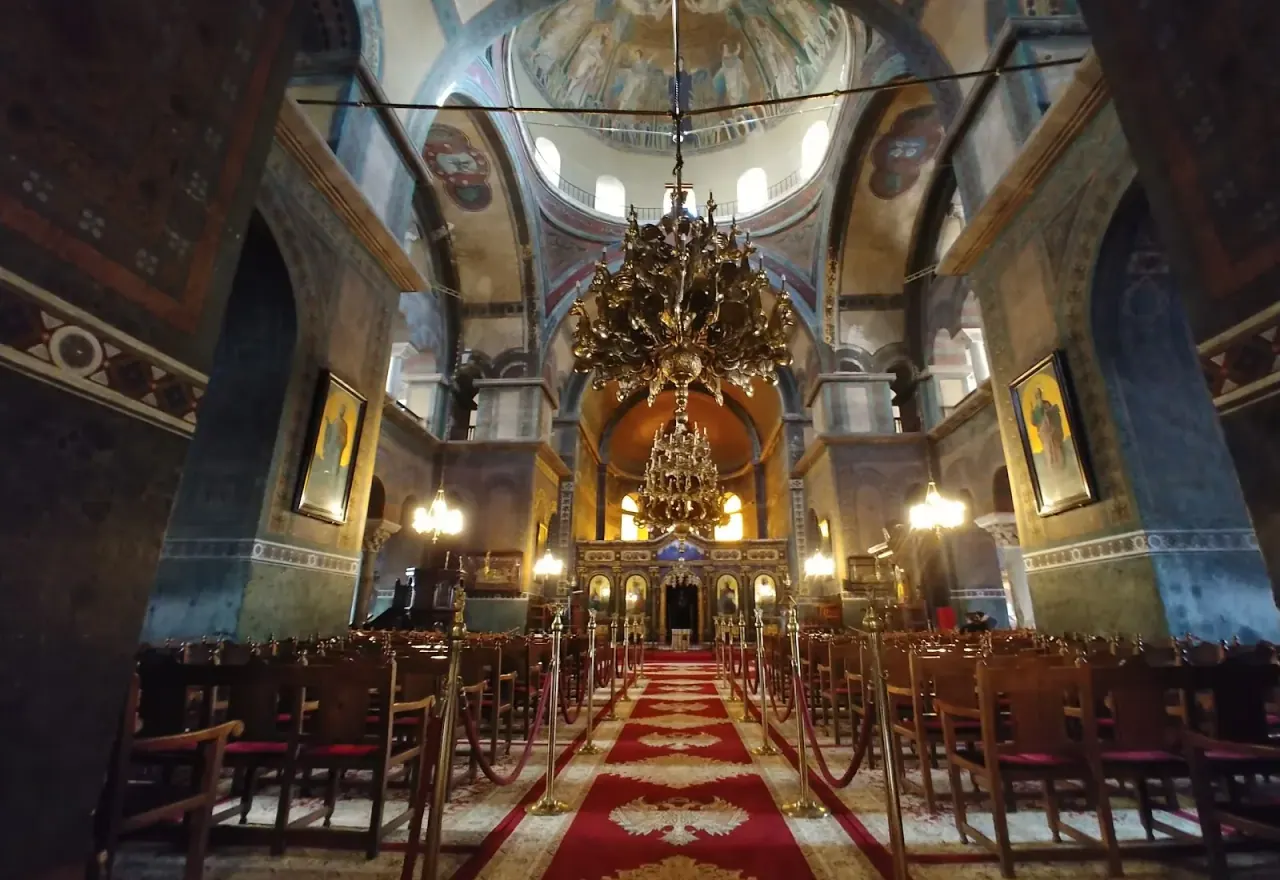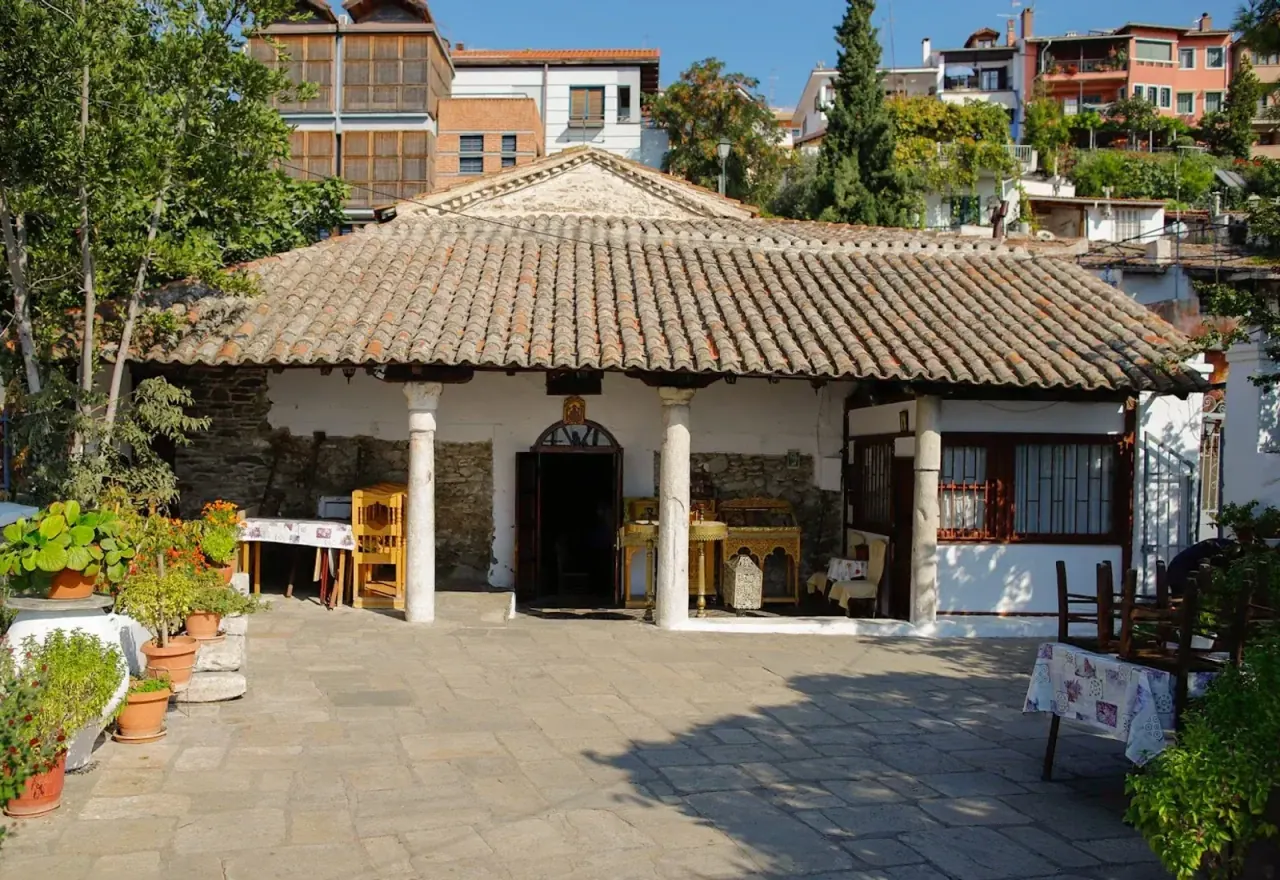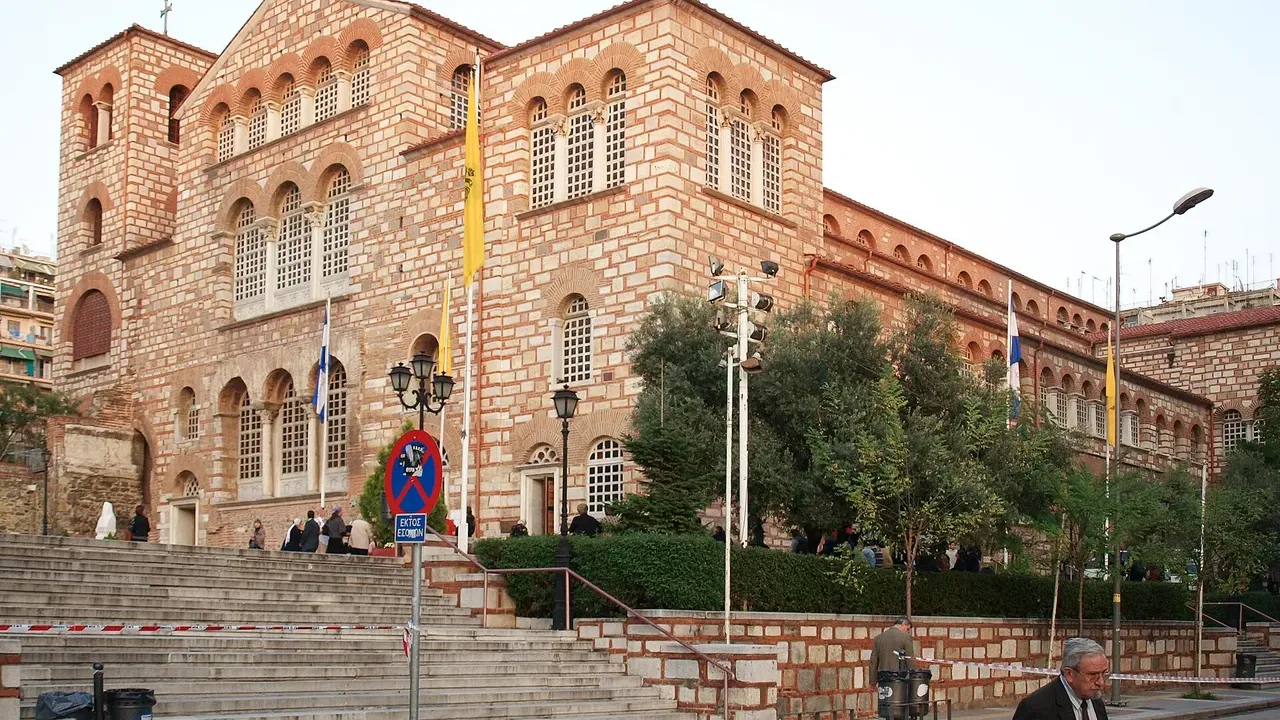
If you only step inside one church in Thessaloniki, make it this one. Locals don't treat the Church of Agios Dimitrios (Greek: Άγιος Δημήτριος) as a monument to be ticked off — they treat it as the heart of the city, the place named for the saint whose name half of them carry. Walk in on an ordinary morning and you'll find candles burning, people praying, the murmur of a service somewhere in the vast nave. It is the largest church in the city and its most beloved, and unlike the showpiece monuments along the seafront it asks nothing of you to enter. Here's why it matters, what to look for, and how to visit.
Visiting Agios Dimitrios: at a glance
It's free, it's central, and it's the city's highest-rated sight — so there's no reason to walk past it. The essentials:
| Detail | |
|---|---|
| Entry | Free (church and crypt) |
| Hours | Church daily (midday break); crypt closed Tuesdays |
| Rating | 4.9 (11,459 reviews) — the city's highest |
| Built | 7th c.; largely rebuilt by 1949 |
| UNESCO | Yes (Paleochristian & Byzantine Monuments) |
| Don't miss | The free crypt and the surviving 7th-century mosaics |
It stands on Agiou Dimitriou street, a short walk north of the Roman Forum and the Aristotelous and market area, on the natural climb up toward Ano Poli. Full practical details are on the Agios Dimitrios landmark page.
Who was Saint Demetrius?
Saint Demetrius — Agios Dimitrios, the patron saint of Thessaloniki — was a Roman soldier, an officer of the early 4th century, executed for his Christian faith during the Roman persecutions. According to tradition he was held and martyred in the city's Roman baths, run through with spears, and his cult took root almost immediately. For Thessalonians he is not a distant figure but a protector, credited down the centuries with defending the city in its sieges, and his name remains one of the most common in town — which is part of why the church is never empty. From the 7th century his tomb became famous for streaming fragrant myron (holy myrrh), earning him the epithet the Myrrh-streamer (Myroblytes); his relics rest in the church today.
That devotion is also why the building grew into the largest church in the city rather than just another neighbourhood chapel. As pilgrims came to honour the soldier-saint, the shrine over his grave was enlarged again and again until it became the vast five-aisled basilica you see today, big enough to hold the crowds his cult attracted.
The church was raised directly over those Roman baths where he died. That's the detail that gives the place its weight: this isn't a basilica built near the story, it's built on top of it. The earliest church on the site dates back to the 5th century; the great five-aisled basilica that followed took shape in the 7th century, and it has been the focus of the city's devotion ever since. For where it sits among the city's other great churches, see our Byzantine and UNESCO monuments guide.
The mosaics and the Great Fire of 1917
The artistic treasure here is a set of 7th-century mosaics, and the reason they feel so precious is that they so nearly didn't survive. In August 1917 the Great Fire tore through Thessaloniki, gutting the city centre and badly damaging Agios Dimitrios. Most of its decoration was lost — but a handful of the early mosaic panels came through, and they are among the few that survived the fire anywhere in the building. The basilica was then faithfully rebuilt to its original plans over 1926–1949 (delayed by war) and reconsecrated in 1949, so the great church you walk into today is a careful reconstruction of the 7th-century original — the excavations during the rebuild also uncovered the Roman baths beneath it.
Look for them flanking the sanctuary, mostly low on the piers near the front: small, intimate scenes showing the saint himself, often with the children and officials who commissioned them as offerings of thanks. They're votive rather than grand — portraits of devotion, made by real people for a saint they believed had answered them. Stand close. Unlike a dome mosaic you crane your neck at, these are roughly at eye level, so you can read the faces and the gold tesserae up close, the way the donors who paid for them once did.
After the fire the church was largely rebuilt and reconsecrated in 1949, which is why the soaring interior reads as restored rather than ancient; the surviving mosaics are the genuine early-Byzantine fragments embedded in that restoration. Knowing that backstory changes how you look at the place — the columns and roof are 20th-century work standing faithfully on the old plan, while these few panels are the real survivors, the threads of continuity that connect the rebuilt church to the basilica that burned. If the gold dome of the Rotunda is the city's most spectacular early-Christian art, these panels are its most human.
The feast of 26 October
The saint's feast day, 26 October, is the biggest day in Thessaloniki's calendar — the patron-saint celebration, marked by processions and services centred on this church, and a local public holiday. It carries an extra layer of meaning here: the city was liberated from Ottoman rule on 26 October 1912 — Saint Demetrius's own feast day — so the date now doubles as both the religious festival and the anniversary of the modern city's freedom, feeding into the wider Dimitria cultural festival and the 28 October Ohi Day just after.
The crypt
Below the main church lies the crypt, and it's the part most visitors miss — which is a mistake, because it's free and it's the most atmospheric corner of the whole site. This is where the bath complex stood, the place tradition marks as the site of the martyrdom itself. Descending into the cool, dim, low-vaulted space underneath the busy basilica is a complete change of mood: stone, water, quiet, and the sense that you've reached the actual ground the church was built to honour.
The crypt now doubles as a small display of architectural fragments and carved marble recovered over the years, but the reason to go down is simpler than that — it's the oldest, most affecting layer of a building defined by its layers. Above you the church has been raised, burned, and rebuilt over the centuries; down here you're standing closest to where the whole story began, on the ground of the Roman baths. Take a few minutes even if the upper church is busy. It's also reliably cool and quiet, a welcome pause on a hot afternoon, and because so many visitors don't realise it's there you often have it almost to yourself.
Visiting Agios Dimitrios
Entry to both the church and the crypt is free. The church is open daily (generally with a midday break) and remains a fully working one, so services run through the day. The crypt, though, is run as a state museum with its own schedule and is closed on Tuesdays — its hours run broadly 08:00–20:00 in summer (to 15:00 in winter), with an early 14:30 close on summer Saturdays — so if the crypt is your main reason to come, don't pick a Tuesday. Either way, time your visit around the worship rather than through it. Dress respectfully: covered shoulders and knees, no loud talk, and keep cameras low-key, especially when people are praying.
The one date to know is the feast day on 26 October — Agios Dimitrios day, the city's biggest religious celebration, when the church overflows and crowds spill into the surrounding streets. It falls close to the date Thessaloniki marks its liberation, so the whole city is in festive mood; the city's flagship Dimitria arts festival is named for the saint and runs around this time. It's extraordinary to witness but not the moment for a quiet look at the mosaics.
For the rest of the time, slot it into a walk through the upper old town. The church sits just above the Roman Forum and a short climb below Ano Poli, so it pairs naturally with the ancient agora below and the Byzantine lanes above — and it's an easy add-on after the White Tower and the seafront, or alongside the other landmarks on the same hill. A sensible route is to start at the seafront, cut up through Aristotelous and the market, pause at the Roman Forum, then climb to Agios Dimitrios before continuing up into Ano Poli — the church lands right in the middle of that ascent, both as a landmark and as a natural place to slow down.
Because it costs nothing and sits squarely on that path, it's the rare must-see you can give as much or as little time as you like. Five minutes for a quick look at the nave and the mosaics, or the better part of an hour if you take the crypt slowly and sit a while in the vast, candle-lit space. Either way, you'll understand the city a little better for having been inside.
Frequently Asked Questions
Is Agios Dimitrios free to visit?
Yes. Both the main church and the crypt below are free to enter — there's no ticket and no combined-pass requirement. It remains a working church, so the only thing asked of visitors is respectful dress and quiet behaviour, especially during the services that run through the day.
When is the crypt open?
The crypt is free but, unlike the church, is run as a state museum and is closed on Tuesdays. In summer (April–October) it opens broadly 08:00–20:00, with a shorter Saturday (to 14:30); in winter it closes around 15:00. The main church above is open daily, so a Tuesday visit still gets you the nave and mosaics — just not the crypt.
Who was Saint Demetrius?
Saint Demetrius (Agios Dimitrios) was a Roman army officer martyred in Thessaloniki for his Christian faith in the early 4th century, executed in the city's Roman baths. He became the patron saint of Thessaloniki, revered as the city's protector, and the basilica was built directly over the site of his martyrdom.
What are the mosaics in Agios Dimitrios?
They are 7th-century votive mosaic panels, mostly near the sanctuary, showing Saint Demetrius with the donors — including children — who commissioned them in thanks. They are precious because they are among the few that survived the Great Fire of 1917, which destroyed most of the church before its rebuilding by 1949.
When is the feast day of Agios Dimitrios?
The feast day is 26 October, the saint's day and the largest religious celebration in Thessaloniki, when the church fills and crowds gather in the surrounding streets. It falls close to the date the city marks its liberation, making late October a high point in the local calendar.
How long do you need at Agios Dimitrios?
Around 30 to 45 minutes is enough to take in the vast five-aisled nave, find the surviving 7th-century mosaics near the front, and head down into the crypt below. Allow a little longer if a service is on or if you're combining it with the Roman Forum and the climb up to Ano Poli.