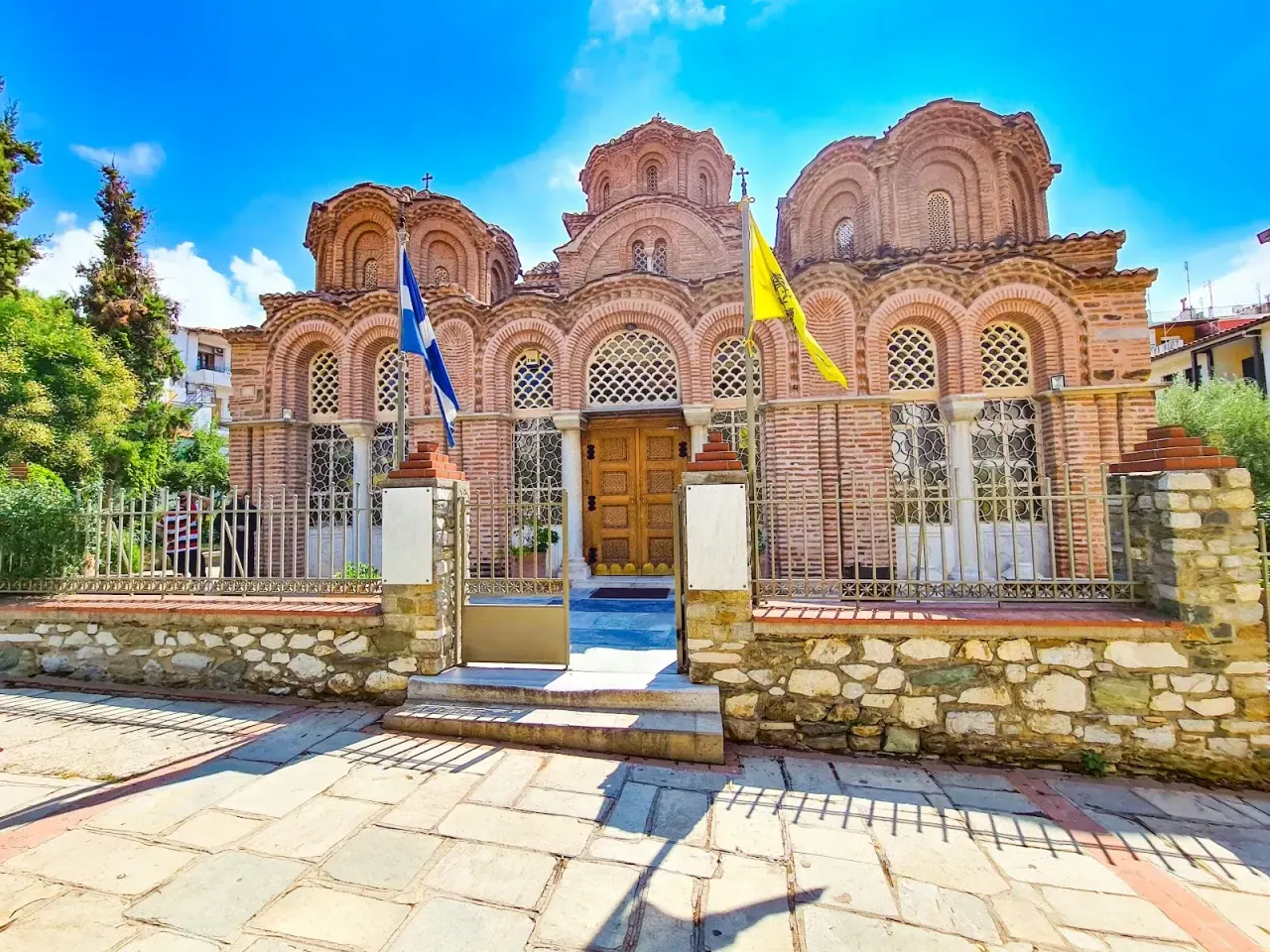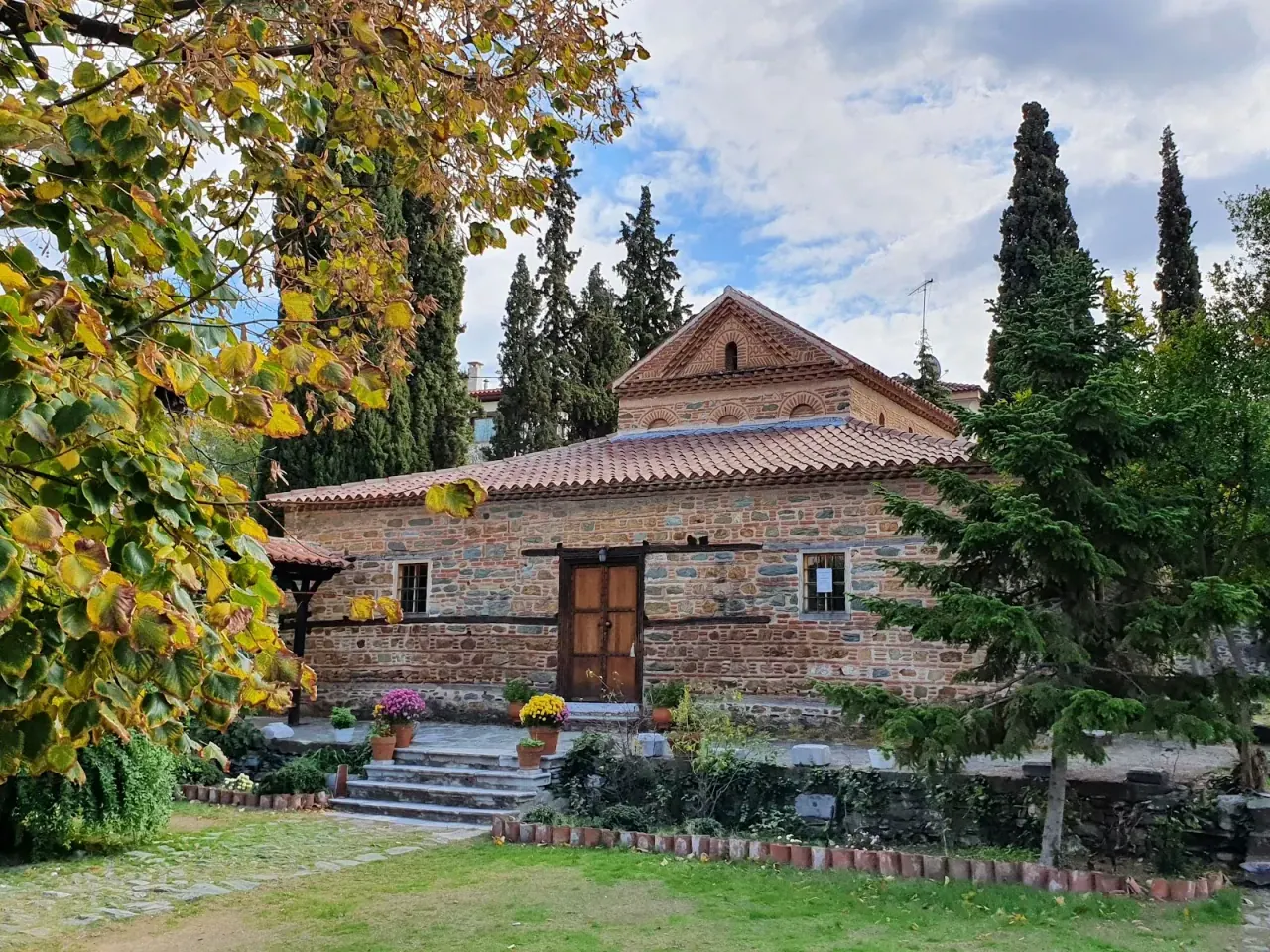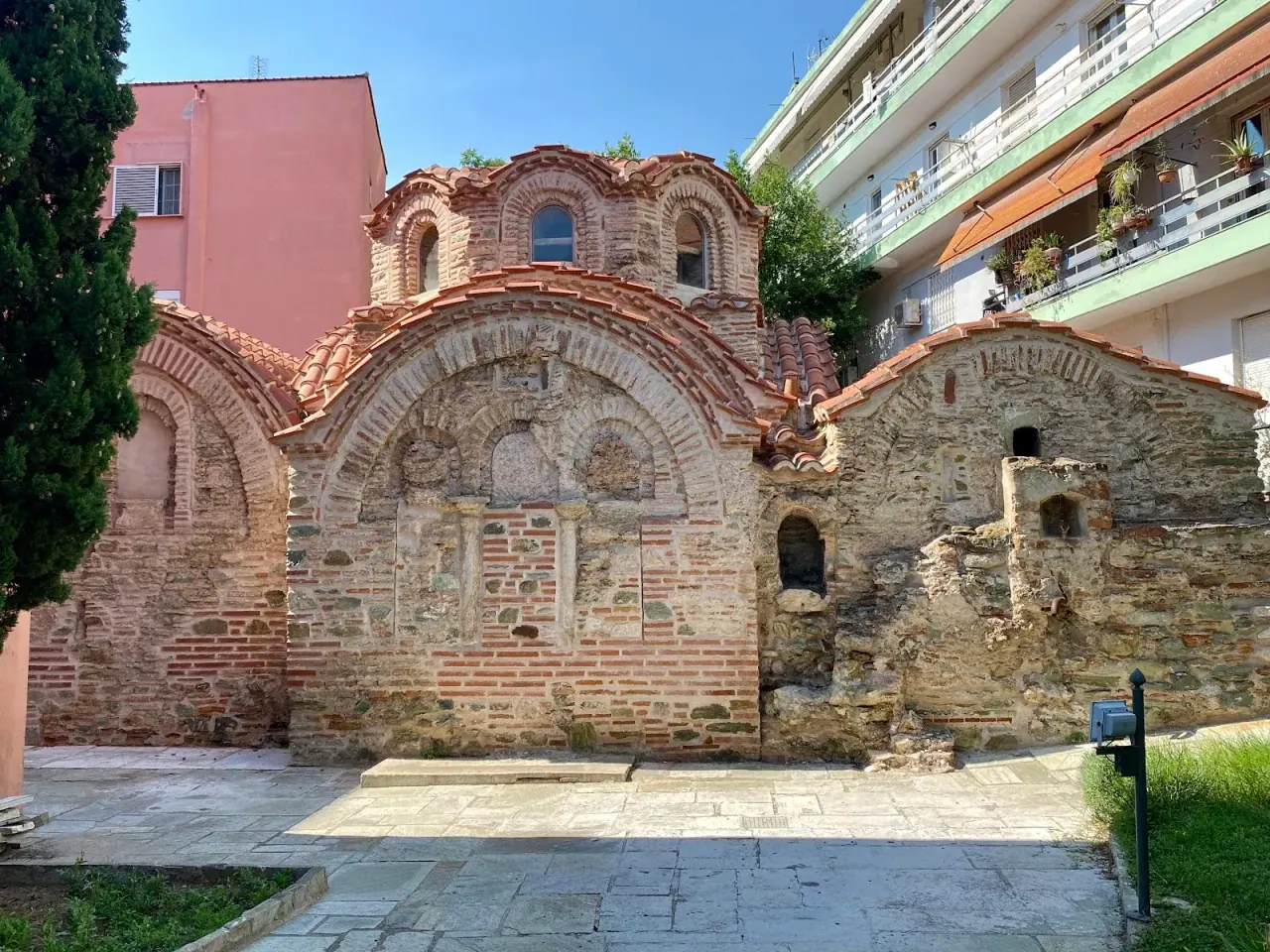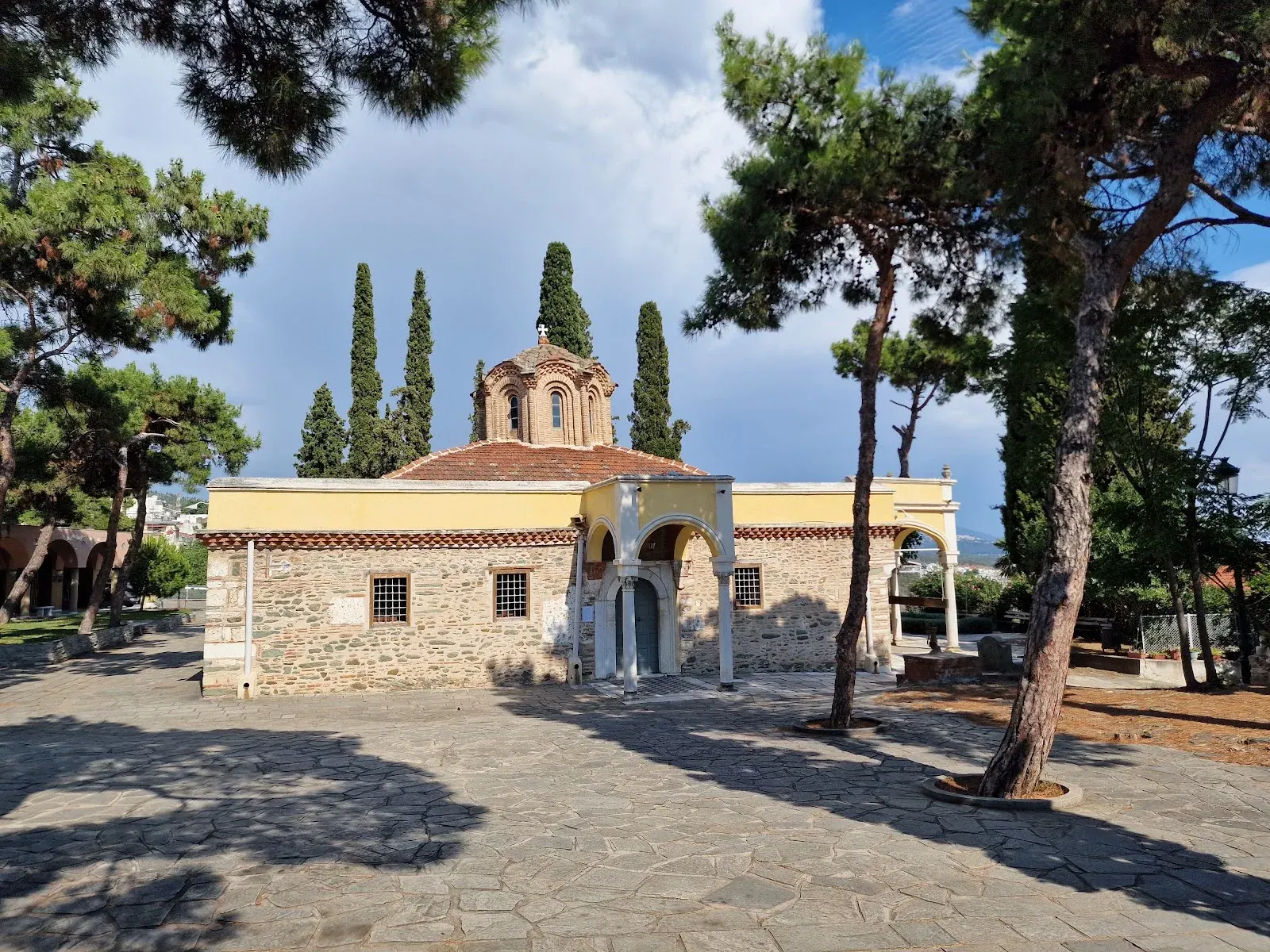
Near the top of Ano Poli, behind a walled garden of cypresses and pines, sits the quietest of Thessaloniki's great monuments: Vlatadon Monastery, the only Byzantine monastery in the city still living and working after six centuries. Most visitors climb up here for the view — one of the best in the city — and stay for the calm. Here's what it is and how to visit.
What it is
Vlatadon (Moni Vlatadon) was founded in the mid-14th century by two brothers, Dorotheos and Markos Vlatades, students of Gregory Palamas, the great theologian-archbishop of Thessaloniki — and it's from them that the monastery takes its name. Its katholikon (the central church) still preserves 14th-century frescoes, and the whole complex is one of the fifteen Paleochristian and Byzantine monuments of the city inscribed on the UNESCO World Heritage list in 1988. Unlike the city's other Byzantine churches, it never became a ruin or a museum: it survived the Ottoman conquest and remains a functioning monastery with a resident community.
Where St Paul preached
The monastery carries one of the city's oldest traditions. It's said to stand on the very ground where, in 51 AD, the Apostle Paul preached to the Thessalonians during his second missionary journey — the visit that lies behind his two New Testament letters to the city (1 and 2 Thessalonians). Whether or not the spot is exact, it ties this quiet hilltop to the very beginnings of Christianity in Europe.
A living centre of Byzantine scholarship
Vlatadon isn't only a relic. Alongside the old church stand the modern buildings of the Patriarchal Institute for Patristic Studies, founded in 1968 — a major research centre for early-Christian and Byzantine theology, with an important library of manuscripts. So the monastery remains what it always was: a working place of Orthodox learning, not just a monument to visit.
The garden, the peacocks and the view
For most visitors, though, the pleasure is simpler. The monastery sits in a peaceful walled garden where peacocks roam among the trees, and from its terrace the ground falls away to a sweeping panorama over Thessaloniki and the Thermaic Gulf — Mount Olympus on the horizon on a clear day. It's a favourite spot to catch your breath at the top of the Ano Poli climb, and lovely in the late-afternoon light.
How to visit
- Where: high in Ano Poli near the acropolis, about a 25-minute uphill walk from the centre (or take a bus up into the upper town).
- Cost: free — it's a working monastery, open to visitors by day.
- Dress: modestly, as at any Greek monastery — covered shoulders, and longer skirts or trousers; keep quiet, especially during services.
- When: late afternoon for the light and the view; it's calmest outside service times.
Fold it into a walk through the upper town with our Ano Poli guide — it pairs naturally with the Byzantine city walls and the Heptapyrgion fortress just above, and it's one of the quiet highlights of the city's Byzantine monuments and of free things to do.
Frequently Asked Questions
What is Vlatadon Monastery?
Vlatadon (Moni Vlatadon) is a 14th-century monastery high in the Ano Poli upper town — the only Byzantine-era monastery in Thessaloniki still active today. Founded by the brothers Dorotheos and Markos Vlatades, it preserves 14th-century frescoes in its church, is a UNESCO World Heritage monument, and today also houses the Patriarchal Institute for Patristic Studies.
Can you visit Vlatadon Monastery, and is it free?
Yes. It's a working monastery open to visitors during the day, and entry is free. Dress modestly — covered shoulders and longer skirts or trousers — and be quiet inside, particularly during services. Allow about half an hour for the church, the garden and the view.
Why is Vlatadon Monastery important?
Because it's the last living Byzantine monastery in a city famous for Byzantine monuments, and it stands, by tradition, where the Apostle Paul preached to the Thessalonians in 51 AD. It combines a frescoed medieval church, a UNESCO listing, a peaceful peacock garden, and a leading centre of Byzantine theological scholarship.
What is the view like from Vlatadon Monastery?
Excellent. Sitting near the top of Ano Poli, the monastery's terrace looks out over the rooftops of Thessaloniki to the Thermaic Gulf, with Mount Olympus visible across the water on a clear day. It's one of the best and calmest viewpoints in the upper town, especially in the late afternoon.