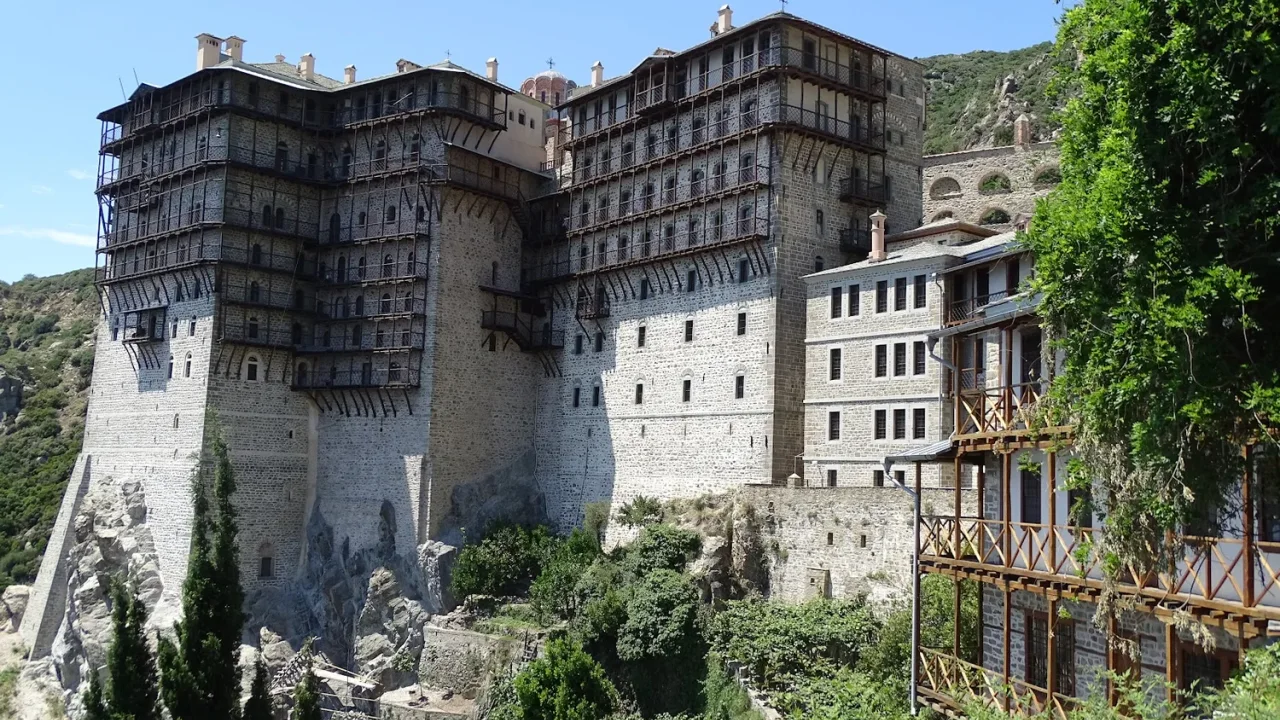
The cliff-perched Simonopetra monastery on Mount Athos rising above the forested slopes
landmark

Mount Athos

Aussi : Agion Oros · Holy Mountain · Άγιον Όρος

Distance
≈120 km to Ouranoupoli · ~2–2.5 h
Meilleure période
Spring to autumn, when the coastal cruises run daily; the sea is calmest in summer
Comment s'y rendre
Drive or KTEL bus to Ouranoupoli (~2–2.5 h); pilgrim ferries and tourist cruises both leave from there; permits (men only) arranged in advance via the Thessaloniki Pilgrims' Bureau
Idéal pour
Orthodox heritage, Boat cruises, Byzantine history, Dramatic scenery, Pilgrimage (men, by permit)

The thousand-year monastic republic on Halkidiki — 20 Orthodox monasteries, closed to women but seen by all on a coastal cruise from Ouranoupoli.

Réserver cette excursion

4.3 (407) · à partir de €25 par personne · annulation gratuite jusqu'à 24 h avant

Vérifier la disponibilité

At a glance

Detail
What it is Autonomous Orthodox monastic republic (20 monasteries) — a UNESCO site
From Thessaloniki ≈120 km to Ouranoupoli · ~2–2.5 h by car or KTEL bus
Access Men only, by permit; everyone else by coastal cruise (~500 m offshore)
Permit Via the Thessaloniki Pilgrims' Bureau, months ahead; €25 Orthodox / €30 non-Orthodox (cash)
Season Spring–autumn (cruises daily); calmest sea in summer
Best for Orthodox heritage, boat cruises, Byzantine history
Time needed Full day (or a multi-day pilgrimage)

The Holy Mountain

On the easternmost of Halkidiki's three peninsulas rises Mount AthosAgion Oros, the Holy Mountain — an autonomous Orthodox monastic republic under Greek sovereignty and a UNESCO World Heritage Site. Twenty monasteries, some clinging to sheer cliffs above the sea, have kept a continuous monastic life going here for over a thousand years. It is one of the most important centres of Eastern Orthodox spirituality in the world, and one of the most striking landscapes in Greece.

It also keeps a rule found almost nowhere else: the avaton, which for roughly a thousand years has barred all women from the peninsula. That single fact shapes any visit.

Visiting, by permit or by sea

For men, Athos can be entered only as a pilgrim, with a diamonitirion permit arranged months ahead through the Pilgrims' Bureau in Thessaloniki — places are strictly limited each day. It is a religious retreat of prayer and simple monastic hospitality, not sightseeing.

For everyone else — women, and men without a permit — the way to experience Athos is from the water. Coastal cruises sail along the peninsula to the legal limit, about 500 metres offshore, with close views of the great monasteries — cliff-top Simonopetra, the Russian St Panteleimon, Dochiariou — and the 2,000-metre peak behind. These run daily in summer and are open to all.

How to do it from Thessaloniki

Either way you start at Ouranoupoli, the small port at the end of the third leg, about 120 km / 2–2.5 hours southeast by car or KTEL bus. Pilgrims take the morning ferry; cruise-goers board a tour boat from the same harbour (cruises also leave from Ormos Panagias on Sithonia). It pairs naturally with a few days in Halkidiki — see our full Mount Athos from Thessaloniki guide for the permit rules and cruise options.
Photos

Meilleure période

Spring to autumn, when the coastal cruises run daily; the sea is calmest in summer

Idéal pour

Orthodox heritageBoat cruisesByzantine historyDramatic sceneryPilgrimage (men, by permit)

Emplacement

Foire aux questions

Can anyone visit Mount Athos?+

No. Mount Athos is a self-governing Orthodox monastic state, and the centuries-old avaton rule bars all women from entering. Only adult men may go ashore, and only as pilgrims holding a permit (diamonitirion). Everyone else — women included — can experience it by coastal boat cruise, which sails to the permitted limit (about 500 m offshore) for views of the monasteries from the sea.

How do men get a permit (diamonitirion)?+

Male visitors apply in advance — up to six months ahead — through the Mount Athos Pilgrims' Bureau in Thessaloniki, as daily places are limited (about 100 for Orthodox visitors and 10 for non-Orthodox). You confirm a date, then collect the permit at Ouranoupoli (€25 for Orthodox pilgrims, €30 for non-Orthodox, €10 for students, free for large families with four or more children, paid in cash) before boarding the early ferry into the monastic state. Stays are typically up to four days.

How do you get to Mount Athos from Thessaloniki?+

Head for Ouranoupoli, the gateway port at the tip of Halkidiki's third leg, about 120 km (2–2.5 hours) southeast by car or KTEL bus. Pilgrims catch the ferry into Athos from there; everyone else boards a coastal cruise from the same harbour (or from Ormos Panagias on Sithonia). Many visitors combine it with a stay in Halkidiki rather than rushing back the same day.