Thessaloniki holds the second-largest collection of Byzantine monuments in the world, and fifteen of its Paleochristian and Byzantine buildings — thirteen churches, plus the city walls (with the Heptapyrgion fortress) and the Byzantine baths — are jointly inscribed on the UNESCO World Heritage list (inscribed 9 December 1988) — the densest concentration of Byzantine World Heritage anywhere in Greece. Most are still working churches you can walk into for free, scattered across a walkable centre. Here's which ones actually reward a visit, in the order a first-timer should tackle them.
The essential Byzantine monuments
You won't see all fifteen UNESCO sites in a short trip, and you don't need to. These are the ones worth your time, all rated by visitors:
| Monument | Era | Why go | Rating |
|---|---|---|---|
| Rotunda | 4th c. | Roman dome, gold mosaics | 4.6★ |
| Agios Dimitrios | 5th–7th c. | The patron saint's basilica | 4.9★ |
| Hagia Sophia | 8th c. | Domed mosaics, a mini Constantinople | 4.8★ |
| Acheiropoietos | 5th c. | One of the oldest churches in use | 4.8★ |
| Agios Nikolaos Orfanos | 14th c. | The best-preserved frescoes | 4.8★ |
| Vlatadon Monastery | 14th c. | Working monastery, Ano Poli views | 4.7★ |
See all of them on the landmarks page; the highlights below explain where to start.
Start with the Rotunda
The 4th-century Rotunda is the one sight no first visit should skip — a vast Roman cylinder built for the emperor Galerius, later a church, later a mosque, and lined inside with some of the earliest Christian gold mosaics in existence. It straddles Roman and Byzantine Thessaloniki in a single room and sits a short walk from the Arch of Galerius — for the Roman side of that story see our Roman Thessaloniki guide, and for what came after, Ottoman Thessaloniki.
Agios Dimitrios — the city's soul
The five-aisled basilica of Agios Dimitrios is the most beloved monument in the city (and its highest-rated), built over the Roman baths where Thessaloniki's patron saint was martyred. Its 7th-century mosaics are among the few that survived the Great Fire of 1917. Don't miss the crypt below.
Hagia Sophia and Acheiropoietos
Two more essentials sit in the centre. The 8th-century Hagia Sophia echoes its namesake in Constantinople, with a domed mosaic of the Ascension. A few streets away, the 5th-century Acheiropoietos is one of the oldest churches in the world still in continuous use — a austere, early-Christian basilica with original column capitals.
The hidden mosaic: Osios David
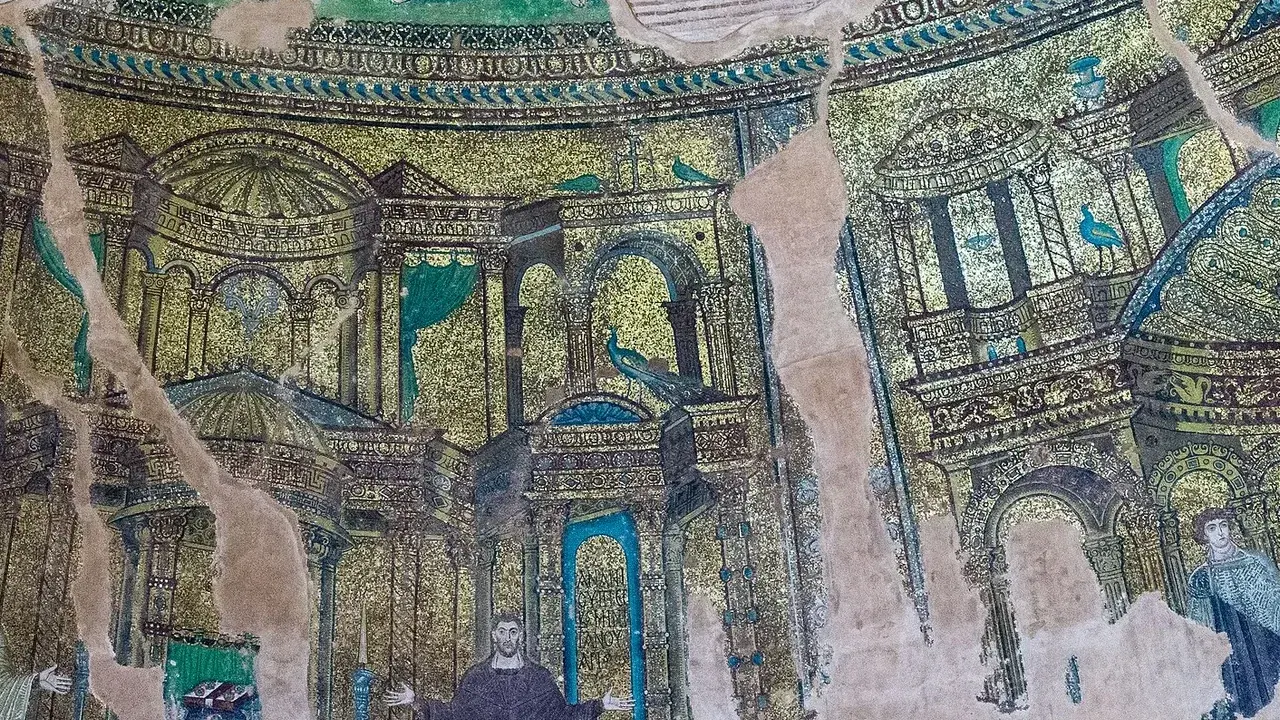
The trip's biggest surprise is its smallest church. Tucked in the Ano Poli lanes, Osios David — the surviving chapel of the Latomou Monastery — holds a late-5th-century apse mosaic, the 'Vision of Ezekiel', showing a rare youthful, beardless Christ enthroned in a mandorla. One of the oldest and finest early-Christian mosaics anywhere, it was hidden under plaster while the church was a mosque and only rediscovered in 1921. Easy to miss, impossible to forget — our full Osios David guide has the story.
The Red Church: Panagia Chalkeon
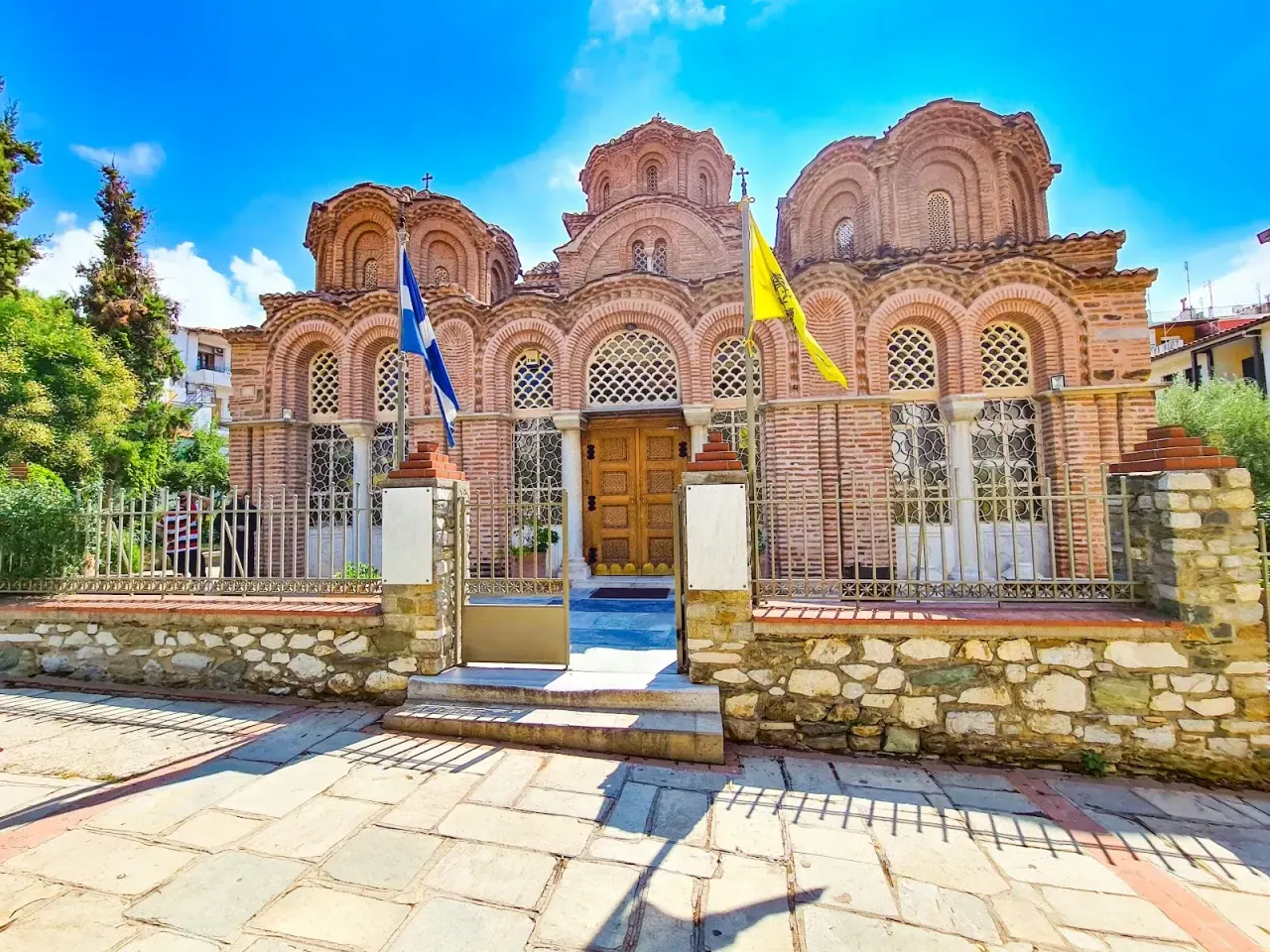
Back in the centre beside the Roman Forum, Panagia Chalkeon is a precisely dated church of 1028 — its founder's inscription survives over the door — built almost entirely of warm red brick, which earns it the nickname the 'Red Church'. It's a textbook of 11th-century Byzantine masonry, sunk in a quiet garden minutes from the markets.
The brickwork masterpiece: Holy Apostles
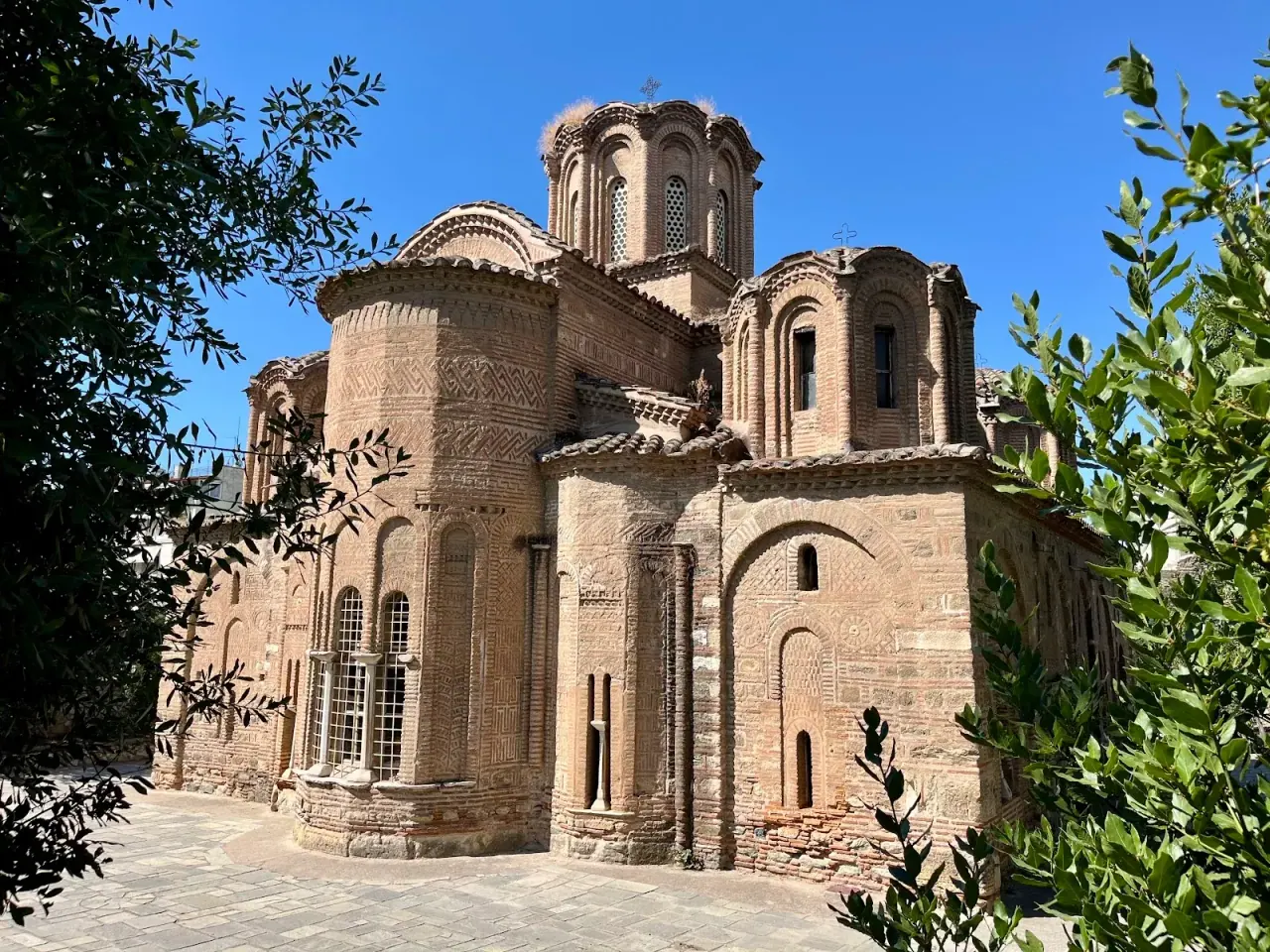
On the western edge of the old town, the Church of the Holy Apostles shows off the other side of Byzantine artistry — its architecture. Built around 1310–1314 by Patriarch Niphon I, this five-domed church is wrapped in some of the most dazzling decorative brickwork anywhere: recessed arches, meanders and dog-tooth patterns laid out like embroidery across the apses, with the founder's monogram set into the masonry (location and visiting details). Inside, early-14th-century mosaics and frescoes from the Palaiologan golden age survive in the ambulatory vaults.
The frescoes: Agios Nikolaos Orfanos
For most visitors the surprise of the trip is tiny Agios Nikolaos Orfanos in Ano Poli — a small 14th-century church whose interior is covered, floor to ceiling, in exceptionally well-preserved Palaiologan frescoes. It's the best place in the city to understand late-Byzantine painting (location and visiting details).
Two more Palaiologan gems: Agia Aikaterini & Agios Panteleimon
Two further UNESCO-listed churches round out the set, both around 1300. Up in the northwestern Ano Poli, Agia Aikaterini is a beautifully proportioned five-domed church with a columned ambulatory and intricate brickwork — quiet and rarely busy (location). Down in the centre, a couple of minutes from the Rotunda, Agios Panteleimon sits in a leafy courtyard and is the easiest of all the Byzantine churches to drop into on a walk through town (location).
The Mount Athos plan: Profitis Ilias
On the slope below Ano Poli, Profitis Ilias is the odd one out — the only church in the city built on the Athonite plan used by the great monasteries of Mount Athos, with side apses for the monks' choirs. Built in the mid-14th century, it's a tall, dramatic building fronted by a wide arched portico, with fragments of Byzantine frescoes inside (location and visiting details).
The rarest plan: the Church of the Saviour
The smallest and least-visited of the fifteen, the Church of the Transfiguration of the Saviour (Metamorfosi tou Sotiros), on Egnatia in the centre, completes the set. Dated to around 1350 by a coin found in its dome during post-earthquake restoration, it is a rare inscribed tetraconch — four curved niches folded into a compact square plan beneath a single tall dome — its lower walls of rough stone, its upper storey of patterned brick. It sits a little below the modern street, a quiet Palaiologan footnote most people walk straight past.
Not a church: the Byzantine Bath
The set isn't all churches. Tucked into Ano Poli beside Agios Nikolaos Orfanos, the Byzantine Bath is the only surviving Byzantine bath in Thessaloniki — a little brick building that kept working as a public bath, and later an Ottoman hammam, for some seven centuries until 1940. It's a rare glimpse of everyday Byzantine life rather than its worship — and its grander Ottoman counterpart, the Bey Hamam, the grandest Ottoman bathhouse in Greece, stands down on Egnatia.
Up in Ano Poli: Vlatadon and the walls
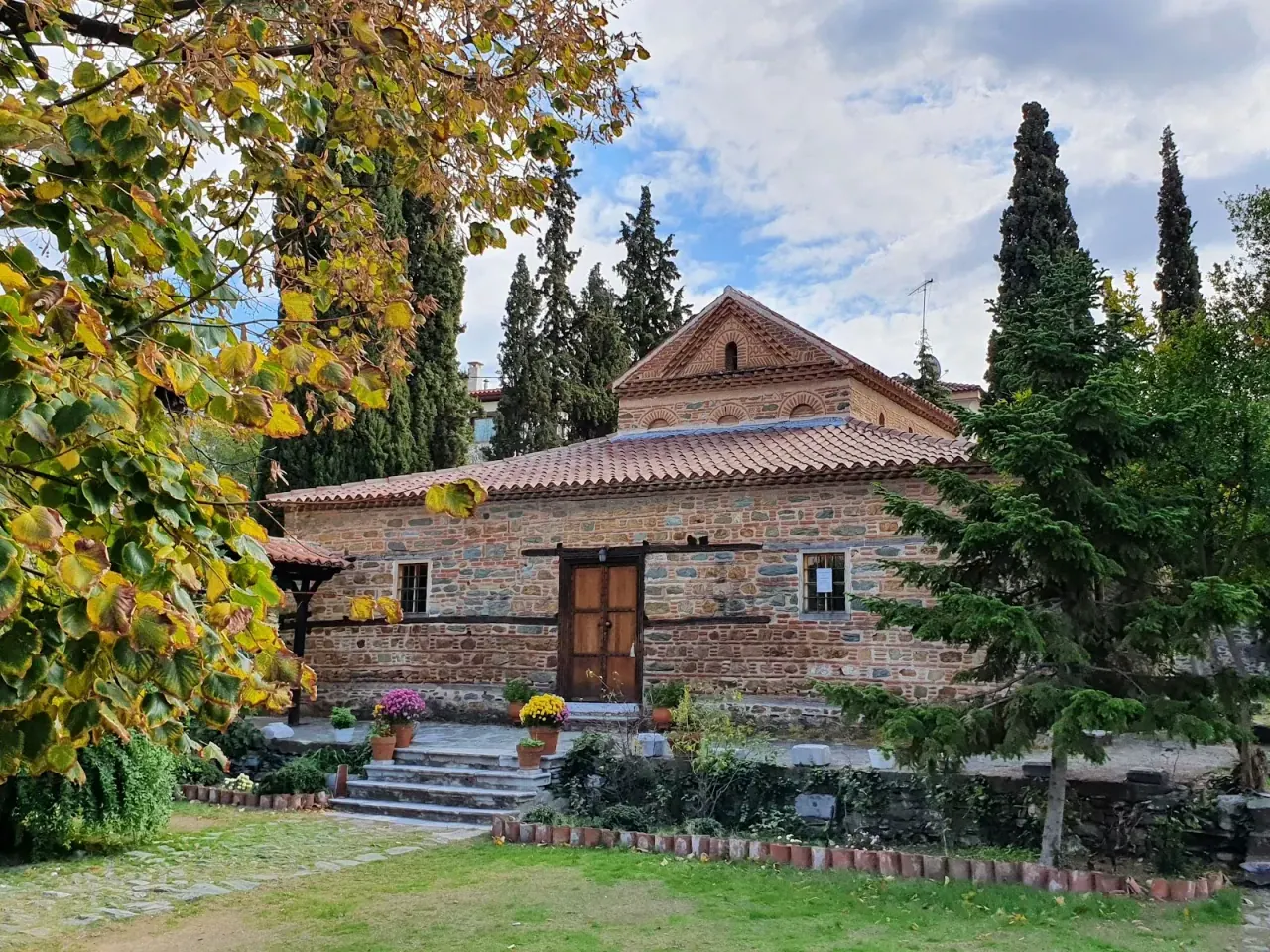
While you're in the upper town, the working Vlatadon Monastery offers both a 14th-century chapel and one of the best panoramas over the city. The Byzantine city walls and the Heptapyrgion fortress crown the hill — the medieval edge of Thessaloniki, still largely intact.
Get oriented first: the museum
If you want the context before the churches, the Museum of Byzantine Culture — a former Council of Europe Museum Prize winner — is the finest primer, walking you from early-Christian tombs through the full Byzantine millennium. Pair it with the Archaeological Museum next door.
Practical tips
- Most working churches are free to enter. The Rotunda, the White Tower, and the two big museums charge admission.
- A €15 combined ticket (valid 3 days) covers the White Tower, the Rotunda, the Archaeological Museum, and the Museum of Byzantine Culture — the best value if you're seeing several.
- Free-entry days at state sites: the first and third Sunday of each month from November to March, plus 6 March, 18 April, 18 May, the last weekend of September, and 28 October (Ohi Day).
- Dress modestly for working churches and monasteries — covered shoulders, and longer skirts or trousers for the monastery.
Weave these into a longer visit with our 3-day Thessaloniki itinerary.
Frequently Asked Questions
How many Byzantine churches are there in Thessaloniki?
Thessaloniki has the second-largest collection of Byzantine monuments in the world, with fifteen Paleochristian and Byzantine buildings — thirteen churches, the city walls (with the Heptapyrgion) and the Byzantine baths — jointly inscribed on the UNESCO World Heritage list in 1988. Many more Byzantine and Ottoman-era churches stand beyond the listed fifteen, most still in use as working churches.
Are Thessaloniki's Byzantine churches free to visit?
Most of the working churches — including Agios Dimitrios, Hagia Sophia, and Acheiropoietos — are free to enter. The Rotunda and the major museums charge admission, but a €15 combined ticket covers the Rotunda, White Tower, Archaeological Museum, and Museum of Byzantine Culture for three days.
What is the most important Byzantine site in Thessaloniki?
The Rotunda and Agios Dimitrios are the two essentials. The Rotunda is the oldest and most architecturally striking, with early Christian gold mosaics; Agios Dimitrios, the basilica of the city's patron saint, is the most revered and the highest-rated by visitors.