Good news for visitors: Thessaloniki is one of the easiest Greek cities to get around. The centre is flat and compact enough to walk end to end — see accessible Thessaloniki for how well that holds on wheels — and long-distance buses leave from the KTEL Macedonia station. As of late 2024 it finally has a metro — a gleaming, driverless one — to cover the longer hops. Add cheap buses and metered taxis and you rarely need to think hard about transport. Here's how each option works, what it costs, and when to use it.
The options at a glance
The metro and buses share the same low fares (though you buy a separate ticket for each), and most of the centre is walkable anyway. Quick comparison:
| Mode | Cost | Best for |
|---|---|---|
| Walking | Free | The compact central core |
| Metro | €0.60 | Fast hops along the spine; airport-area links |
| Bus | €0.60 | Areas the metro doesn't reach |
| Taxi | Metered, from ~€4 | Late nights, luggage, groups |
| Airport bus (01X) | €2.00 | To/from the airport |
A single ticket is €0.60 and lets you transfer freely within the same mode for 70 minutes — but the metro and the buses are ticketed separately, so a trip using both needs two tickets (about €1.20). A 10+1 pack is €5.80 and a 24-hour pass €2.50 (per mode; not valid on airport buses).
Walking: the default
The historic centre is small, flat along the coast, and best seen on foot. From the White Tower you can walk the length of the waterfront, up through Aristotelous Square to the markets, and over to the Roman Rotunda in well under an hour. The only real climb is up to Ano Poli, where it's worth riding up and walking down. For most of a typical visit, walking is all you need — our self-guided walking tour links the essentials into one route. If you'd rather not walk it — with kids, in the summer heat, or short on time — the red open-top hop-on-hop-off sightseeing bus loops the headline sights (the White Tower, the Archaeological Museum, Agia Sofia, Agios Dimitrios, the Ano Poli castles, the Rotunda and Aristotelous Square) on an all-day ticket for about €16 (children/students €10), running roughly April–October, every 30 minutes, with audio commentary in a dozen languages; see our activities page to book.
The metro: new and driverless
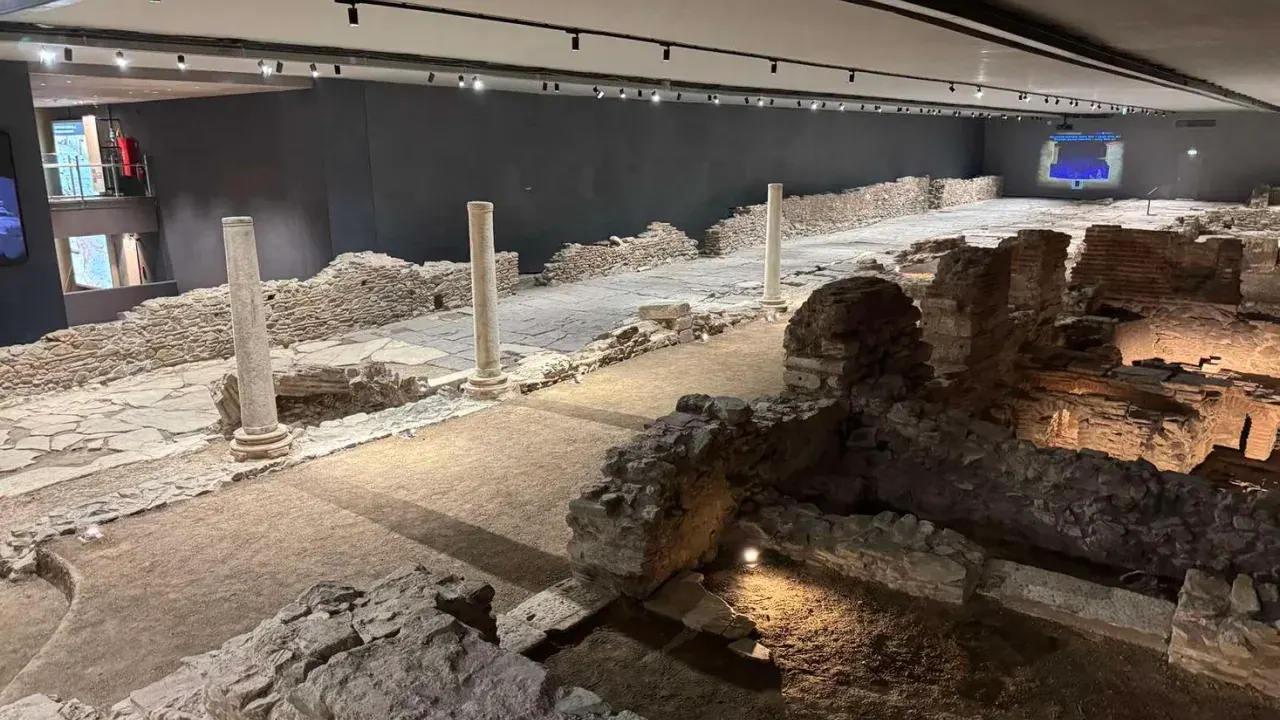
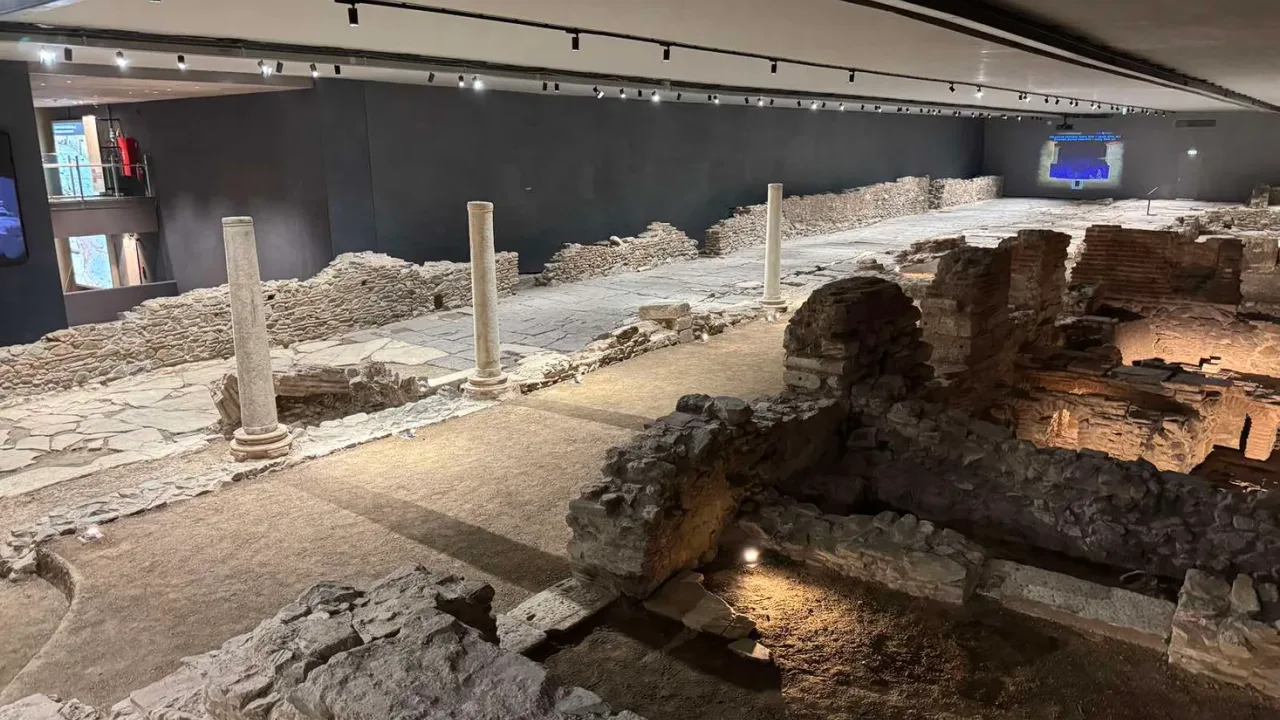
Thessaloniki's metro opened on 30 November 2024 — Greece's first fully driverless system, with sleek trains and platform screen doors. The initial line runs about 9.6 km with 13 stations along the city's spine, and a five-station eastern extension toward Kalamaria (Nomarchia, Kalamaria, Aretsou, Nea Krini and Mikra) is in final certification, with test trains already running and passenger service expected around the end of July 2026 — opening dates have slipped before, so check before you count on it — adding 4.78 km toward the southeastern seaside suburbs and bringing the line to 18 stations (see thessmetro.gr for the current status). A lovely quirk: the dig unearthed so many antiquities that several stations display ancient finds in situ — Venizelou station preserves the marble-paved Roman Decumanus Maximus, the city's ancient main avenue (later a Byzantine market street), right where commuters pass. It's fast, cheap, air-conditioned and a genuine attraction in its own right. A single ride is €0.60; our Thessaloniki metro guide has the line, stations, hours and tickets in full. Trains run from about 05:30 to 00:30 Sunday to Thursday, and later — until roughly 02:30 — on Friday and Saturday nights. For sightseeing, the handiest central stops are New Railway Station (the train and KTEL bus hub, and the line's western end), Venizelou (steps from Aristotelous Square and the Modiano and Kapani markets, and itself a mini-museum with the Roman and Byzantine avenue displayed in situ) and Agia Sofia (beside the Byzantine church of the same name); at the eastern terminus, Nea Elvetia, the 02X bus connects to the airport (about €2, ~15–20 min).
Buses
The city's buses (run by TheTA, the transport authority) fill in everywhere the metro doesn't reach — the upper town, the eastern suburbs, the airport. They charge the same €0.60 base fare as the metro (urban routes; suburban ones are €0.80), on a separate bus ticket. Note that buses are cashless — you pay by tapping a contactless card (or phone) on the onboard reader, or buy a ticket beforehand; you can't pay a driver in cash. Buses can be crowded and slowed by traffic at peak times, so for central trips the metro or your feet are usually quicker.
Tickets and fares
Simple and cheap — just note the metro and buses are ticketed separately:
- Single ticket — €0.60, valid 70 minutes with free transfers within the same mode (metro-to-metro or bus-to-bus). Suburban bus routes are €0.80.
- Metro + bus in one trip — buy one ticket for each (about €1.20); a metro ticket isn't valid on the bus, or vice versa.
- 10+1 tickets — €5.80.
- Reduced fares — students, seniors and children pay half: €0.30 a single ride and €2.90 for the 10+1 pack (carry proof of eligibility).
- 24-hour pass — €2.50 for unlimited rides in a 24-hour window on one mode (not valid on airport buses or the tourist Line 50).
- Airport express (01X) — €2.00.
Buy at metro-station machines (which still take cash) or on the app, or tap a contactless card on the bus's onboard reader — cash isn't accepted on the buses themselves. Validate every ride. For budgeting the rest of your trip, see Thessaloniki on a budget.
Taxis and apps
Thessaloniki's blue-and-white taxis are metered and reasonably priced — a central hop is only a few euros, with a higher night tariff after midnight. Hail one on the street, find a rank, or book through a taxi app for convenience and a fixed record of the fare. FreeNow is the app locals use, and Uber also works here — but note that in Greece both simply dispatch a regular licensed taxi on the meter, not a private car, and Bolt does not operate in Thessaloniki (it runs in Athens and Crete but hasn't come north). Taxis are the easy choice late at night, with luggage, or in a group when splitting the cost beats the bus.
Driving and parking
You don't need a car in Thessaloniki, and in the compact centre one is a liability — narrow one-way streets, heavy traffic and scarce parking. If you're renting for day trips (Vergina, Mount Olympus, the Halkidiki beaches), the smart move is to pick the car up on your way out rather than drive it in the city.
Central on-street parking runs on the municipal THESi controlled system: spaces marked in white are for visitors (blue are residents-only), charged about €1.70 an hour, up to 4 hours in one zone, Monday–Friday 08:00–21:00 and Saturday mornings — free in the evenings, on Sundays and on holidays. Pay via the ParkPal app or at one of the shops around town displaying the blue THESi sticker. Simplest of all, leave the car in a parking garage or the large municipal lot near the port and walk or take the metro into the centre.
Getting to and from the airport
Thessaloniki Airport (SKG) is about 13 km southeast of the centre. The cheapest link is the express bus (Line 01X) at €2.00, running day and night and taking about 40 minutes to the centre; a taxi is faster (around 30 minutes) on a fixed flat rate of €25 by day and €35 after midnight (luggage and tolls included). Note the metro does not reach the airport (its Kalamaria extension — five new stations running southeast to Mikra, expected to open in late July 2026 — will improve southeastern connections but still stops short of SKG). Full options, times and tips are in our airport-to-city guide, and arrival logistics in getting here.
Frequently Asked Questions
Does Thessaloniki have a metro?
Yes. Thessaloniki's metro opened on 30 November 2024 — Greece's first fully driverless system — with an initial line of 13 stations running about 9.6 km along the city's spine, and a five-station Kalamaria extension in final certification, expected to open at the end of July 2026. Several stations display ancient artefacts unearthed during construction. A single ride costs €0.60.
What are the Thessaloniki metro's opening hours?
The metro runs from about 05:30 to 00:30 (half past midnight) from Sunday to Thursday, and stays open later — until roughly 02:30 — on Friday and Saturday nights. Trains are frequent and driverless, so there's no timetable to plan around for a normal trip; just turn up. Hours can shift slightly around the Kalamaria-extension testing, so check thessmetro.gr if you need the last train.
How much is public transport in Thessaloniki?
A single metro or city-bus ticket is €0.60 (€0.80 on suburban bus routes), valid 70 minutes with free transfers within the same mode. The metro and buses are ticketed separately, so a journey using both needs two tickets (about €1.20). A 10+1 pack is €5.80 and a 24-hour pass €2.50 (one mode; not valid on airport buses). The airport express bus (Line 01X) is €2.00. Buses are cashless — pay by contactless card on board or buy ahead — though metro-station machines still accept cash.
Is Thessaloniki walkable?
Very. The historic centre is flat and compact, so you can walk from the White Tower along the waterfront, up to Aristotelous Square and the markets, and across to the Rotunda in under an hour. The only real climb is up to Ano Poli — ride up and walk down. Most visits need little transport.
How do you get from Thessaloniki airport to the city?
The airport (SKG) is about 13 km southeast of the centre. The cheapest option is the express bus, Line 01X, at €2.00, running day and night. A taxi takes about 30 minutes on a fixed flat rate of €25 by day and €35 after midnight (luggage and tolls included). See our dedicated airport-to-city guide for all the options, times and current fares.
Is there Uber or Bolt in Thessaloniki?
FreeNow is the main taxi-hailing app in Thessaloniki, and Uber operates here too — but in Greece both connect you to a regular licensed taxi on the meter, not a private driver, so fares match a normal street taxi. Bolt does not operate in Thessaloniki (it's live in Athens and Crete only), so don't rely on it here. For most trips a metered street taxi or FreeNow is simplest.
Is public transport in Thessaloniki wheelchair accessible?
The metro is your best bet — being brand new, every station has lifts and level, step-free boarding, so it's fully accessible (see our metro guide). The city buses are officially low-floor with ramps and a kneeling system, but in practice it's variable — drivers don't always deploy the ramp or stop close to the kerb — so treat the metro as the reliable option where it reaches. The flat central grid is easy to walk or wheel, though the cobbled lanes and steep streets of Ano Poli (the Upper Town) are hard going. Accessible taxis exist but are limited, so book ahead if you need one.