Thessaloniki's wine-tour operators mostly bus you out to tasting rooms and back — useful, but it skips the town itself. Naoussa is worth a day trip precisely because it isn't just a wine label: it's a working Macedonian town with a river running through its centre, a genuine philosophical pedigree, and a ski mountain at its back door. The question is whether one day is enough to do all three.
What a Naoussa day actually covers
Naoussa rewards a loose, three-part day rather than a single-stop itinerary: the town and its river park, the vineyards that gave the wine its name, and — a short drive further out — the ruins where Aristotle is said to have taught a young Alexander the Great. Doing all three properly needs a full day; doing one or two well is easily manageable with a late morning start.
| Naoussa day trip | |
|---|---|
| Distance from Thessaloniki | ~90 km |
| Drive time | About 1 h 15 min |
| Core sights | Arapitsa river park, Xinomavro wineries, School of Aristotle |
| Best paired with | Ski day at 3-5 Pigadia (winter) or a wine tasting itinerary |
| Good for | Wine lovers, history buffs, a green break from the city |
Getting to Naoussa from Thessaloniki
Naoussa sits about 90 km west of the city, and the drive — largely via the A2/Egnatia Odos and then north off the highway — takes roughly 1 hour 15 minutes in normal traffic; some route calculators put it closer to 1.5 hours depending on the exact final approach into town, so build in a little slack. It's a genuinely easy self-drive day, flatter and faster than the mountain roads out to Edessa or Kastoria. There's no meaningful public transport option that makes a wine-tasting day workable, so this is a car trip; see our car rental guide for pickup options in the city.
The Arapitsa river and Agios Nikolaos park
Naoussa's defining feature isn't the wine — it's the Arapitsa, a spring-fed river whose source sits about 3 km northwest of town at the foot of Mount Vermio, wrapped in Agios Nikolaos park: a large grove of centuries-old plane trees with an artificial lake of ducks and trout and cafés and tavernas set right along the water. From there the river runs down into Naoussa itself and on to the plain. We walked the park loop on a July afternoon in 2026, and the shaded riverside paths run several degrees cooler than the open streets — a genuinely pleasant midday break in high summer, and free to wander.
Xinomavro wine country
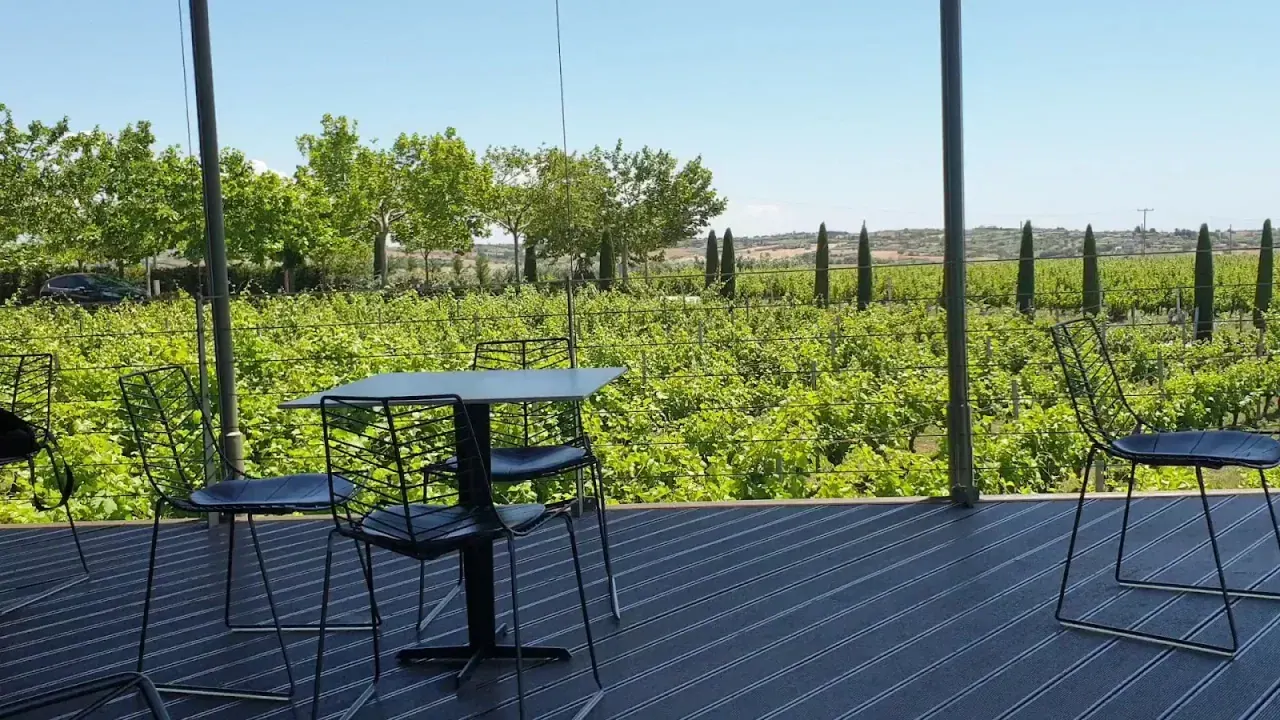
Naoussa gives its name to Greece's most respected red wine appellation, and it's worth understanding why before you taste it: Xinomavro, the grape behind it, is often compared to Nebbiolo for its structure, acidity and long ageing potential — high praise in a country better known for whites. Naoussa was Greece's very first region to receive Protected Designation of Origin (PDO) status, back in 1971 — the model for the country's whole appellation system — and the vineyards ringing the town remain some of its most serious. A handful of estates around town run tastings, typically by appointment — check ahead rather than turning up unannounced, especially outside peak season. If you'd rather have someone else handle logistics, the Thessaloniki wine tours guide covers organised trips into this same wine country, and wine-country day tours out of Thessaloniki are bookable if you want a guide and driver rather than a self-drive day. For a deeper dive into the grape itself, see our Xinomavro wine guide.
The School of Aristotle
A short drive from town, in the wooded area known as Isvoria, lies the site traditionally identified as the School of Aristotle — where the philosopher is said to have tutored the young Alexander the Great and his peers in the 4th century BC. The associated Nymphaion of Mieza, a sanctuary dedicated to the Nymphs, preserves the foundations of a two-storey Ionic stoa and other structures uncovered by excavation, alongside a large adjacent gymnasium complex. It's a quiet, shaded site — more atmosphere than spectacle, but a genuinely rare thing to stand where ancient sources place one of history's most consequential classrooms.
Naoussa vs. a city wine tour
If you've already read our Thessaloniki wine tours piece, the distinction matters: that guide is built around organised tastings that can start from the city itself, while this is the self-drive version that adds the town, the river park and the ancient site into the same day. Neither replaces the other — pick the wine-tour route if you want someone else driving and pouring; pick the Naoussa day trip if you want the fuller picture of the town behind the label.
Where to eat in Naoussa
The town's restaurant scene is small but genuine — this is a working wine town, not a tourist stop, so the best meals tend to be simple, seasonal Macedonian cooking rather than anything elaborate. Look for a taverna near Agios Nikolaos park for a riverside lunch, where grilled meats, wild greens and local cheeses are the standard order, and don't hesitate to ask whoever's serving you what red they'd pour with it — in a town built on Xinomavro, the house recommendation is rarely wrong. Portions run generous and prices stay well below what you'd pay for equivalent food in central Thessaloniki, one of the quieter rewards of a trip out here.
Pairing it with a ski day
In winter, Naoussa sits directly below 3-5 Pigadia, one of the region's three organised ski centres, about 17 km above the town on Mount Vermio. It's entirely possible to ski a morning and taste Xinomavro in the afternoon on the same December-to-March day — our ski resorts near Thessaloniki guide compares 3-5 Pigadia against the region's other two mountains if you're planning that combination.
Planning your route through town
Naoussa is small enough to cover on foot once you've parked, and the sensible order for a day trip is to start with the Arapitsa park in the cool of the morning, move on to a vineyard visit or tasting around midday, and save the School of Aristotle for the late afternoon when the light through the trees at Isvoria is at its best. If you're combining Naoussa with another stop on the same day, it sits close enough to Edessa and Veria that a two-town day is realistic for travellers with an early start, though we'd suggest picking one and doing it properly rather than rushing all three — the wine country in particular rewards a slower pace than a tick-box itinerary allows.
Best time of year to go
Naoussa works as a day trip almost year-round, but the character of the visit changes with the season. September and October bring the wine harvest, when some estates run tastings tied to the year's picking and the town has a genuine buzz to it. Spring, roughly April to June, is when the Arapitsa park is at its greenest and most comfortable for a long walk before the summer heat sets in. Summer favours the shaded river park over the open vineyard rows at midday, and winter shifts the emphasis toward the ski mountain above town rather than the wine trail. There's no genuinely bad season here — just a different reason to come.
Frequently Asked Questions
How far is Naoussa from Thessaloniki?
About 90 km, roughly a 1 h 15 min drive via the Egnatia Odos and then north off the highway. Some routes run closer to 1.5 hours depending on the exact approach into town, so it's worth checking current traffic before you set off, especially on summer weekends.
What is Naoussa famous for?
Naoussa is Greece's best-known red wine region, home to Xinomavro — a structured, age-worthy grape often compared to Nebbiolo — and the country's first Protected Designation of Origin appellation, awarded in 1971. The town itself also has the Arapitsa river running through its centre and the nearby site traditionally identified as Aristotle's School.
Can you visit Naoussa without a car?
It's difficult. There's no realistic public transport route that lets you combine the town, the vineyards and the School of Aristotle in a single day, so a rental car or an organised tour from Thessaloniki is the practical option. The drive itself is straightforward — mostly highway.
Is the School of Aristotle worth visiting?
If ancient history interests you, yes — it's the site traditionally identified as where Aristotle tutored Alexander the Great, with excavated foundations of a Nymphs' sanctuary and gymnasium complex. It's a quiet, low-key site rather than a dramatic ruin, so temper expectations accordingly; it rewards a slow, curious visit over a quick photo stop.
Can you ski and taste wine in Naoussa on the same day?
Yes, in winter. The 3-5 Pigadia ski centre sits about 17 km above Naoussa on Mount Vermio, making it entirely feasible to ski a morning and visit a Xinomavro producer in the afternoon between December and March, weather permitting.