Long before it was a Byzantine city, Thessaloniki was a Roman one — and for a few years around 300 AD it was an imperial capital. The emperor Galerius, one of the four rulers of Diocletian's Tetrarchy, made the city his seat and laid out a grand complex of palace, arch and rotunda that still shapes the centre today. You walk over and around it constantly: a triumphal arch on the main street, a giant domed hall, a sunken forum, an emperor's palace ringed by cafés. Here's what Roman Thessaloniki left behind, and how to see the best of it in a single easy morning.
The Roman monuments at a glance
Four sights make up the core, all within a ten-minute walk of each other along the city's Roman spine:
| Monument | Era | Why go | Entry |
|---|---|---|---|
| Arch of Galerius (Kamara) | c. 300 AD | Carved battle reliefs; the city's meeting point | Free, always open |
| Rotunda | early 4th c. | Vast Roman dome, early-Christian gold mosaics | €10 (€5 reduced) |
| Roman Forum (Ancient Agora) | 2nd–3rd c. | Odeon and underground cryptoporticus | Free (museum extra) |
| Palace of Galerius | early 4th c. | An emperor's palace open in a modern square | Free |
See them all on the landmarks page; the sections below explain what each one is and the order to walk them.
The Galerius complex: an imperial capital
When Galerius ruled the eastern empire as Caesar and then Augustus, he rebuilt a swathe of Thessaloniki as a monumental showpiece — the only Tetrarchic palace complex in Greece. A single ceremonial axis linked his palace in what is now Navarinou Square to the Rotunda at the top of the hill, passing under the Arch of Galerius that straddled the main road. Around it stood the throne-room Octagon and a hippodrome (remembered today in Ippodromiou Square). Understanding that these pieces were built as one plan is the key to Roman Thessaloniki — they aren't scattered ruins but the surviving fragments of a single emperor's capital.
Start at the Arch of Galerius (Kamara)
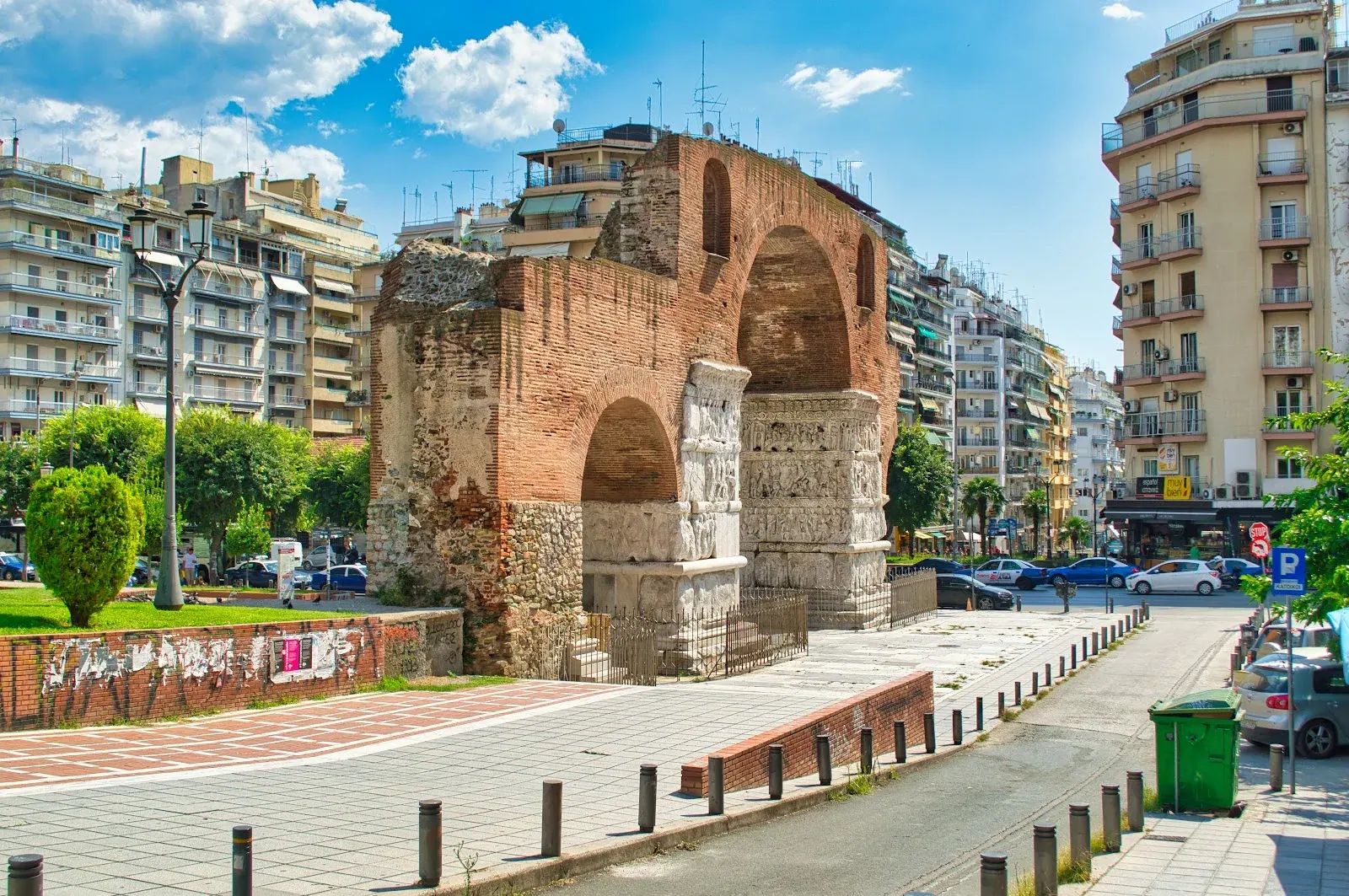
The natural first stop is the Arch of Galerius, which everyone in the city simply calls the Kamara — "the arch" — and uses as the place to meet. Raised around 300 AD to celebrate Galerius's victory over the Sasanid Persians, its surviving marble piers are carved with dense registers of battle scenes, sacrifices and the emperor himself. It stands in the open on Egnatia and is free at any hour, so it slots into any walk through the centre — come back after dark when it's lit and the crowds thin.
The Via Egnatia underfoot
The arch didn't stand over an ordinary street. Modern Odos Egnatia traces the Via Egnatia, the great Roman highway that ran from the Adriatic coast at Dyrrachium clear across to Byzantium, and Thessaloniki grew rich as its natural halfway halt. When you walk under the Kamara you're crossing the line of a road that carried legions, traders and the Apostle Paul alike — the reason the city mattered enough to become an imperial seat in the first place.
The Rotunda — Rome's great dome
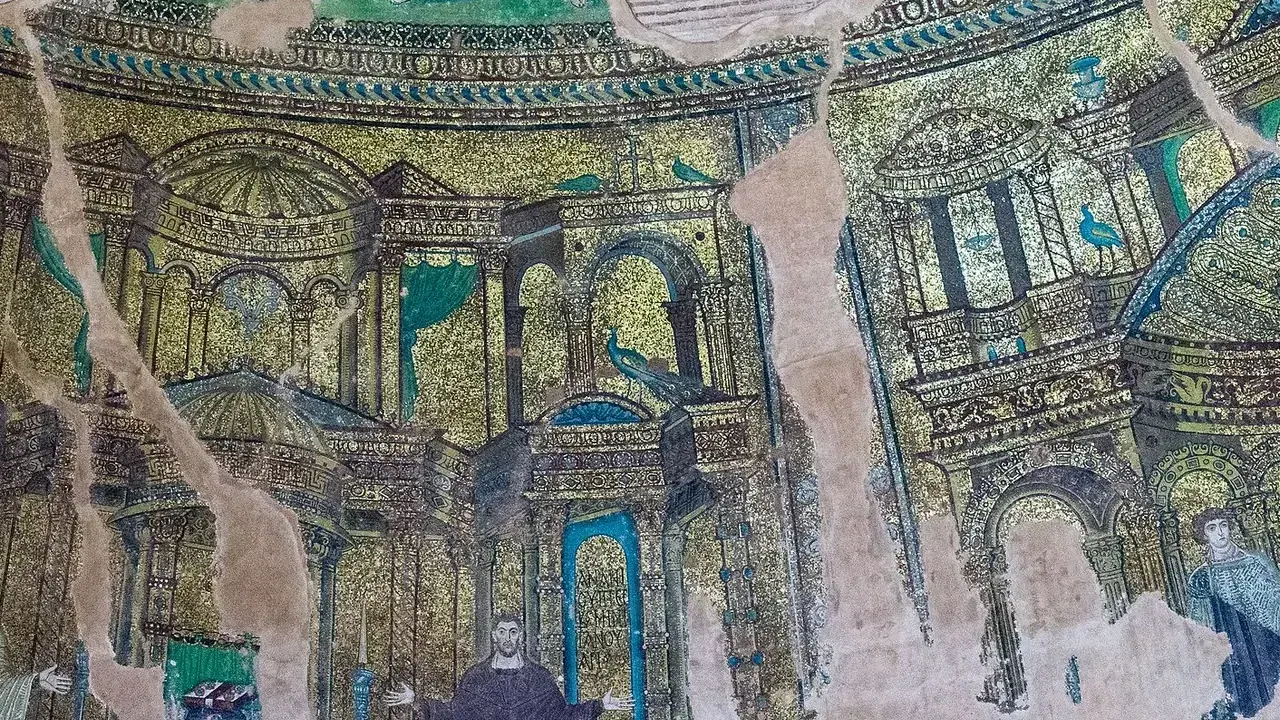
A two-minute walk up the pedestrian street brings you to the Rotunda, the single most striking survival of Roman Thessaloniki: a colossal brick cylinder built in the early 4th century, its walls six metres thick, capped by one of the oldest great domes still standing anywhere. Galerius likely intended it as a mausoleum or temple; it was later converted into a Christian church and lined with some of the earliest and finest gold mosaics in existence, then served as a mosque (its minaret still stands). Entry is €10 (reduced €5; recently raised, so some older guides still quote €6), and the €15 combined three-day ticket that also covers the White Tower and the Archaeological and Byzantine Culture museums is worth it if you're doing the monument circuit. Hours are roughly 08:00–20:00 in summer and 08:30–15:30 in winter, and it is usually closed on Tuesdays — plan around that (the neighbouring Archaeological and Byzantine Culture museums, by contrast, stay open daily in summer). It's part of the city's UNESCO World Heritage listing.
The Palace of Galerius and the Octagon
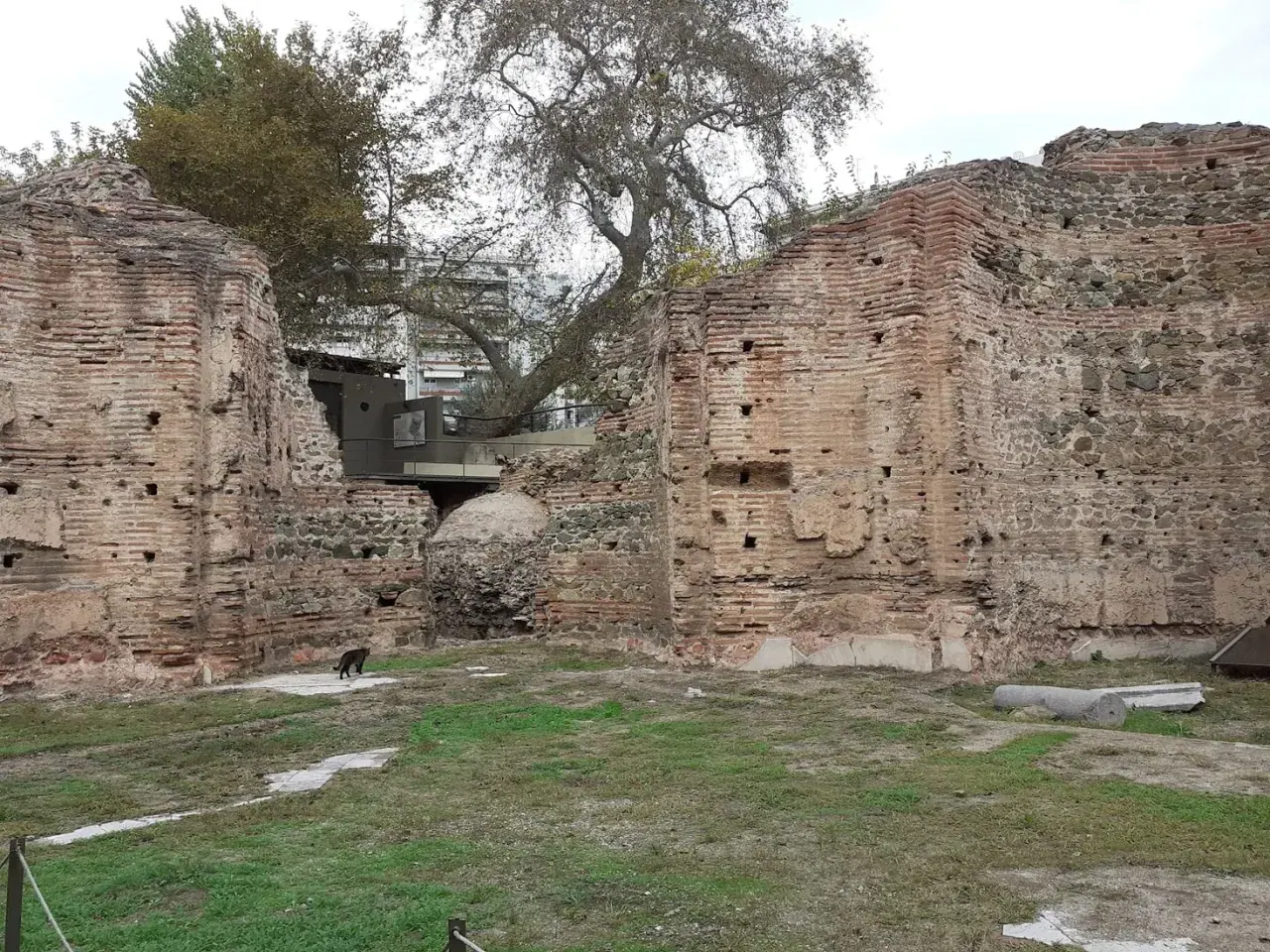
Head downhill toward the sea and you reach the Palace of Galerius, lying open in the middle of Navarinou Square — great brick-banded walls and apses sunk below the modern street, ringed by cafés and students. This is where the emperor actually lived. The main ruins are free to view from the railings around the square, day or night; the adjacent Octagon, thought to be the palace's throne room, is a separate archaeological site with its own hours. Allow about twenty minutes for the surreal contrast of a Roman palace among the café tables.
The Roman Forum — the civic heart
Two blocks north of the shopping streets, the ground drops into a sunken field of stone: the Roman Forum, or Ancient Agora, the civic centre of the Roman city from the 2nd–3rd centuries. Its restored odeon (a small theatre), colonnaded square and the atmospheric underground cryptoporticus — a vaulted arcade that once supported the plaza — sit a full storey below the modern town. The open site is free; a small underground museum explaining daily Roman life has a separate admission. Come in the morning, before the unshaded square bakes and while the low light picks out the arches.
Where Rome meets Byzantium: Agios Dimitrios
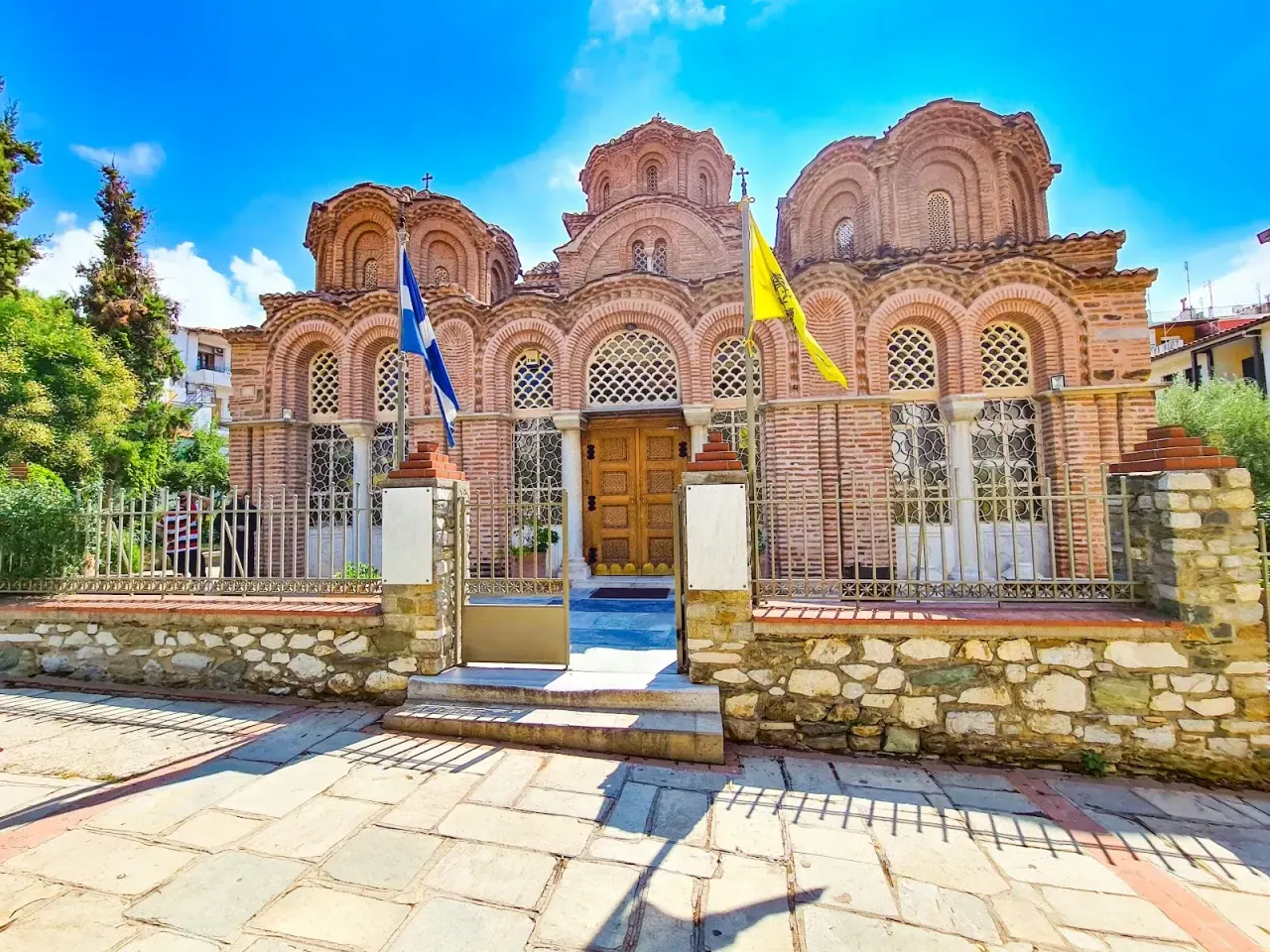
The Roman city didn't end so much as become the Christian one, and nowhere shows the seam better than the basilica of Agios Dimitrios, the city's patron saint. It was built over the Roman baths where, by tradition, Dimitrios was imprisoned and martyred around 300 AD — the crypt below the church still preserves the bath structures. For the full sweep of what came next, our Byzantine & UNESCO monuments guide picks up the story where the Roman one leaves off, and the Ottoman Thessaloniki guide carries it through to 1912.
See it all in one morning
The beauty of Roman Thessaloniki is how tight it is. A natural loop — Roman Forum → Arch of Galerius → Rotunda → Palace of Galerius — takes about half a day at a gentle pace, all of it central and mostly free. Start early at the open, unshaded Forum, and finish with a coffee in Navarinou Square beside the palace. It fits neatly into day one of our 2-day itinerary, and most of it belongs on any list of free things to do. For the objects that once filled these buildings, the Archaeological Museum is the essential companion.
Frequently Asked Questions
What Roman ruins are there in Thessaloniki?
The main Roman sights are the Arch of Galerius (the "Kamara"), the Rotunda, the Roman Forum (Ancient Agora) and the Palace of Galerius in Navarinou Square — most built around 300 AD as part of the emperor Galerius's imperial complex, the only Tetrarchic palace complex in Greece. All four sit within a short walk of each other in the city centre.
Was Thessaloniki a Roman capital?
Yes. In the early 4th century AD the emperor Galerius, one of the four rulers of Diocletian's Tetrarchy, made Thessaloniki his imperial seat and built a monumental complex of palace, arch, hippodrome and rotunda linked along a single ceremonial axis. Much of it still survives in the modern centre.
Are Thessaloniki's Roman sites free to visit?
Mostly, yes. The Arch of Galerius, the Palace of Galerius ruins and the open Roman Forum are all free; only the Rotunda charges admission (€10, reduced €5 — recently raised, so some older guides still quote €6), and the Forum's small underground museum has a separate ticket. A €15 combined three-day ticket covers the Rotunda together with the White Tower and the Archaeological and Byzantine Culture museums.
How long do you need for Roman Thessaloniki?
About half a day. A loop of the Roman Forum, the Arch of Galerius, the Rotunda and the Palace of Galerius takes three to four hours at an easy pace, since everything is central and close together. Start early at the unshaded Forum and save the ticketed Rotunda for last.