For nearly five centuries — from 1430 until 1912 — Thessaloniki was an Ottoman city, known as Selanik, and one of the most important ports of the empire. Its bathhouses still stand, though what you can actually bathe in today is a different list — see hammams and spas. That long chapter left more behind than most visitors realise: the very symbol of the city is an Ottoman building, its markets still trade under Ottoman domes, and the founder of modern Turkey was born a few streets from the seafront. Here's how to read the Ottoman layer of Thessaloniki, from its emblem on the waterfront to the bathhouses, bazaars and fortress that survive in the modern centre.
The Ottoman sights at a glance
The best-preserved Ottoman monuments are all central and easy to string together:
| Monument | Built | What it is | Entry |
|---|---|---|---|
| White Tower | 15th c. | The city's waterfront emblem and museum | €8 (€4 in winter/reduced) |
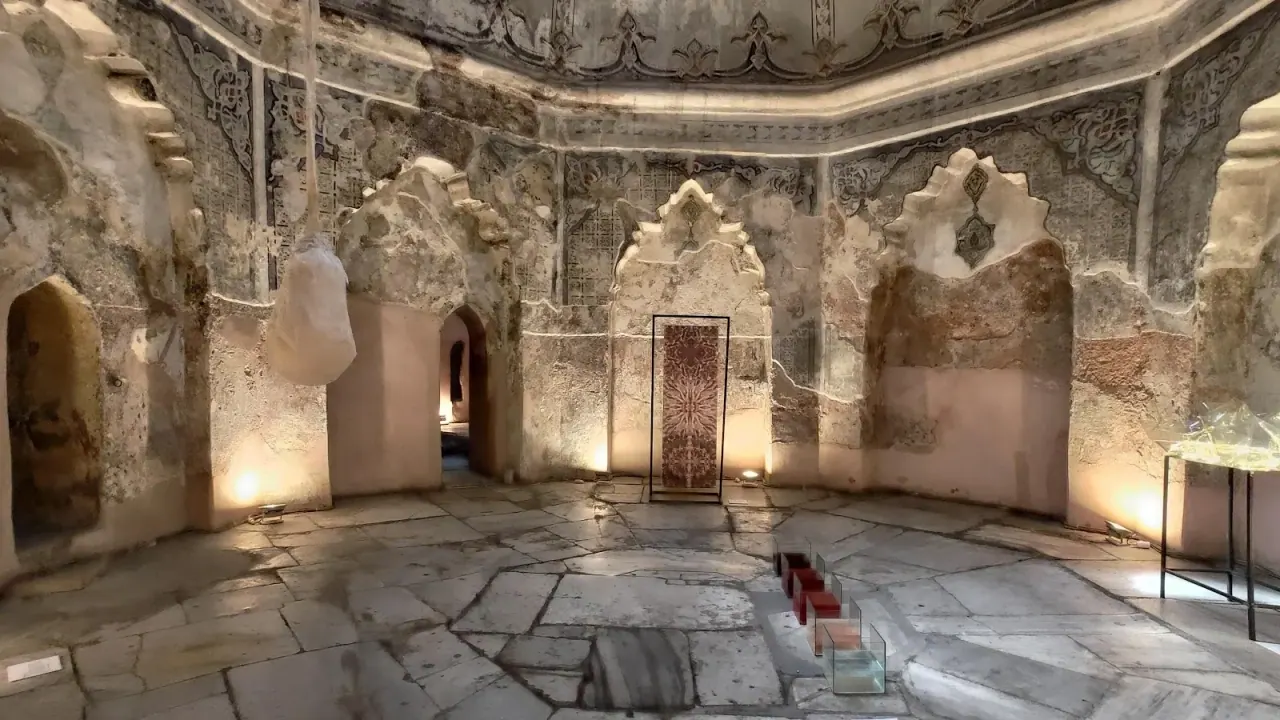
| Bey Hamam | 1444 | The grandest Ottoman bathhouse in Greece (oldest in the city) | Free / low |
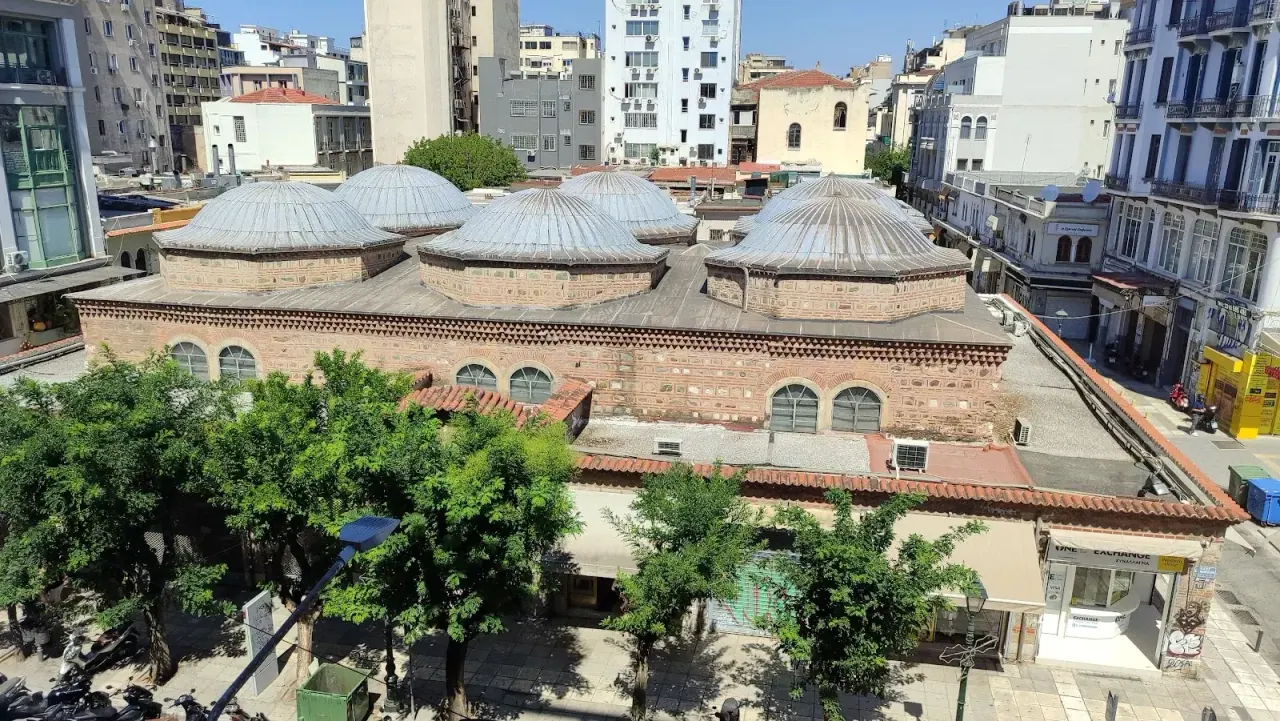
| Bezesteni | late 15th c. | A domed covered bazaar, still trading | Free |
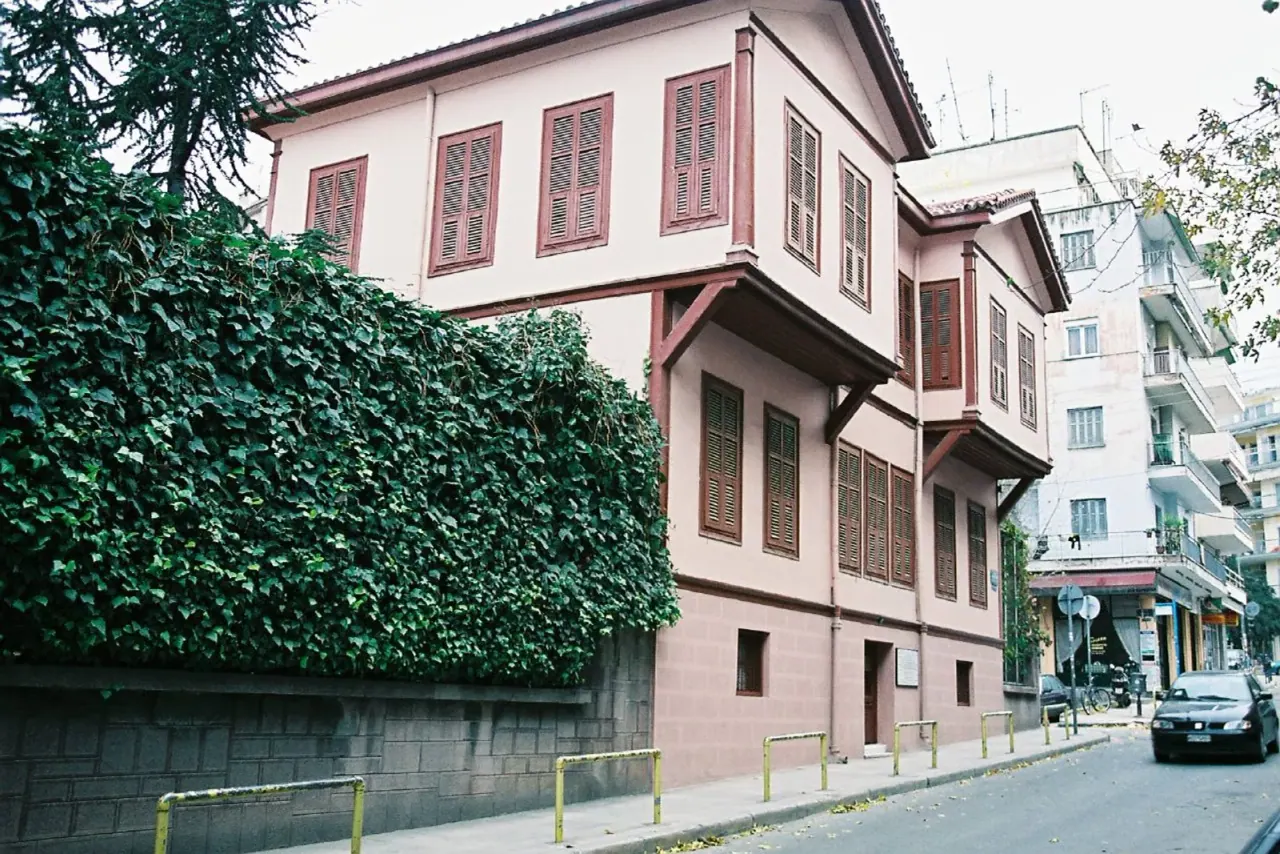
| Atatürk's House | 1881 (birth) | Birthplace of modern Turkey's founder | Free (ID) |
| Heptapyrgion (Yedi Kule) | Byz.–Ottoman | Hilltop fortress and former prison | Free |
Browse them all on the landmarks page; the sections below explain each and how they fit together.
The emblem itself: the White Tower
Start with the obvious. The White Tower — the 34-metre cylinder on the waterfront that ends up on every postcard — is an Ottoman structure, raised in the 15th century on the site of an older Byzantine tower to anchor the city's sea walls. It later became a garrison and a prison whose executions earned it the grim nickname the "Tower of Blood"; the story goes that it was whitewashed to shed that reputation, and the name White Tower stuck. Inside, a six-floor museum climbs a spiral ramp to the best central rooftop view in the city. Entry is €8 (€4 in winter/reduced), on the €15 combined three-day ticket that also covers the Rotunda and the two big museums; hours are 08:00–20:00 in summer and 08:30–15:30 in winter.
The baths: Bey Hamam
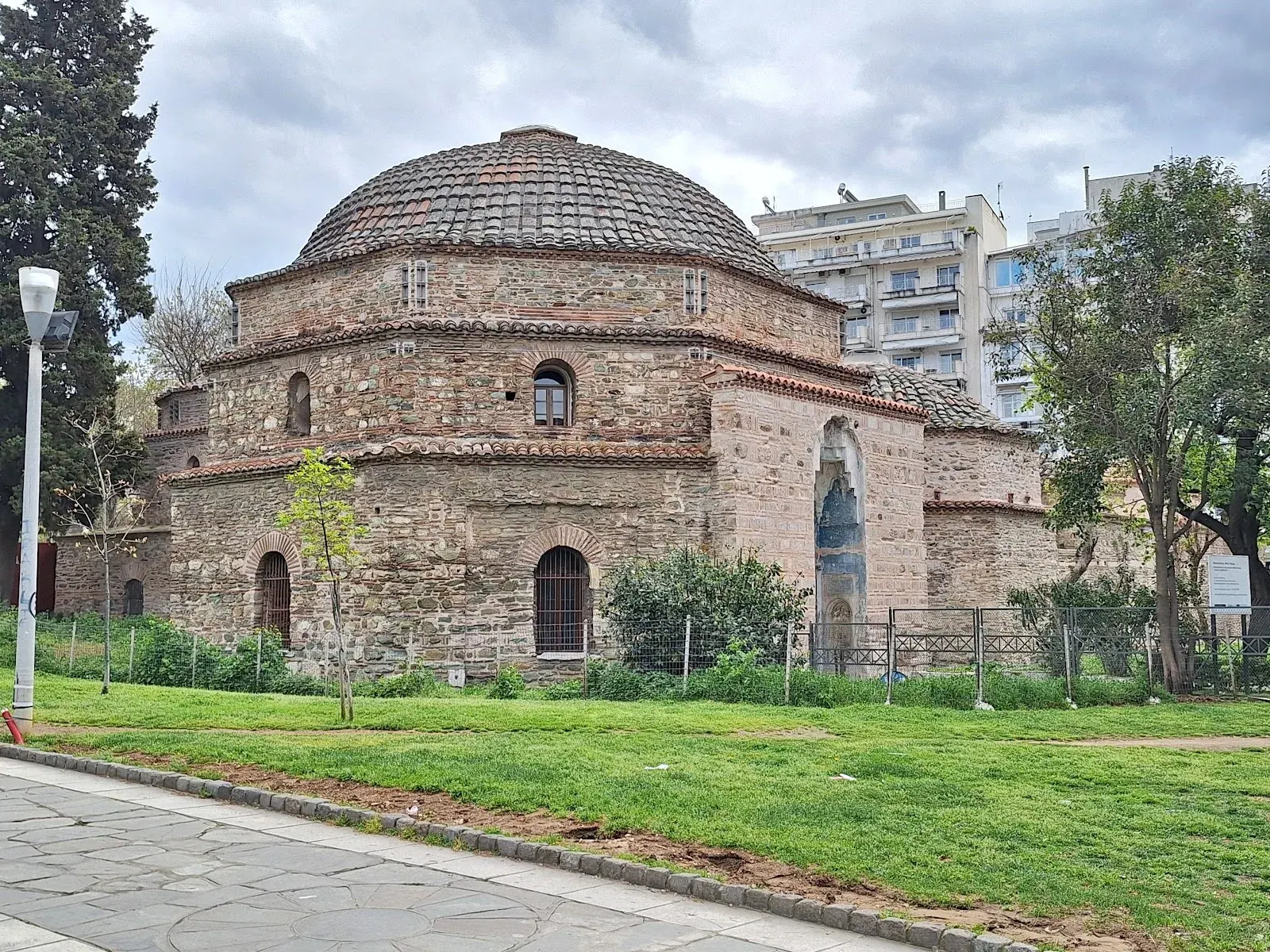
A block off Egnatia stands the Bey Hamam, the "Paradise Baths" — the grandest Ottoman bathhouse in Greece and the oldest in the city, built in 1444 under Sultan Murad II. Behind its plain stone-and-brick exterior lie domed chambers pierced with star-shaped skylights, marble basins and traces of painted decoration; the baths stayed in use into the 20th century. It's the finest place in the city to understand the Ottoman hamam, the social heart of every Ottoman neighbourhood. Thessaloniki keeps others too — the Byzantine bathhouse in Ano Poli spent centuries as an Ottoman hammam, and the Yahudi Hamam still anchors the flower market.
The bazaar: Bezesteni
In the commercial heart of the city, ringed by the modern shopping streets, the Bezesteni is a lead-domed covered market from the late 1400s — six brick-vaulted bays that have never stopped trading, now lined with little shops of fabric, trimmings and jewellery. It's one of the very few working Ottoman commercial buildings left in Thessaloniki, and it sits amid the sprawling markets — Kapani and Modiano — whose alleys still follow the old Ottoman bazaar quarter.
The birthplace: Atatürk's House
A short walk uphill, behind the Turkish consulate, is one of the city's most-visited sights for foreign travellers: the pink three-storey Atatürk's House, where Mustafa Kemal Atatürk, the founder of modern Turkey, was born in 1881. Thessaloniki was then still an Ottoman city, and the house is preserved as a museum furnished in period style. Entry is free, but you'll need to show ID at the consulate gate to go in.
Atatürk's birth here was no accident of the city's importance. Late-Ottoman Selanik was the empire's most rebellious city — the headquarters of the Committee of Union and Progress (the "Young Turks"), the reformist officers' movement (Mustafa Kemal among them) that in July 1908 launched the Young Turk Revolution from here, forcing Sultan Abdul Hamid II to restore the constitution. For a few years this port was where the Ottoman Empire's future was being fought over.
The fortress-prison: Heptapyrgion
Crowning the top of Ano Poli, the Heptapyrgion — Greek for "seven towers", the Turkish Yedi Kule — is a citadel of Byzantine towers with later Ottoman additions, the ultimate stronghold of the walled city. Its darker fame is more recent: from the 1890s until 1989 it served as the city's most feared prison, a chapter that echoes through Greek rebetiko songs. Restored and open today, it pairs with the best view over the rooftops.
The living legacy: a mosaic city
The Ottoman centuries did more than leave buildings. Under Ottoman rule Thessaloniki became a famously plural city — its majority for four hundred years was Sephardic Jewish, the "Jerusalem of the Balkans", alongside Muslim and Christian quarters. That world is told in our Jewish heritage guide, and its surviving mosques — the 15th-century Hamza Bey Mosque (the "Alcazar") on Egnatia and the Alaca Imaret — still stand among the shops. Most singular of all is the Yeni Cami ("New Mosque"), built in 1902 for the Dönmeh — descendants of 17th-century Jews who followed the self-proclaimed messiah Sabbatai Zevi into Islam yet kept crypto-Jewish traditions. Its eclectic, almost Alhambra-like design even works discreet Stars of David into the stonework; after the Dönmeh left in the 1923 population exchange, the building housed the Archaeological Museum for decades and is now an exhibition space. Several Byzantine churches spent those centuries as mosques too, among them the five-domed Holy Apostles, whose rare mosaics survived precisely because they were plastered over. For the city's earlier layers, see our companion guides to Roman Thessaloniki and its Byzantine monuments.
See it in half a day
The Ottoman monuments slot neatly into a walk through the centre: Bezesteni and the markets → Bey Hamam → Atatürk's House → the White Tower on the seafront, with the Heptapyrgion saved for a climb into Ano Poli. Most are free, and it maps closely onto our 2-day itinerary. For where these sights sit on the ground, use the interactive landmarks map.
Frequently Asked Questions
What Ottoman monuments are there in Thessaloniki?
The main survivals are the White Tower (the city's emblem, itself Ottoman-built), the Bey Hamam bathhouse of 1444, the Bezesteni covered bazaar, Atatürk's birthplace, and the Heptapyrgion (Yedi Kule) fortress-prison, along with surviving mosques such as the Hamza Bey Mosque and the Alaca Imaret. Most are central and free or cheap to visit.
How long was Thessaloniki under Ottoman rule?
Nearly five centuries. The Ottomans took the city in 1430 and held it, as "Selanik", until 1912, when it passed to Greece during the Balkan Wars. For much of that time it was one of the empire's great multicultural ports, with a Sephardic Jewish majority alongside Muslim and Christian communities.
Is the White Tower Ottoman or Byzantine?
The White Tower as it stands is Ottoman, built in the 15th century on the site of an earlier Byzantine tower to anchor the city's sea defences. It later served as a garrison and prison before becoming the museum and viewpoint it is today.
What was Thessaloniki's role in the Young Turk Revolution?
The city — then Ottoman Selanik — was the heart of the movement. The Committee of Union and Progress (the "Young Turks"), a secret society of reformist army officers based here, launched the Young Turk Revolution in July 1908, forcing Sultan Abdul Hamid II to restore the Ottoman constitution. Mustafa Kemal (later Atatürk), born in the city in 1881, was among the young officers connected to the movement.
Where was Atatürk born in Thessaloniki?
Mustafa Kemal Atatürk was born in 1881 in a pink three-storey house behind what is now the Turkish consulate, near the Roman-era Rotunda. It is preserved as a museum, furnished in period style; entry is free, but you must show identification at the consulate gate.