Forty minutes west of Thessaloniki lies the city where Alexander the Great was born — and where he was tutored by Aristotle before setting out to conquer the known world. Pella was the capital of Macedon at its height, and what survives is a broad, open site of street grids and grand houses floored with some of the finest pebble mosaics ever made, plus a first-rate modern museum. It's one of the easiest and most rewarding history day trips from the city. Here's how to do it.
The day trip at a glance
Pella is close, flat and pairs naturally with Vergina — so it's an easy half-day on its own or one half of a big Macedonian-history day. The essentials:
| Detail | |
|---|---|
| Distance | ≈40 km · ~40 min from Thessaloniki |
| Famous for | Birthplace of Alexander; pebble mosaics |
| Site + museum | Open archaeological site + Museum (opened 2009) |
| Entry | around €10 each for the site and the museum (about €5 reduced); a €15 combined ticket covers the site, the museum and the palace of Pella together — confirm current prices at the desk or on the official site |
| Hours | Open daily; roughly 08:00–20:00 in summer, 08:30–15:30 in winter (Nov–Mar), when it's closed on Tuesdays; in summer Tuesday opens later, around midday. Last entry ~20 min before closing |
| Rating | 4.4 (site) |
| Pairs with | Vergina — the royal tombs |
The site is largely open-air, so spring and autumn are the most comfortable times to walk it.
Where Alexander was born
Pella became the royal capital of Macedon around the end of the 5th century BC, replacing Aigai (modern Vergina), and grew into the wealthiest, most cultured city in the Greek world. It was here, in 356 BC, that Alexander the Great was born, and here that the young prince was tutored by Aristotle before he marched east to topple the Persian Empire. Standing in the agora, among the grid of streets and the footprints of colonnaded houses, you're in the cradle of the empire that spread Greek culture from Egypt to India. Back in Thessaloniki, the giant waterfront statue of Alexander the Great is the modern city's tribute to its most famous son.
The pebble mosaics
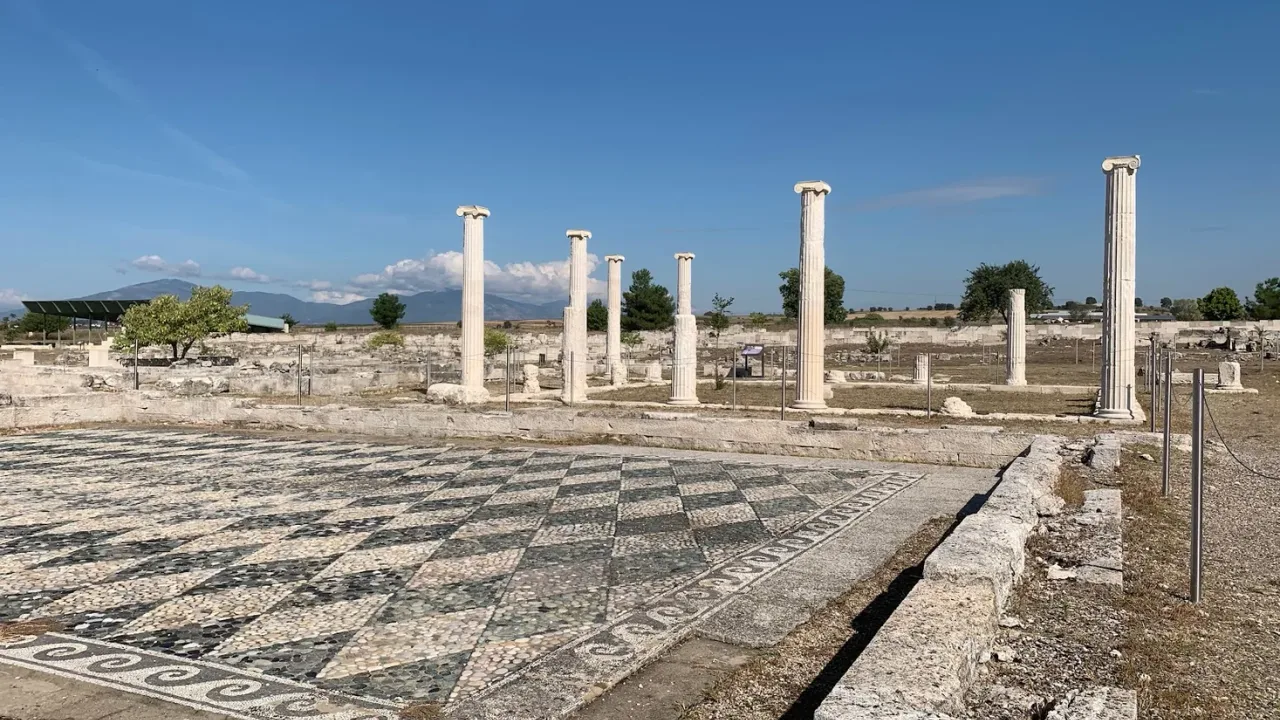
The reason to come is the mosaics — and they're extraordinary. Made entirely from natural river pebbles, not cut tesserae, they render hunting scenes and mythological figures with a sense of movement and shading that feels centuries ahead of its time. Some remain in situ on the floors of the houses; the very best are displayed in the museum: the lion hunt, the stag hunt (signed by the artist Gnosis), and a Dionysus riding a panther. Pella is where the art of the pebble-mosaic floor was perfected, and seeing them is worth the trip alone.
The site and the museum
Give yourself time for both halves. The open archaeological site preserves the city plan — the agora, the streets, and grand houses with mosaics in place — across a wide, walkable expanse on the Macedonian plain. Just north, the excellent Archaeological Museum of Pella (opened 2009) gathers the finest mosaics and finds under one modern roof, with clear displays that make sense of the city. Allow around 2–3 hours for the pair; bring sun protection, as the site has little shade. Check current hours and tickets on the official Pella site before you go. For the wider context of Macedonian treasures, see our best museums in Thessaloniki guide.
Getting there from Thessaloniki
| Option | How | Best for |
|---|---|---|
| Car | ~40 min on the Thessaloniki–Edessa road | Combining with Vergina |
| Bus | KTEL buses toward Giannitsa / Edessa stop at Pella | Car-free travel |
| Guided tour | Round-trip, usually Pella + Vergina | No driving, full context |
A car is simplest and lets you pair Pella with Vergina. By bus, take a KTEL service toward Giannitsa or Edessa and ask for the Pella stop. For a hands-off day, the Vergina & Pella day trip on GetYourGuide (around €58, rated 4.7) covers both with a guide; it's listed among our day trips. See how to reach the region in our getting here guide.
Pair it with Vergina
Pella and Vergina are the two poles of Macedonian history and sit a manageable drive apart, so most visitors do them together: the city where Alexander was born (Pella) and the tombs where his father Philip II and his dynasty were buried (Vergina). It makes a complete, deeply rewarding day — see the ranked day trips from Thessaloniki for how it compares to the others.
Frequently Asked Questions
Why is Pella important?
Pella was the capital of the kingdom of Macedon from around 400 BC and the birthplace of Alexander the Great in 356 BC. It grew into the greatest city in the Greek world under Philip II, and it was the seat from which Alexander set out to conquer the Persian Empire. It's also home to the finest ancient pebble mosaics.
What is there to see at Pella?
The open archaeological site preserves the city's streets, agora and grand houses with pebble mosaics in place, while the Archaeological Museum of Pella (opened 2009) displays the best — including the lion hunt, the stag hunt and a Dionysus riding a panther. Allow 2–3 hours for both the site and museum.
How do you get to Pella from Thessaloniki?
Pella is about 40 km, roughly 40 minutes by car on the road toward Edessa. KTEL buses heading to Giannitsa or Edessa stop at the site, and most guided tours pair Pella with the royal tombs at Vergina for a full day of Macedonian history.
Can you visit Pella and Vergina in one day?
Yes — they're the classic pairing. Pella (where Alexander was born) and Vergina (where his dynasty was buried) sit a manageable drive apart, and many guided tours combine both in a single full day. With a car you can do the same at your own pace, allowing a few hours at each.