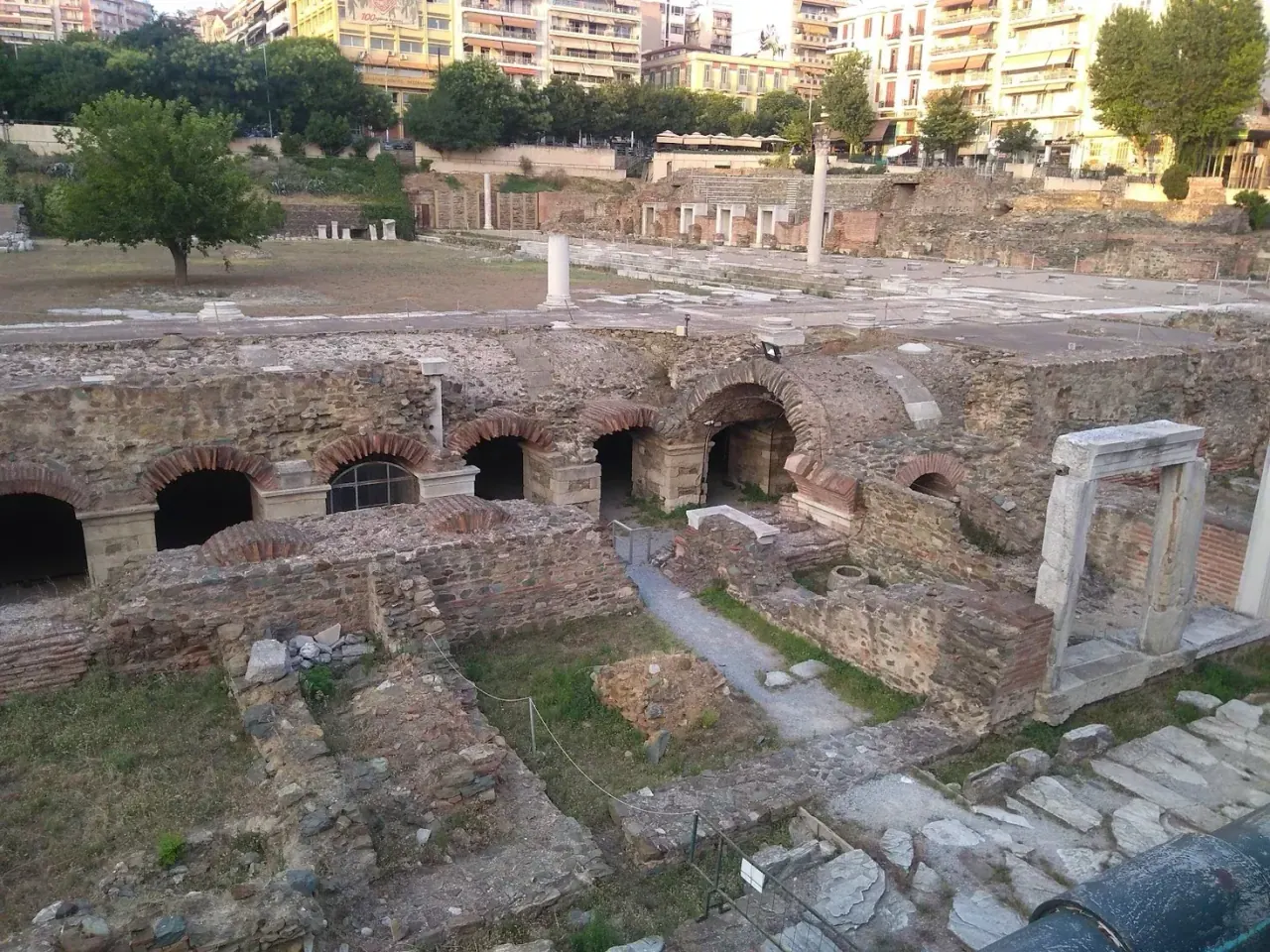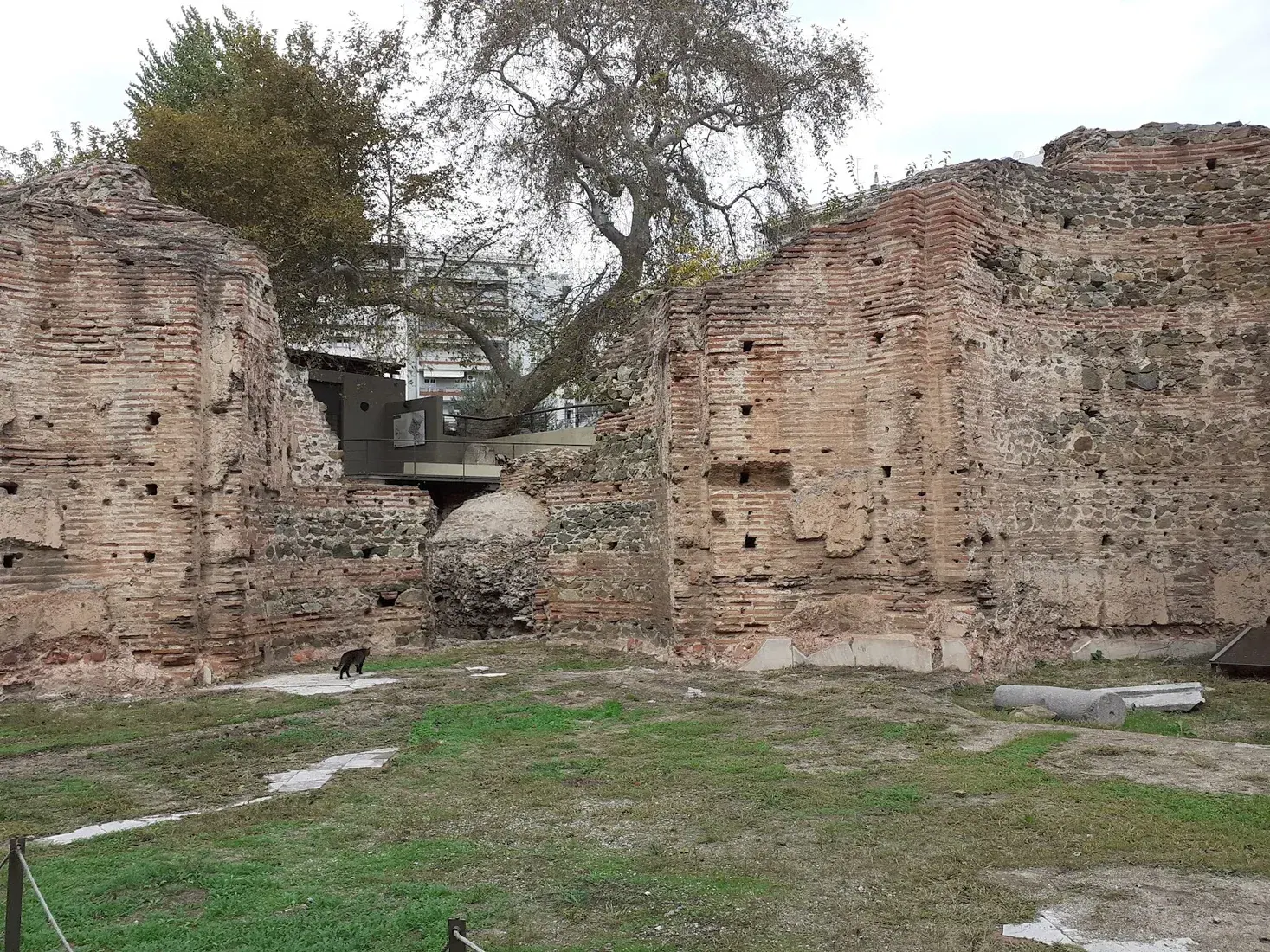
Thessaloniki was once an imperial capital, and this is where its emperor lived. The Palace of Galerius lies open in the middle of Navarinou Square — great brick-banded walls and apses sunk below the modern street, ringed by cafés and students. Most people walk past without realising they're looking at a Roman emperor's residence. Here's the story in the ruins and how to see them, ideally alongside the two monuments Galerius built to go with them — the Palace of Galerius listing has the location on Navarinou Square.
The quick version
There's no ticket for the open ruins in the square — you look down on them from the railings. Come for the history and the surreal contrast of a palace among the café tables.
| Detail | |
|---|---|
| What | The emperor Galerius's palace complex |
| Built | Early 4th century AD (from ~299 onward) |
| Where | Open in Navarinou Square, sunk below street level |
| Entry | Free — the sunken ruins are viewable from the square; the enclosed Octagon site keeps set hours (Tue–Sun, closed Mon) |
| Rating | 4.5★ on Google (~890 reviews) |
| Time needed | About 20 minutes |
| Best time | Evening, with the square in full swing |
It's a two-minute walk from the Arch of Galerius and the Rotunda — the three were built as one grand complex, and seeing them together is the point.
When Thessaloniki was an imperial capital
In 299 AD, fresh from a decisive victory over the Persians, the emperor Galerius — one of the four rulers of the Tetrarchy — chose Thessaloniki as his seat and set about building a capital worthy of it. His palace quarter became the administrative and religious heart of Roman Thessaloniki, and it remains the only Tetrarchic palace complex in Greece. What survives today in Navarinou Square is a slice of that quarter: walls, apses and floors of the imperial residence, in the characteristic late-Roman banding of brick and rubble.
The Octagon
The showpiece was the Octagon — a vast eight-sided hall of about 875 square metres, almost certainly the palace's throne room or formal audience chamber. Seven of its eight sides held semicircular niches, the eighth was the entrance, and the interior blazed with white and coloured marble. Galerius died in 311 AD with it still unfinished; it was later adapted toward a Christian church, one more chapter in a building that never quite became what its emperor intended. The enclosed Octagon site sits just south of the main square ruins and keeps its own hours — open Tuesday to Sunday and closed Mondays, roughly 08:00–20:00 in summer and 08:00–15:00 in winter.
The Galerian complex: palace, arch, rotunda
The palace never stood alone. Galerius laid out a processional axis linking three monuments you can still walk between:
- The Palace (Navarinou Square) — his residence and the seat of government.
- The Arch of Galerius (Kamara) — the triumphal arch on the Via Egnatia, carved with his Persian victories, straddling the road up from the palace.
- The Rotunda — the colossal domed hall at the top of the axis, built as part of the same scheme (probably as a mausoleum or throne hall) and later a church and mosque.
Walking the short line from Navarinou up through the Arch to the Rotunda is the best way to grasp the ambition of Roman Thessaloniki — see that guide for the emperor's full complex, or our Byzantine monuments guide for what came after.
Best time to visit
Come in the evening, when Navarinou Square is at its liveliest — the ruins are floodlit and the surrounding cafés and student bars are in full swing, one of the more atmospheric spots in the centre for a drink beside 1,700-year-old walls. It's an easy add to day one of our 2-day itinerary, and the square is a good place to eat and people-watch; see our where to eat guide.
Frequently Asked Questions
What is the Palace of Galerius?
It's the excavated remains of the palace built by the Roman emperor Galerius in the early 4th century AD, when he made Thessaloniki his imperial capital. The ruins lie open in Navarinou Square in the city centre, and are part of a larger complex — the only Tetrarchic palace complex in Greece — that also included the Arch of Galerius and the Rotunda.
What is the Octagon of Galerius?
The Octagon was the grandest hall of the palace — an eight-sided chamber of about 875 square metres, thought to be the throne room or formal audience hall, faced in white and coloured marble with seven semicircular niches. It was still unfinished when Galerius died in 311 AD and was later adapted toward a Christian church.
Is the Palace of Galerius free to visit?
Yes — the main ruins are an open site in Navarinou Square that you view for free from the railings around the square, day or night. The separate enclosed Octagon archaeological site keeps set hours — open Tuesday to Sunday and closed Mondays (roughly 08:00–20:00 in summer, 08:00–15:00 in winter), with the usual Greek state free-admission days. Allow about 20 minutes, and pair it with the nearby Arch of Galerius and the Rotunda, which were built as part of the same complex.
How do the Arch, Rotunda and Palace connect?
Galerius built all three as a single monumental scheme along a short processional axis: the palace in Navarinou Square as his residence, the Arch of Galerius (Kamara) straddling the Via Egnatia above it, and the Rotunda at the top. You can walk between them in a few minutes, and together they form the core of Roman Thessaloniki.