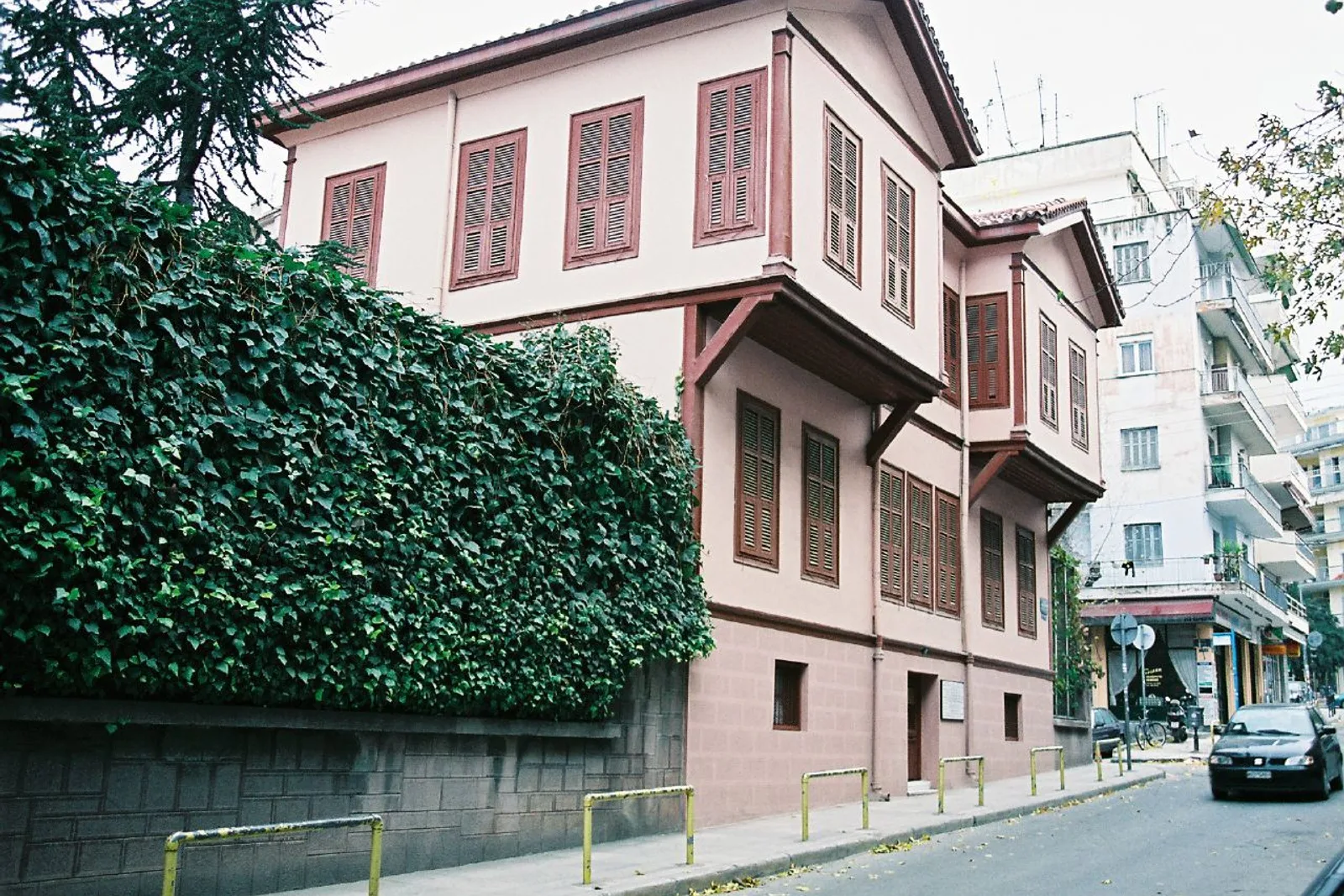
A short walk from the Rotunda, on Apostolou Pavlou street, stands a pink three-storey house behind a walled garden: the birthplace of Mustafa Kemal Atatürk, the founder of modern Turkey. Thessaloniki — then the Ottoman city of Selânik — was where he was born in 1881, and the house is now a museum that draws a steady stream of visitors, many of them making a pilgrimage from Turkey — and if you're travelling the other way, see our Thessaloniki to Istanbul guide. Here's what it is and, crucially, how to get in.
Whose house it is
Mustafa Kemal — later given the name Atatürk, "father of the Turks" — was born in this house in 1881 (the year is recorded but not the exact day), to his father Ali Rıza Efendi and mother Zübeyde Hanım, when Thessaloniki was one of the Ottoman Empire's great port cities. It's a classic late-Ottoman konak: a timber-framed, three-storey merchant's house with shuttered windows and projecting upper floors, painted the distinctive pink that makes it easy to spot. It stands on what was then Ottoman Islahane Street, today Apostolou Pavlou.
A Selânik childhood
The city didn't just witness his birth — it shaped him. Young Mustafa was schooled here: after a traditional primary he moved, at his own wish, to the modern Şemsi Efendi School, then the Salonica civil secondary school, and in 1893 entered the city's Military School — where a mathematics teacher, struck by his ability, gave him the second name "Kemal" ("maturity, perfection"). Only then did his path lead onward, to the Manastır (Bitola) Military High School and the Military Academy in Istanbul. The house museum's evocation of a late-Ottoman family home is really a portrait of the world this childhood belonged to.
Selânik in those years was also the cradle of the Young Turk movement — the stronghold of the Committee of Union and Progress (CUP) whose officers launched the 1908 Young Turk Revolution from Ottoman Macedonia against Sultan Abdülhamid II. Growing up and training in this politically charged port city put the young officer at the very heart of the ferment that would remake the empire, and eventually make him the founder of the Turkish republic.
From family home to museum
In 1935, Thessaloniki's city council gave the house to the Turkish State, which restored it and opened it as a museum — to the public on 10 November 1953, the date deliberately chosen to mark the anniversary of Atatürk's death (he died on 10 November 1938). In the walled courtyard stands a pomegranate tree said to have been planted by Atatürk's father. Inside, the rooms are laid out as a late-19th-century Ottoman-Turkish family home would have been: period furniture, textiles and household objects, alongside family belongings, photographs and displays on Atatürk's life and the Ottoman city he was born into. It's a small, quiet museum — about half an hour is enough — but an evocative window onto both a pivotal historical figure and everyday late-Ottoman Thessaloniki.
Visiting — how to get in
This is the part to plan around: the house sits inside the grounds of the Turkish Consulate, so entry is through consulate security, not a normal museum door.
- Bring photo ID (a passport is safest). Security checks apply, and you may be asked to leave bags.
- Entry is free.
- Hours are generally Tuesday to Sunday, roughly 10:00–17:00 (closed Mondays and public holidays) — but the slots are limited and can change, and because you enter through consulate security it's worth checking with the consulate ahead of a special trip rather than turning up on spec.
- Mornings are the calmest; tour groups can arrive later in the day.
It's an easy add-on to the Roman and Ottoman core of the centre — the Rotunda and Arch of Galerius are minutes away, and the house is one of the landmarks of Ottoman Thessaloniki. See our best museums guide for how it fits with the city's bigger collections, and the landmark page for the map.
Frequently Asked Questions
Where was Atatürk born?
Mustafa Kemal Atatürk, the founder of modern Turkey, was born in 1881 in Thessaloniki — then the Ottoman city of Selânik — in a pink three-storey house on Apostolou Pavlou street, near the Rotunda. The house is preserved as a museum today.
Can you visit Atatürk's House in Thessaloniki?
Yes, but it's inside the Turkish Consulate grounds, so you enter through consulate security rather than a standard museum entrance. Bring photo ID (a passport is best), expect a security check, and ideally confirm the opening hours with the consulate beforehand — it generally opens Tuesday to Sunday, roughly 10:00–17:00, and is closed on Mondays and public holidays. Entry is free.
Is there an entry fee for the Atatürk Museum?
No — admission is free. The house is maintained by the Turkish State as a museum to Atatürk; you only need valid identification to pass the consulate's security and limited daytime opening hours to plan around.
Where did Atatürk go to school in Thessaloniki?
He was schooled in the city as a boy: after a traditional primary he moved to the modern Şemsi Efendi School, then the Salonica civil secondary school, and in 1893 the city's Military School — where a mathematics teacher gave him the name "Kemal". He then went on to the Manastır (Bitola) Military High School and the Military Academy in Istanbul.
Why is Thessaloniki important to Atatürk's story?
Beyond being his birthplace, Ottoman Salonica was the cradle of the Young Turk movement — the base of the Committee of Union and Progress, whose officers launched the 1908 Young Turk Revolution from Macedonia. Growing up and training there placed the young Mustafa Kemal at the centre of the political ferment that would eventually lead him to found modern Turkey.
When did Atatürk's House become a museum?
Thessaloniki's city council gave the house to the Turkish State in 1935, and it opened to the public as a museum on 10 November 1953 — the date chosen to mark the anniversary of Atatürk's death in 1938. It preserves the rooms as a late-19th-century Ottoman family home, with furnishings and belongings connected to Atatürk's early life, and a pomegranate tree said to have been planted by his father stands in the courtyard.