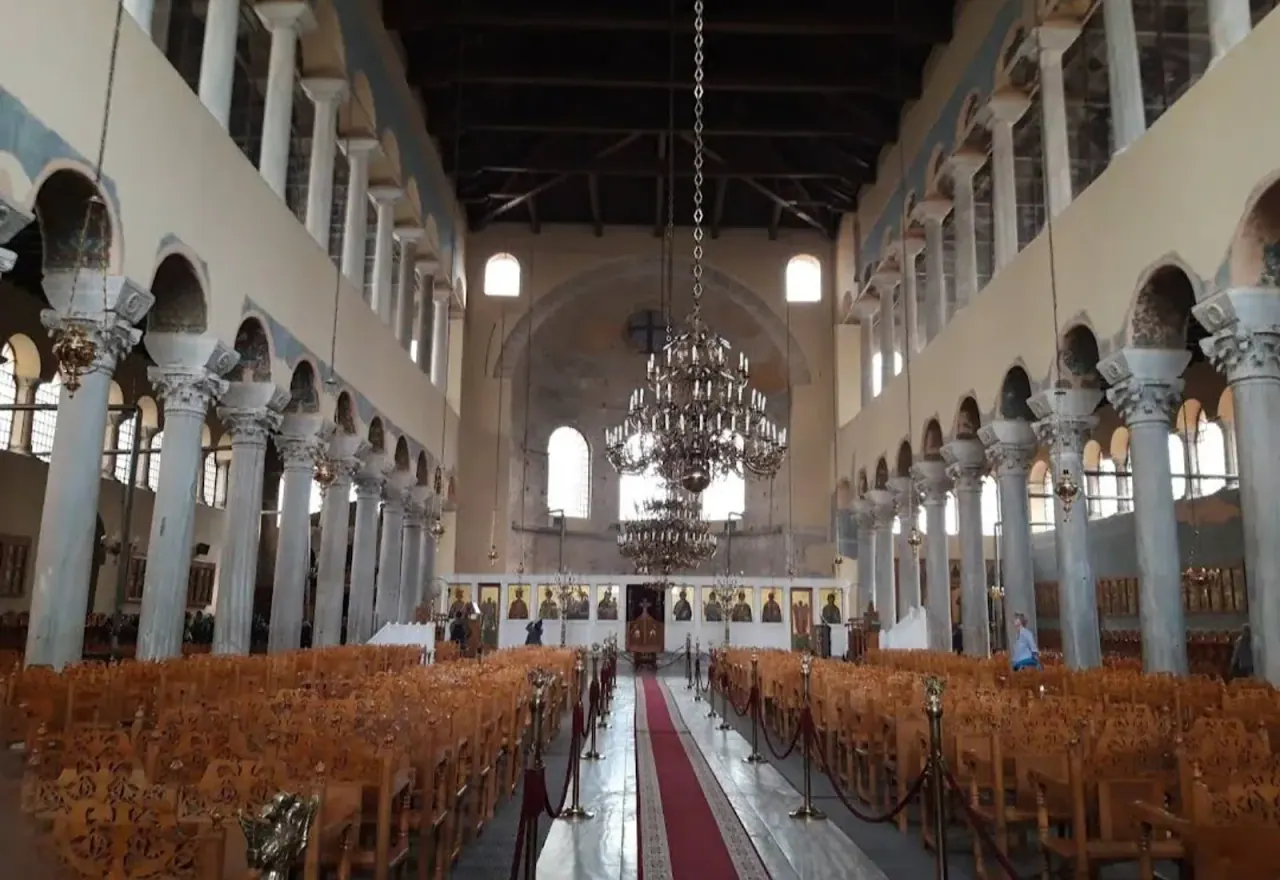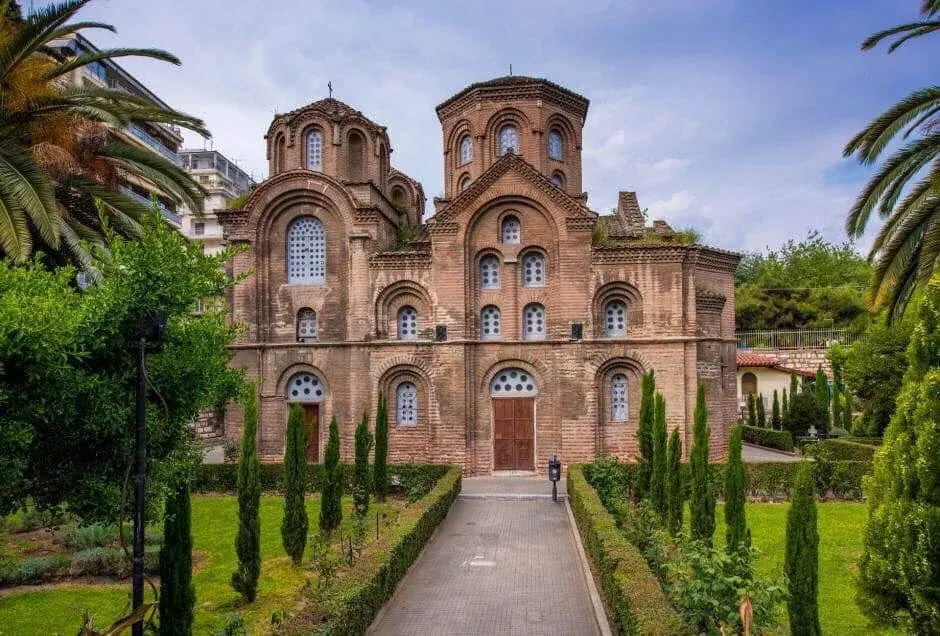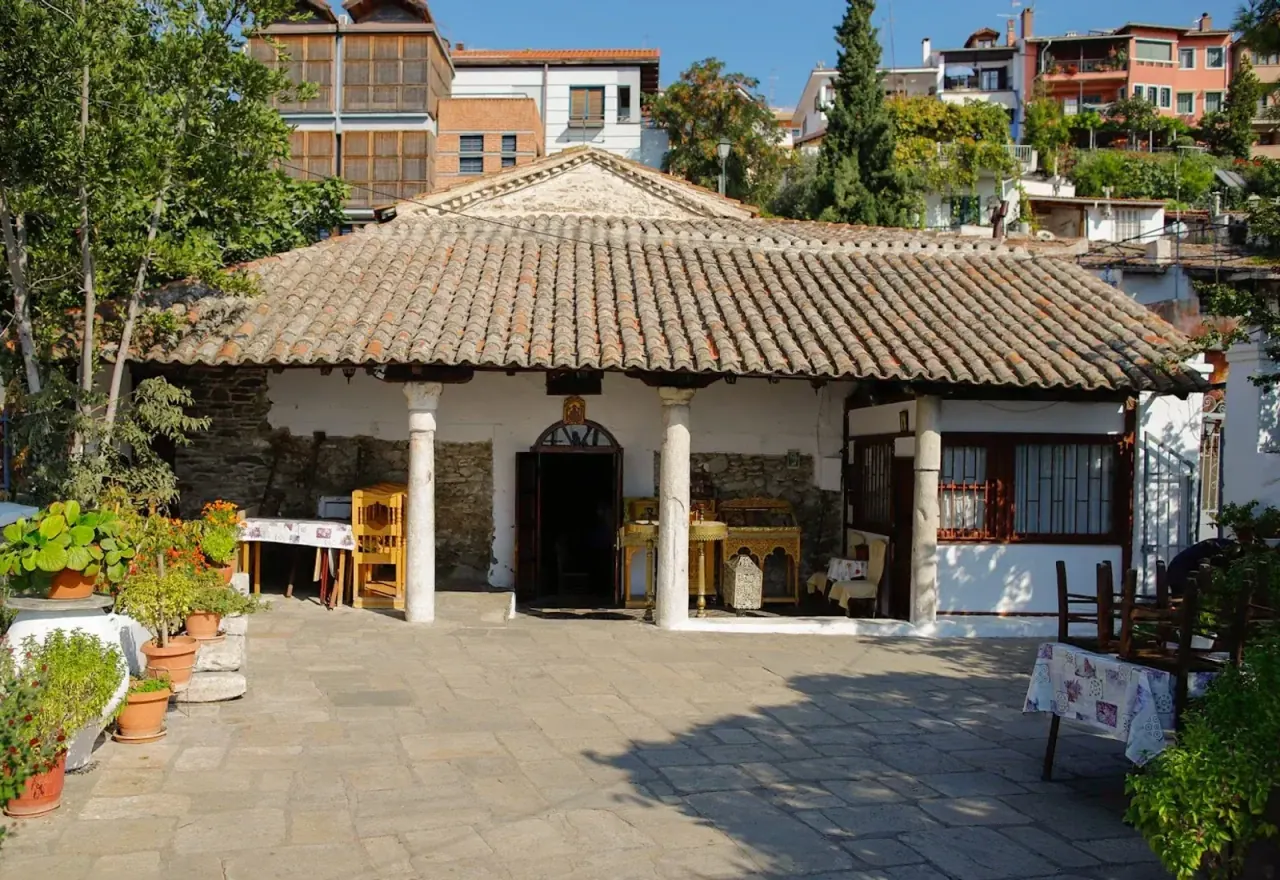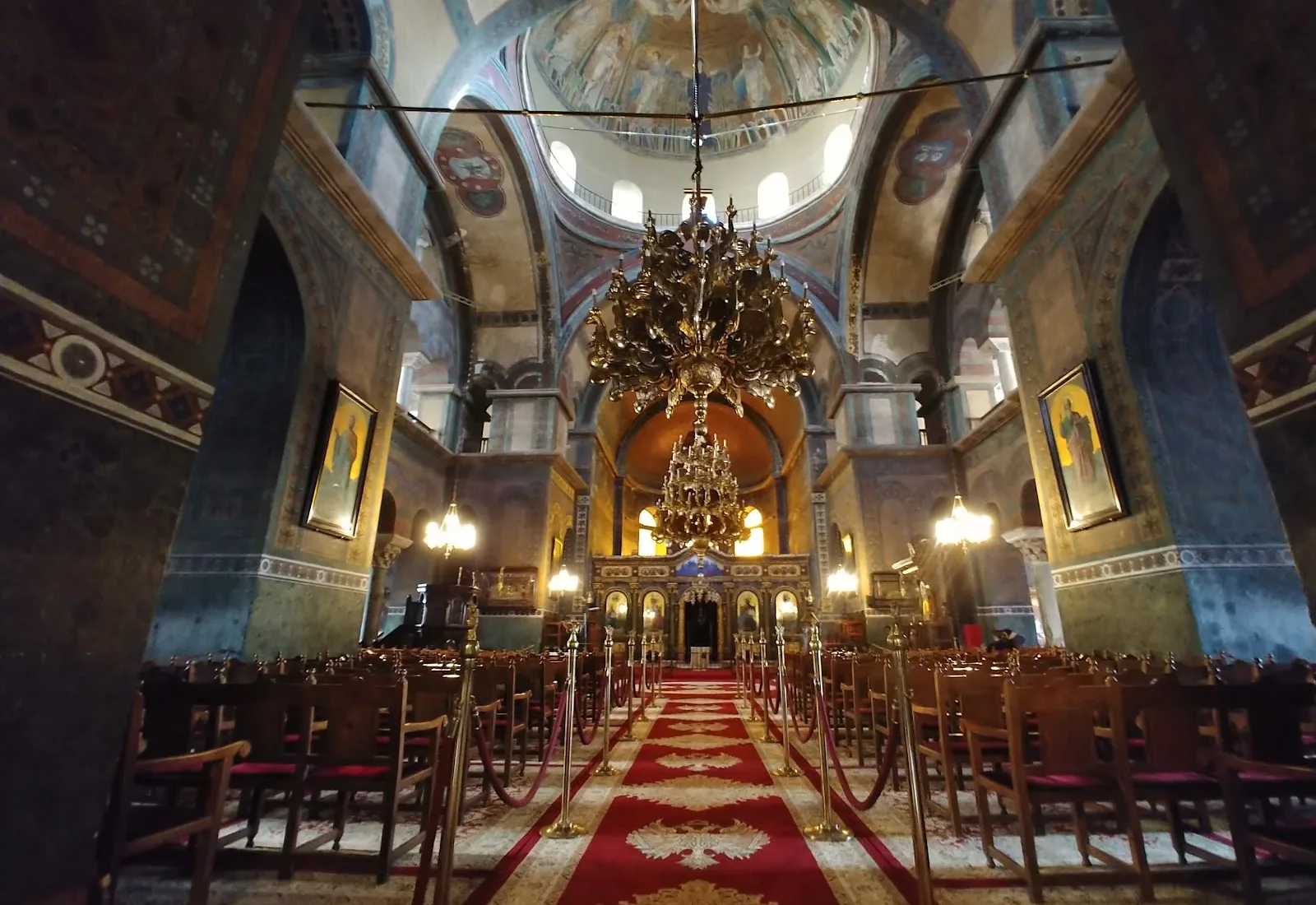
Not to be confused with its famous namesake in Istanbul, the Hagia Sophia of Thessaloniki is a masterpiece in its own right — a squat, powerful 8th-century domed church that was the city's cathedral for much of the Byzantine era, and one of Thessaloniki's UNESCO-listed monuments. Its great draw is overhead: a luminous mosaic of the Ascension filling the dome. Here's what to see and how to visit.
What it is
Built in the 8th century and dedicated, like its Constantinople model, to the Holy Wisdom (Hagia Sophia) of God, this is a transitional building — it sits between the early-Christian basilica and the fully developed cross-in-square church, wrapping a domed core in the walls of a basilica. That makes it architecturally important as well as beautiful: you can read the whole shift of Byzantine church design in one squat, massive shell of brick and stone. It served as the cathedral of Thessaloniki through much of the Byzantine period, second in the city only to the shrine of Agios Dimitrios.
The mosaics
The reason to look up is the dome mosaic of the Ascension, a 9th-century composition showing Christ carried to heaven in a golden mandorla by two angels, ringed below by the Virgin, two angels and all twelve apostles. A band of inscription runs the base of the dome — the words the angels speak in Acts, "Ye men of Galilee, why stand ye gazing up into heaven?" It is one of the great surviving works of Byzantine monumental mosaic.
The apse tells a subtler story. It was first decorated during the Iconoclasm — the 8th–9th-century Byzantine ban on religious images — when figural art was forbidden, so it carried only a plain jewelled cross. After the icon-venerators won out, the cross was overlaid with the enthroned Virgin and Child you see today; look closely and the ghost of the earlier cross is still faintly visible beneath and beside her. Few buildings anywhere let you see the argument of Iconoclasm written so plainly on a single wall.
From cathedral to mosque and back
Hagia Sophia has changed faith with the city. After the Ottoman conquest it was converted into a mosque in 1523: a porch was added to the front, the bell-tower replaced by a minaret, and the interior whitewashed. In 1890 a great fire — one of several that swept Ottoman Thessaloniki — gutted the building and damaged its mosaics; it was patched up and restored between 1907 and 1910. When the city was freed from Ottoman rule in 1912, Hagia Sophia was returned to Christian worship, and it has served as an Orthodox church ever since. Those layers — cathedral, mosque, cathedral again — are the same story the whole city tells, from its Roman beginnings through its Byzantine height to its Ottoman centuries.
Visiting
Hagia Sophia sits in its own garden square in the centre, an easy few minutes from Aristotelous and the seafront. It's a working church and free to enter, open through the day but, like many Greek churches, it often closes for a few hours in the early afternoon — so aim for the morning or the later afternoon to be sure of getting in. As everywhere, dress modestly and be quiet inside, especially during services. Pair it with the nearby Rotunda, the 5th-century Acheiropoietos basilica a few streets away, and the other Byzantine churches for a walk through the city's early-Christian heritage; it's one of the quiet pleasures on our free things to do list, and the landmark page has the practical details.
Frequently Asked Questions
What is the Hagia Sophia of Thessaloniki?
It's an 8th-century Byzantine domed church, once the cathedral of Thessaloniki, dedicated to Holy Wisdom and modelled on the Hagia Sophia of Constantinople. Now one of the city's UNESCO-listed monuments, it's famous for the 9th-century mosaic of the Ascension in its dome and the enthroned Virgin and Child in the apse.
Why is there a cross under the apse mosaic?
Because the apse was first decorated during Byzantine Iconoclasm, when religious figures were banned and only a plain jewelled cross was allowed. After the ban ended, the enthroned Virgin and Child was set over the cross — and traces of that earlier cross are still visible around her, a rare surviving record of the Iconoclast controversy.
Was Hagia Sophia in Thessaloniki a mosque?
Yes. After the Ottoman conquest it was converted into a mosque in 1523, gaining a minaret and a front porch. A fire in 1890 badly damaged it, and it was restored in 1907–1910. When Thessaloniki was freed from Ottoman rule in 1912 it became an Orthodox church again, which it remains today.
Is the Hagia Sophia of Thessaloniki free to visit?
Yes. It's a working Orthodox church with free entry. Dress modestly and be discreet inside, particularly during services. It sits in a central garden square, easy to combine with the Rotunda and the city's other Byzantine churches.
Is this the same as the Hagia Sophia in Istanbul?
No — they share a name and a dedication (to Holy Wisdom), but this is the Thessaloniki church, a smaller 8th-century building modelled on the great Constantinople original. It's a distinct monument and well worth seeing for its Byzantine mosaics.