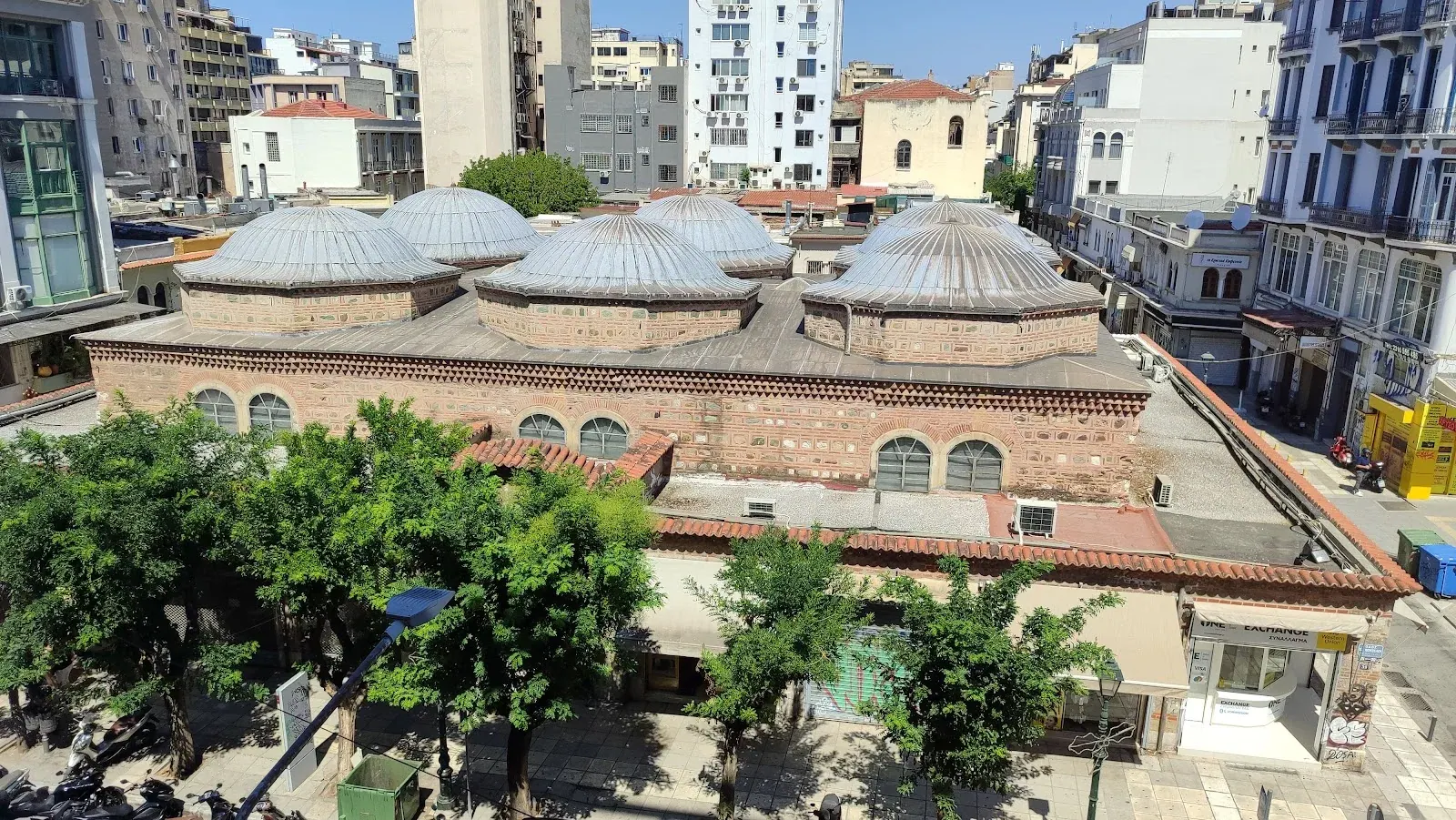
Look up in the shopping streets between Egnatia and the markets and you'll spot six grey lead domes riding above the rooftops — the Bezesteni, a 15th-century Ottoman market hall that has been trading for more than five hundred years and has never once stopped. Most people hurry through it without realising what it is. Here's the story under those domes and how to see it.
What it is
The Bezesteni is a bedesten — a distinctive Ottoman building type: a strong, lockable, fireproof hall where merchants traded and safely stored their most valuable goods, above all fine cloth (the word comes from the Arabic bez, "fabric"), along with jewellery and precious wares. It was the secure commercial heart of Ottoman Thessaloniki, the equivalent of a strongroom-cum-covered-market. It was built in the 15th century — traditionally attributed to Sultan Mehmed II (around 1455–1459), though some scholars date it a little later under Bayezid II.
Architecturally it's a compact, fortress-like box: a rectangular stone hall of roughly 30 by 20 metres, crowned by six lead-covered domes resting on robust piers and arches, and divided inside into six bays. Everything about it was built for security — thick stone walls, very few windows, and a lockable entrance on each of its four sides that guards closed at night, turning the whole building into a communal strongroom for the bazaar.
Five centuries, one purpose
What makes the Bezesteni remarkable isn't just its age but its continuity: it is the only Ottoman monument in Thessaloniki still used for its original purpose, and one of very few markets anywhere in the world that has kept its function for over 500 years. Before the great fire of 1917 that levelled much of the centre, it housed some 113 shops; it came through almost intact, and afterwards a ring of exterior shops was added around its outer walls, which is why the trading now spills out around the building as well as under the domes. Today the little shops still sell exactly what the building was made for — textiles, trimmings, buttons, thread and jewellery. Walking its narrow lanes is a rare, unbroken thread back to the Ottoman city.
By the late 20th century the old hall had begun to lean and subside, and careful restoration in the 1980s and 1990s stabilised it; it's now a protected historical monument, still doing the job it was built for.
How to visit
- Where: at Venizelou and Egnatia, in the commercial centre a block from Aristotelous Square and the Modiano and Kapani markets.
- Cost: free — it's a working market you walk straight into.
- When: normal shop hours (weekday mornings and afternoons, quieter on Sundays); come for the architecture as much as the shopping.
It's a natural stop on any tour of Ottoman Thessaloniki — pair it with the nearby Bey Hamam baths and the markets for a compact loop through the city's surviving Ottoman core, and it's one of the more unexpected free things to do in the centre. For what to actually buy under its domes, see our what to buy in Thessaloniki guide.
Frequently Asked Questions
What is the Bezesteni in Thessaloniki?
The Bezesteni is a 15th-century Ottoman covered market — a bedesten, the secure, lockable hall where merchants traded and stored their most valuable goods, especially fine textiles and jewellery. Roofed with six lead domes and still trading today, it's one of the few working Ottoman commercial buildings left in the city, in the commercial centre by the Modiano and Kapani markets.
What does "bedesten" mean?
A bedesten (from the Arabic bez, meaning fabric) is a type of Ottoman market building: a solid, fireproof, lockable hall at the heart of a city's bazaar, used for trading and safely storing high-value goods such as cloth, jewellery and precious wares. Thessaloniki's Bezesteni was exactly this — the strongroom of the Ottoman market quarter.
How old is the Bezesteni, and who built it?
It dates to the 15th century and is traditionally attributed to Sultan Mehmed II (around 1455–1459), though some scholars place its construction a little later, under Bayezid II. Either way it has stood, and traded, for more than 500 years — one of very few markets in the world still used for its original purpose.
Can you visit the Bezesteni, and what's sold there?
Yes — it's a free, working market you can walk straight into during normal shop hours. Under its six domes, the little shops still sell mostly what the building was made for: textiles, trimmings, buttons, thread and jewellery. Go as much for the architecture and the atmosphere as for the shopping.
What does the Bezesteni look like?
It's a compact, fortress-like rectangular stone hall of about 30 by 20 metres, roofed with six lead-covered domes on heavy piers and arches and divided into six bays inside. Built for security, it has thick walls, very few windows and a lockable door on each of its four sides — originally a communal strongroom for the bazaar. It housed around 113 shops before the 1917 fire, with more added around its outer walls afterwards, and was restored in the 1980s–90s after subsidence.