Ano Poli — the Upper Town — is the Thessaloniki that the rest of the city lost. When the great fire of 1917 levelled the centre below, this hillside quarter inside the Byzantine walls survived, and it's still a maze of timber Ottoman houses, tiny chapels and cobbled lanes that dead-end at a view. Most visitors climb it once and wish they'd allowed longer. Here's how to walk it properly — the route, the stops worth your time, and where to eat with the gulf at your feet.
The walk at a glance
We'd do this as a half-day on foot: bus or taxi up to the top, then wander downhill through the lanes so the climbing is done for you. The core stops, roughly top to bottom:
| Stop | What it is | Entry |
|---|---|---|
| Heptapyrgion | Acropolis fortress & former prison | Free grounds (~€3 interior) |
| Byzantine walls | Ramparts with the city below | Free |
| Trigonion Tower | The classic sunset viewpoint | Free |
| Vlatadon Monastery | Working 14th-c. Byzantine monastery | Free |
| Agios Nikolaos Orfanos | Frescoed Byzantine church (UNESCO) | Free |
Almost everything up here is free — the cost is in your knees, not your wallet. Allow half a day to do it without rushing.
What is Ano Poli?
Ano Poli is the old upper quarter climbing the slope above the modern grid, wrapped by the surviving city walls. Because it escaped the 1917 fire, it kept its pre-fire character: narrow streets, wooden balconied houses, vine-shaded courtyards and a scatter of small Byzantine churches, all far quieter and more village-like than the centre below. It's the city's most atmospheric district — and, from the walls at its top, the source of its best views. Getting lost here is the point; the lanes are the attraction as much as the monuments.
The walls and the Heptapyrgion
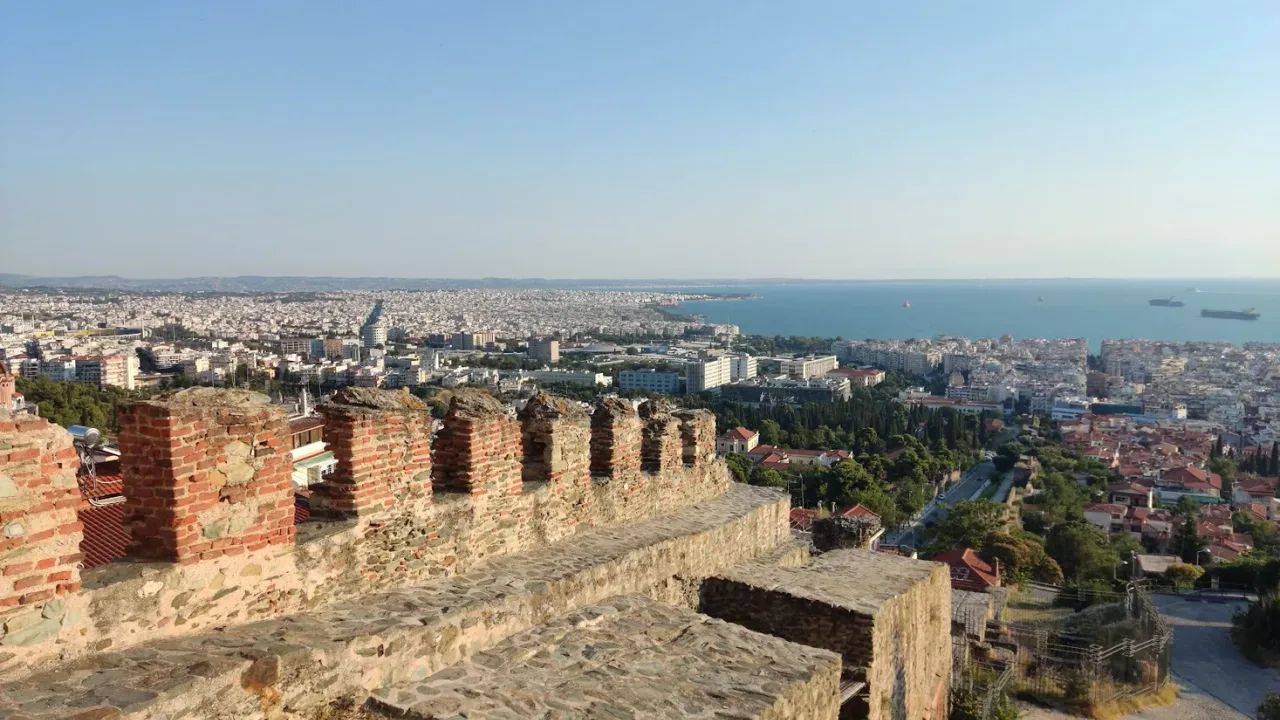
Start at the top, at the Heptapyrgion (also Eptapyrgio or Yedi Kule, all meaning "seven towers") — the walled citadel crowning the acropolis. It guarded the city's highest ground for centuries and then spent from the 1890s until 1989 as Thessaloniki's most feared prison, a chapter remembered in rebetiko songs. The grounds are free; a small fee (~€3) gets you into the interior exhibition, open Tue–Sun 08:30–15:30. From here the Byzantine walls run downhill — late-Roman and Byzantine fortifications you can walk beside past towers and gates, with the whole city, the gulf and Mount Olympus laid out below.
The Trigonion Tower viewpoint
Follow the ramparts to the Trigonion Tower at the northeastern corner — a bulky late-15th-century artillery tower also known as the Chain Tower (Zincirli Kule). The tower is closed, but the terrace beside it is the single most photographed view in Thessaloniki: rooftops tumbling down to the Thermaic Gulf, the White Tower a speck on the shore, Olympus across the water on a clear day. It's free and always open, and it's the city's prime sunset spot — see our best sunset spots guide for timing. Cafés and benches sit right there for the wait.
The Byzantine churches
Ano Poli hides several of the city's UNESCO gems among its lanes:
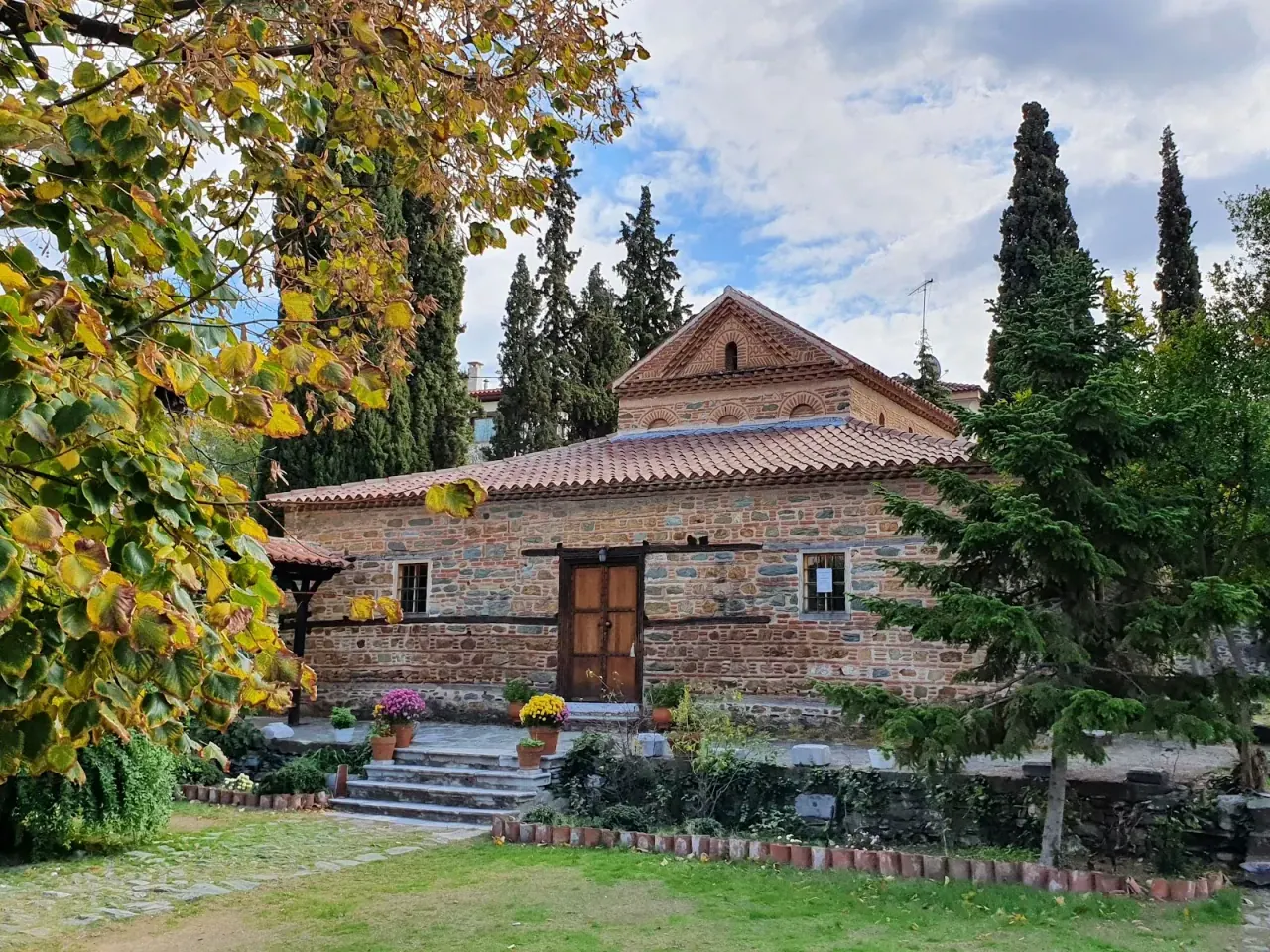
- Vlatadon Monastery — a working 14th-century Byzantine monastery high near the acropolis, with a peaceful walled garden and gulf views. Free; quieter outside service times.
- Agios Nikolaos Orfanos — a small early-14th-century church holding some of the best-preserved Byzantine frescoes in Thessaloniki, part of the city's UNESCO listing. Free, but with limited (usually morning) hours, so go early.
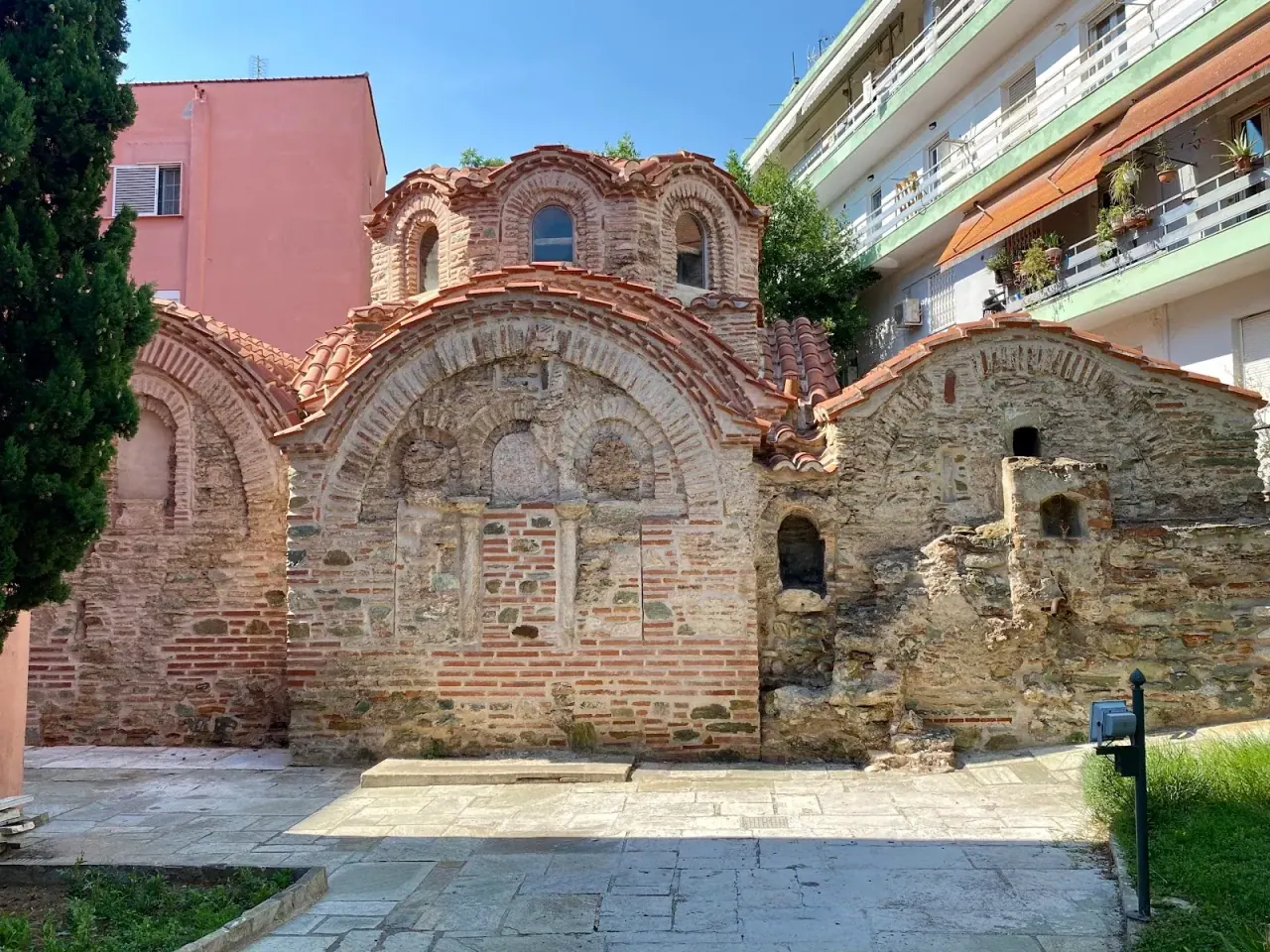
- Byzantine Bath — right beside Agios Nikolaos Orfanos, the only surviving Byzantine bath in Thessaloniki, in use for some seven centuries until 1940. Free or a token fee, on limited hours; unique and quick to see.
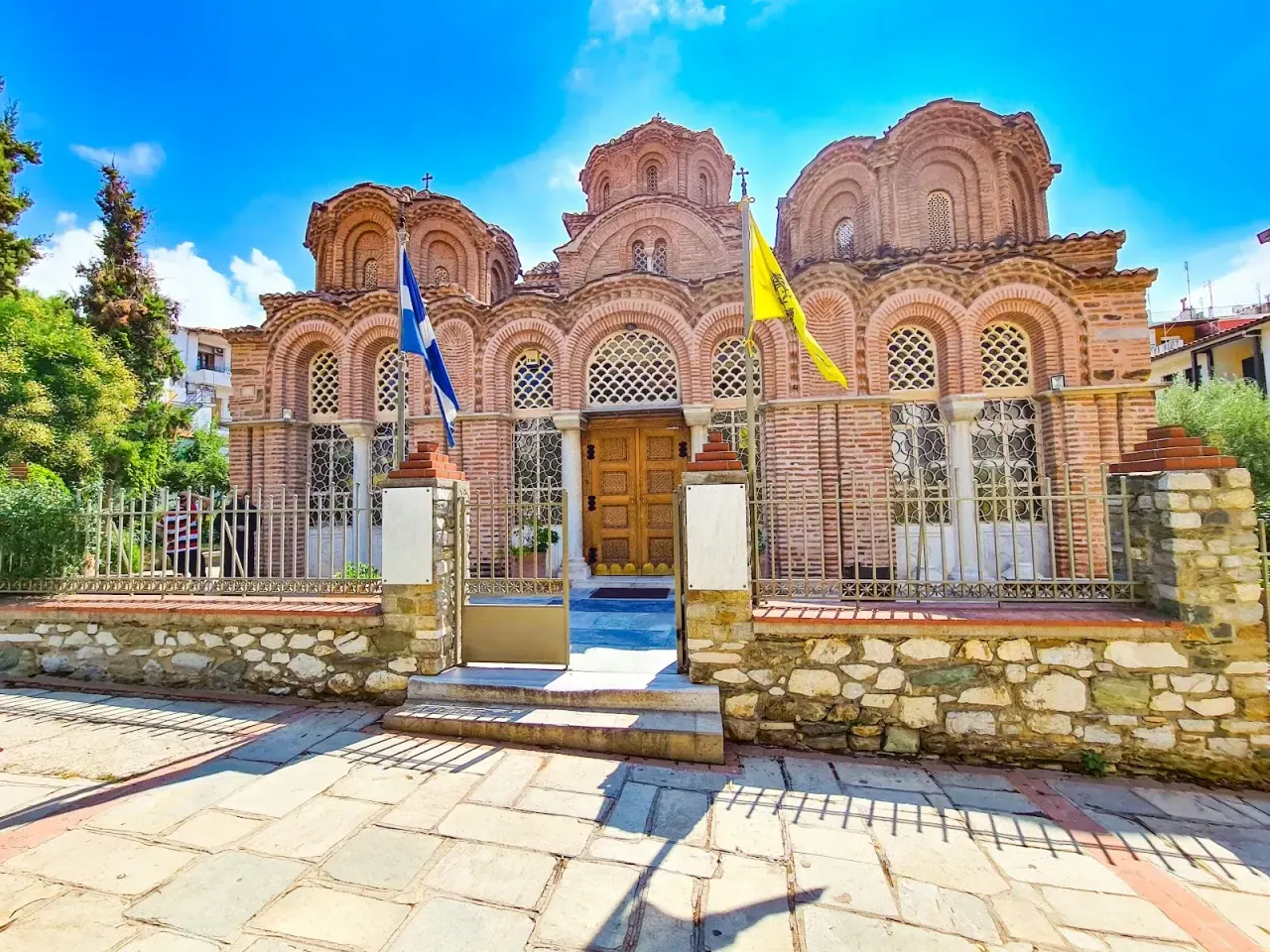
- Agia Aikaterini — up in the northwestern lanes, a graceful five-domed Palaiologan church wrapped in fine brickwork and an arcaded gallery. Free, mostly morning hours, and rarely busy.
- Profitis Ilias — on the slope just below the upper town, the city's only church built on the Mount-Athos "Athonite" plan, with a tall dome and a sweeping arcaded portico. Free.
For the full set of churches, see our Byzantine monuments guide; several of the quarter's quietest corners feature in our hidden gems guide too. Between them, simply follow the lanes downhill — the timber houses, hidden chapels and tavernas are the connective tissue of the walk.
Where to eat up here
The tavernas in Ano Poli are simpler, cheaper and more local than those in the centre, and worth timing the walk around:
- Tsinari — the city's oldest ouzeri (4.5★), in a pastel late-Ottoman house at the old Tsinari fountain; meze and ouzo at gingham tables on the cobbles, as atmospheric as the upper town gets.
- Nea Folia — a well-regarded taverna (4.5★) for a proper sit-down Greek lunch in the upper town.
- Taverna Konaki — a cosy traditional taverna (4.5★) up by the acropolis walls, its room lined with sepia photographs of old Thessaloniki; honest home-style cooking, fried small fish and meze away from the centre.
- Bougatsa Bantis — the legendary hand-stretched-filo bougatsa shop on Panagias Faneromenis, ideal for breakfast before the climb; see our best bougatsa ranking.
A long lunch with a gulf view, then an amble down through the lanes, is the ideal shape for the afternoon — before heading down to Ladadika for dinner and drinks after dark.
How to get up and down
The lanes are steep and uneven, so the smart move is to ride up and walk down. Take a city bus toward the upper town or a short taxi to near the Heptapyrgion or Trigonion Tower, then wander downhill back into the centre — gravity does the work and you finish near the Rotunda and the markets. Wear comfortable shoes; the cobbles are slippery in the wet. For where Ano Poli fits among the city's districts, see our neighborhoods guide.
Frequently Asked Questions
What is Ano Poli in Thessaloniki?
Ano Poli, or the Upper Town, is the historic hillside quarter above the modern centre, inside the Byzantine walls. It's the largest part of old Thessaloniki to escape the 1917 fire, so it keeps its Ottoman-era timber houses, cobbled lanes and small Byzantine churches — and it has the best views in the city.
How do you get to Ano Poli?
It's a 15–25 minute uphill walk from the centre, but the lanes are steep, so many visitors take a city bus toward the upper town or a short taxi up, then wander downhill. Ride up to the Heptapyrgion or Trigonion Tower and walk back down into the centre to avoid the climb.
What is there to see in Ano Poli?
The city walls and Trigonion Tower viewpoint, the Heptapyrgion fortress (a former prison), the working Vlatadon Monastery, and the frescoed church of Agios Nikolaos Orfanos — plus the atmospheric Ottoman lanes themselves. Most sights are free. Allow about half a day to wander it without rushing.
Is Ano Poli worth visiting?
Yes — it's the most atmospheric part of Thessaloniki and home to its best panoramas. The mix of surviving Ottoman houses, hidden Byzantine churches, the walls and the sunset views from the Trigonion Tower make it the one neighbourhood most visitors single out, especially in the late afternoon.