
About Thessaloniki
The city, its 2,300-year history, the Byzantine monuments, and the seafront culture that make Greece's second city unlike anywhere else.
What Thessaloniki Is
Thessaloniki (Greek: Θεσσαλονίκη; also written Salonica or Thessalonica) is Greece's second-largest city and the capital of the region of Central Macedonia, in Greek Macedonia. The city sits at the head of the Thermaic Gulf, on the northern Aegean, with Mount Olympus visible across the water on clear days. It is the country's principal port and cultural centre of the north.
Two things set Thessaloniki apart. The first is its depth of history: founded in 315 BC, it was a great Roman provincial capital and then one of the most important cities of the Byzantine Empire, and that legacy survives in the form of UNESCO-listed Paleochristian and Byzantine Monuments scattered through the modern centre. The second is its living, contemporary culture — a university city famous across Greece for its food, its nightlife, and the long seafront promenade where the whole city walks at dusk.
Quick reference
Geography
Thessaloniki is built around the head of the Thermaic Gulf, an inlet of the northern Aegean Sea, where a broad coastal plain rises gently to the low hills of the Upper Town. The historic centre runs along the curve of the bay, with the modern city climbing the slopes behind it toward the surviving Byzantine and Ottoman walls.
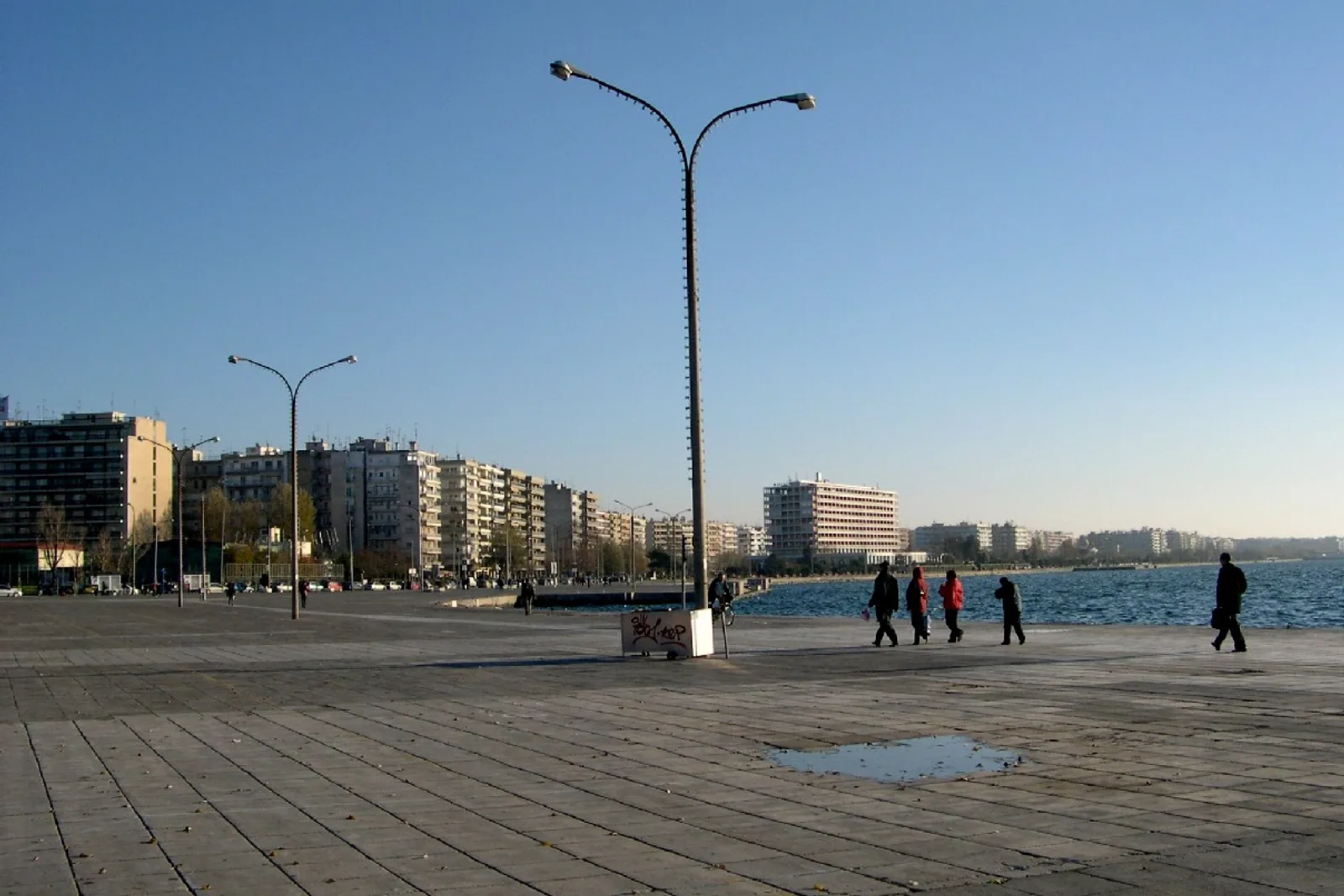
The defining feature of the city is its seafront — a waterfront promenade several kilometres long that links the harbour at one end to the marina and the new sculpted gardens at the other, passing the landmark White Tower roughly at its midpoint. Across the gulf to the southwest, Mount Olympus is visible on clear days, a constant backdrop to the city's skyline.
The surrounding region of Central Macedonia opens onto some of northern Greece's best-known landscapes — the three peninsulas of Halkidiki to the south, the wetlands and wine country inland, and the mountains beyond. For ideas on getting out of the city, see our day trips guide. To find your way around the centre itself, our landmarks guide maps out the key monuments.
People, Language, and Culture
Thessaloniki is a major metropolitan centre — the largest city in northern Greece and second only to Athens nationally. It is, above all, a university city: the Aristotle University of Thessaloniki is the largest in the country, and the student population gives the centre much of its energy, its late-night rhythm, and its reputation for good, affordable food.
The everyday language is Greek, but English is widely spoken, especially in hospitality and among younger residents — visitors get by comfortably with English alone. The city has a deep multicultural past, having been home over the centuries to Greek, Roman, Byzantine, Sephardic Jewish, and Ottoman communities, and that layered heritage is still legible in its churches, monuments, and neighbourhoods.
What you feel most as a visitor, though, is the contemporary culture: a city built around eating, talking, and walking. The density of tavernas, mezedopoleia, and cafés is famous throughout Greece, and meals stretch long into the evening. For the food side of the city, see our restaurants guide and our nightlife guide.
A 2,300-Year Timeline, Briefly
Thessaloniki has been continuously inhabited since its founding in 315 BC. The city was established by the Macedonian king Cassander, who named it after his wife Thessalonike, a half-sister of Alexander the Great. Read the full story in our name-origin guide.
King Cassander founds the city by merging several smaller settlements at the head of the Thermaic Gulf, naming it after his wife Thessalonike.
Becomes a major city of Roman Macedonia, growing into a key stop on the Via Egnatia, the great east–west road across the empire.
The emperor Galerius builds his palace complex, the Rotunda, and the triumphal Arch here — monuments that still stand in the centre today.
Becomes the second city of the Byzantine Empire after Constantinople, building the great churches whose mosaics and architecture survive today.
Ottoman period. The city becomes a major Ottoman port and home to a large Sephardic Jewish community, earning it the nickname “Mother of Israel.”
Thessaloniki becomes part of the modern Greek state during the Balkan Wars.
The great fire destroys much of the historic centre. The city is rebuilt on a grand modern plan, giving it the wide avenues and open squares of the centre today.
Thessaloniki's Paleochristian and Byzantine Monuments are inscribed as a UNESCO World Heritage Site.
To see these monuments for yourself, our landmarks guide covers the White Tower, the Rotunda, the Roman Forum, and the major Byzantine churches, while our activities guide suggests ways to experience the city beyond the monuments.
Climate
Thessaloniki has a Mediterranean climate with continental influences from the plains of Macedonia behind it. Summers are hot and dry; winters are cool and relatively wet, with occasional cold spells pushing down from the north. Spring and autumn are mild and make excellent times to walk the city.
For practical season-by-season planning, see our practical info guide and our getting here guide.
Why Thessaloniki Is Different from Athens
Travelers often ask: why choose Thessaloniki over Athens, or over the islands? Each has its own draw. Thessaloniki's specific strengths — distilled from years of comparison — are these:
- Layered Byzantine and Roman heritage. The UNESCO-listed Paleochristian and Byzantine Monuments sit woven into the everyday city, not behind ticket gates on a single hill.
- A walkable seafront city. The waterfront promenade is the social heart of the city — flat, long, and made for evening strolls, with the White Tower at its centre.
- The food capital of Greece. Thessaloniki is widely regarded as the country's best eating city, from the Modiano and Kapani markets to its tavernas and bougatsa shops. See our best restaurants guide.
- A genuine university energy. The huge student population keeps the nightlife and café culture alive year-round, not just in the tourist season.
- A base for northern Greece. The city is the natural hub for exploring Halkidiki, the wine country, and the wider region — see our day trips guide.
To start planning the visit itself, browse our guides to where to stay, things to do, and practical info.
Thessaloniki Today
In 2026, Thessaloniki is one of the most rewarding city breaks in Greece. It is reachable by direct flights into Thessaloniki Airport (SKG) from across Europe, by a fast train connection from Athens, and by road via the Egnatia motorway. The compact centre means most of the major sights, the markets, and the seafront are walkable from one another.
The city's economy is anchored by its port, its universities, trade fairs, and a growing tourism and tech sector. After the great rebuilding that followed the 1917 fire, the modern centre balances grand boulevards and squares with the surviving Byzantine churches and the narrow lanes of the Upper Town, where the old walls and Ottoman houses still stand.
For practical visiting, our practical info guide covers the essentials, our activities guide gives you a starting plan, and getting here covers transport in detail.
External References
For research, citations, or further reading, the canonical references for Thessaloniki as an entity are:
- Thessaloniki on Wikipedia — historical overview, demographics, administrative status
- Thessaloniki on Wikidata (Q17151) — the city entity
- Thessaloniki on Google Maps — coordinates and street view
- Paleochristian and Byzantine Monuments on UNESCO
Plan Your Visit
The complete travel guide to Thessaloniki — landmarks, restaurants, hotels, transport, and everything else you need.