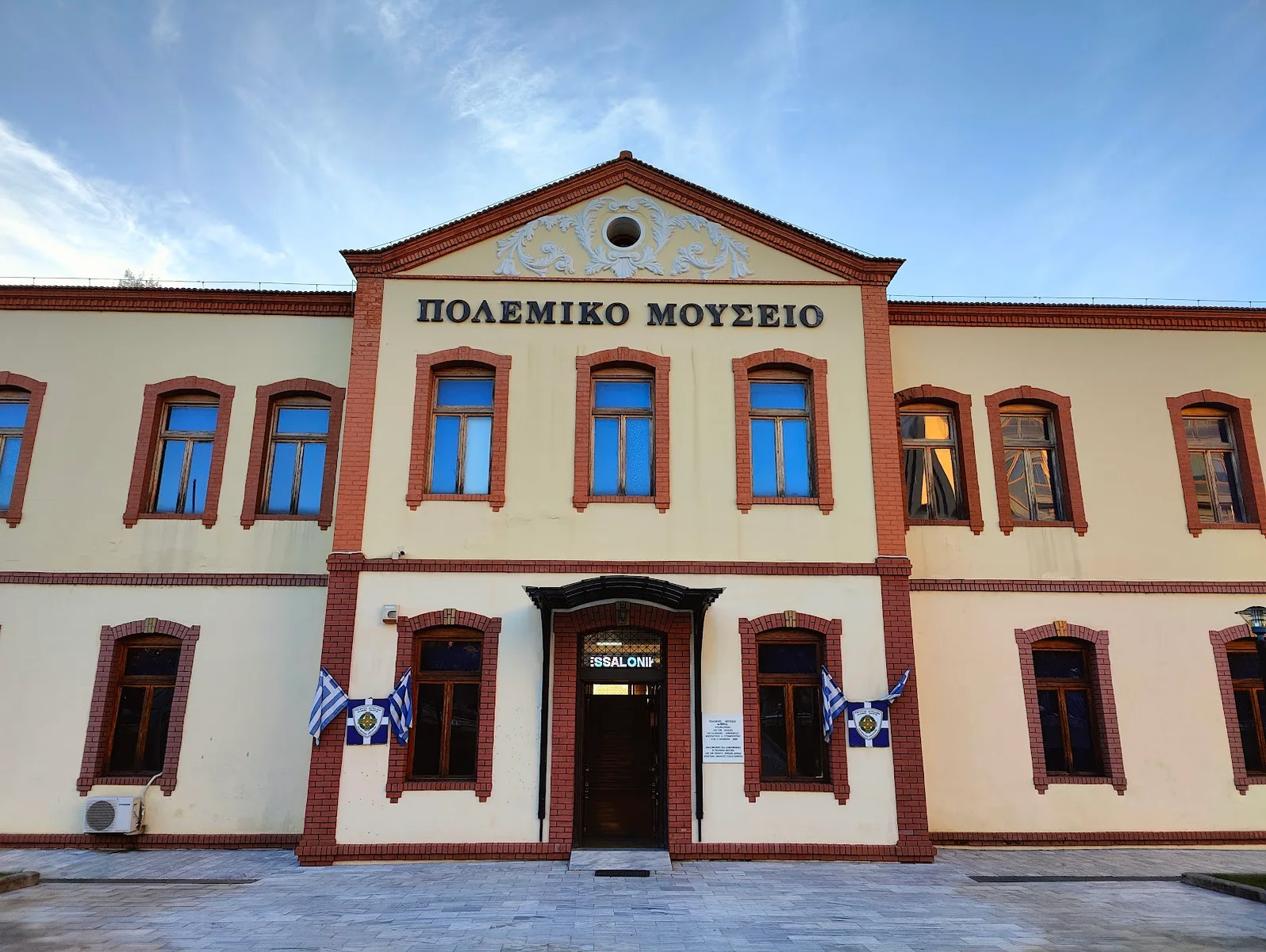
Thessaloniki's history is soldier's history. This was the city the Balkan Wars won for Greece in 1912, and the great Allied base of the First World War's Macedonian (Salonika) Front. The War Museum of Thessaloniki tells that story — cheaply (a €4 ticket, and free for under-18s), with a forecourt of tanks and a fighter jet that makes it an easy win with kids. Here's what it is and how to see it; the War Museum listing has the location near the New Waterfront.
What it is
The War Museum is the northern branch of the Athens War Museum, opened around 2000 in a restored early-20th-century army building among the old military quarters near the seafront. It's a compact, well-kept museum that leans hard into the region's own history rather than trying to cover everything — which is exactly what makes it worth an hour.
What to see
Inside, the galleries run through Greece's modern wars in uniforms (from the kilted evzones to the World Wars), cases of historic firearms and artillery, war paintings, and — the local heart of the collection — maps and photographs of the Macedonian Front, when Thessaloniki was the rear base for a vast multinational Allied army from 1915 to 1918.
Outside, the forecourt is an open-air park of armoured vehicles, field guns and an F-5 fighter jet — free to walk around, and the part younger visitors make straight for.
Why the Macedonian Front matters here
Most visitors don't realise how central Thessaloniki was to the First World War. From 1915 the city became the base of the Allied "Army of the Orient" — French, British, Serbian, Greek and other troops — holding a front line across the mountains to the north. The camps, hospitals and supply depots reshaped the city (and the Great Fire of 1917 broke out during it). And it was from here that the war began to end: the Vardar Offensive of September 1918 shattered the Bulgarian line, and the resulting Armistice of Salonica — signed in Thessaloniki on 29 September 1918 — made Bulgaria the first of the Central Powers to surrender, setting off the collapse that finished the war that November. The museum is the best single place to grasp that chapter, which the big central museums barely touch — and its most moving physical legacy is Zeitenlik, the Allied military cemetery northwest of the centre. The largest in Greece, it holds around 20,000 graves of Serbian, French, British, Italian, Russian and Greek soldiers who died on the front, gathered here from more than 250 scattered wartime burial grounds.
How to visit
- Where: near the New Waterfront and the HELEXPO fairgrounds — a flat, roughly 20-minute walk southeast of the White Tower, close to The Umbrellas and the OTE Tower.
- Cost: €4 (reduced €2 for over-65 EU citizens, EU students and groups). Under-18 EU visitors, EU students under a certain age, disabled visitors and military personnel enter free, and there are free-admission days — the first Sunday of each month from November to March, plus 28 October, 21 November, 25 March, 18 April, 18 May and the last weekend of September. The outdoor forecourt of vehicles is free to walk around.
- When: open daily. In summer (1 Apr–31 Oct) it's Tuesday–Saturday 09:00–19:00, Monday 11:00–16:00 and Sunday/holidays 09:00–17:00; in winter (1 Nov–31 Mar) Tuesday–Saturday close at 17:00 and Sunday/holidays at 15:00 (Monday unchanged). Hours can vary on public holidays, so check before going.
- Time needed: about 1 to 1.5 hours, including the outdoor forecourt.
It pairs naturally with a walk along the New Waterfront and the modern-landmark corner of the city — the Umbrellas and the OTE Tower are minutes away. See more things to do in Thessaloniki to build it into a day.
Frequently Asked Questions
How much is the War Museum of Thessaloniki, and is it free?
General admission is €4 (reduced €2), not free — but it's free for under-18 EU visitors, EU students, disabled visitors and military personnel, and on set free-admission days (the first Sunday of each month from November to March, plus 28 October, 21 November, 25 March, 18 April, 18 May and the last weekend of September). It's the northern branch of the Athens War Museum, open daily — Monday 11:00–16:00 and Tuesday–Sunday during the day (until 19:00 in summer). The outdoor forecourt of tanks and the F-5 jet is free to walk around. Allow about an hour to an hour and a half.
What is in the War Museum of Thessaloniki?
Indoor galleries of military uniforms (from evzones to the World Wars), historic firearms and artillery, war art, and maps and photographs of the First World War's Macedonian Front. Outside, a forecourt holds armoured vehicles, field guns and an F-5 fighter jet that you can walk right up to.
Why visit the War Museum of Thessaloniki?
For the local angle on big history: Thessaloniki was the great Allied base of the First World War's Macedonian Front, and the museum tells that story alongside the Balkan Wars and the Second World War. It's inexpensive (€4, reduced €2, and free for under-18s), family-friendly thanks to the outdoor tanks and jet you can walk right up to, and sits right by the New Waterfront and the city's modern landmarks.
Why was Thessaloniki important in the First World War?
It was the great Allied base of the Macedonian (Salonika) Front — headquarters of the multinational "Army of the Orient" from 1915. It was from this front that the Vardar Offensive broke through in September 1918, and the Armistice of Salonica, signed in the city on 29 September 1918, made Bulgaria the first Central Power to surrender — beginning the collapse that ended the war that November. The War Museum tells this locally pivotal story.
Where is the War Museum of Thessaloniki?
It's near the New Waterfront and the HELEXPO international fairgrounds, about a 20-minute walk southeast of the White Tower, close to The Umbrellas sculpture and the OTE Tower. The entrance and forecourt are step-free.