Greek food has a reputation for being difficult to travel with if you avoid gluten, and it's not entirely fair. Thessaloniki's cuisine leans heavily on grilled meat and fish, salads, pulses and vegetables — genuinely, naturally gluten-free building blocks — even if the city's other specialty, filo pastry, is everywhere you look. The trick is knowing which dishes are safe by default and which need a specific question asked before you order.
What's naturally gluten-free (and what isn't)
Start with the dishes that don't need modification, then know the traps.
| Naturally GF | Needs checking | Contains gluten |
|---|---|---|
| Grilled fish and meat (psari, souvlaki off the skewer) | Fried items (batter, shared fryer oil) | Bougatsa, tsoureki, pita bread |
| Greek salad (horiatiki) | Gigantes / bean dishes (check for added flour) | Moussaka, pastitsio (wheat pasta/béchamel) |
| Grilled or steamed vegetables (horta) | Dolmades (rice-only vs. any filler) | Battered saganaki, most pies |
| Tzatziki, taramasalata (confirm no bread thickener) | Sauces thickened with flour | Beer (unless GF-labeled) |
The honest starting point for a menu you can't read closely: grilled and simple beats sauced and fried, every time, in a Greek kitchen.
The safe defaults
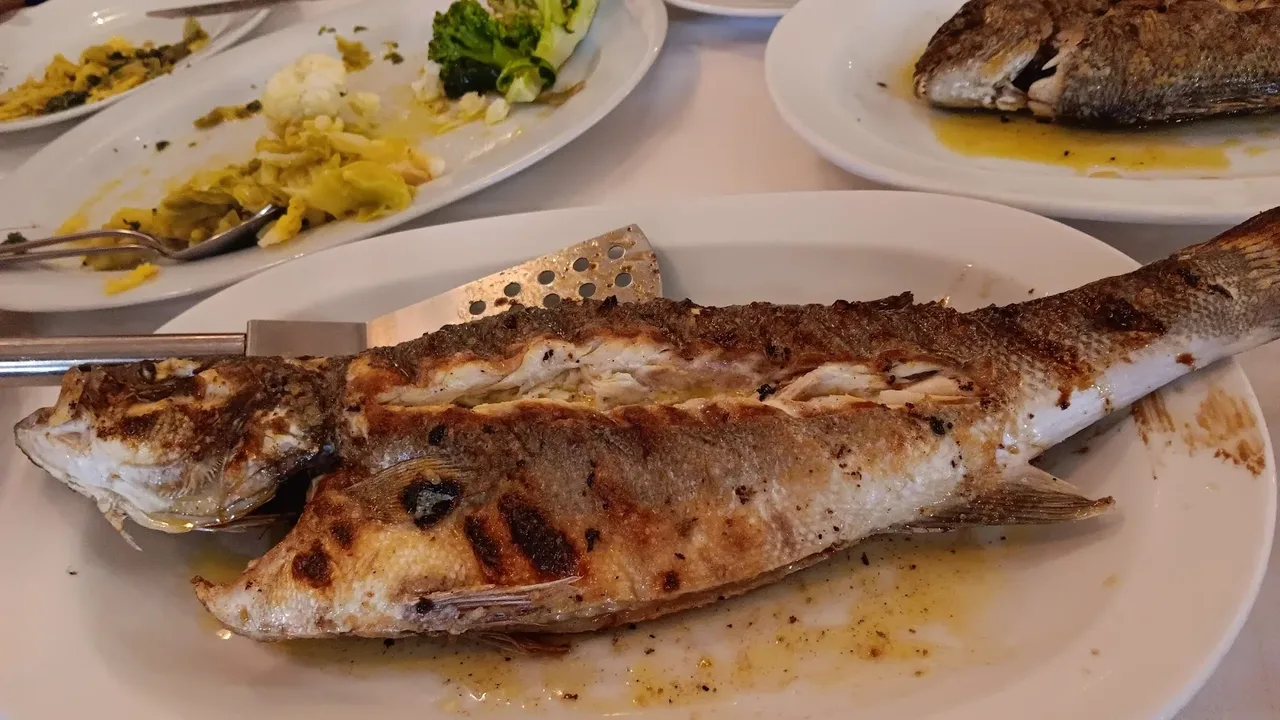
A meal built around grilled fish or meat, a Greek salad and grilled vegetables is close to zero-risk almost anywhere in the city, since none of it touches flour by default. Gigantes (giant baked beans) and dolmades (stuffed vine leaves) are usually naturally gluten-free too, but "usually" is doing real work in that sentence — some kitchens add breadcrumbs or flour to bind dolmades filling, or thicken a bean sauce, so it's worth a direct question rather than an assumption. Psarotaverna O Giannis in Kalamaria, a third-generation family fish taverna, builds its whole menu around exactly this kind of naturally GF cooking — grilled fish off the charcoal, mussels saganaki (confirm the batter-free version), prawns and grilled vegetables. It's a short trip from the centre and one of the more reassuring places to eat without close label-reading.
Where flour hides
The traps are mostly obvious once you know to look for them, but a few are easy to miss. Saganaki, the popular fried cheese starter, is almost always battered before frying — skip it or ask specifically for an unbattered version, which not every kitchen offers. Moussaka and pastitsio both rely on wheat pasta or a flour-thickened béchamel, so they're off the table by default. Fried items in general carry a cross-contamination risk even when the food itself is technically GF, since fryers are rarely dedicated. And obviously, Thessaloniki's two headline specialties — bougatsa (hand-stretched filo) and tsoureki (brioche-style bread) — are built entirely on wheat flour, so factor those out of a GF trip's food bucket list rather than trying to find a workaround.
Dedicated gluten-free bakeries
Two bakeries in the city are worth knowing specifically because they're built around gluten-free from the ground up, rather than offering a token GF item. Foodie's Art Gluten Free Bakery, at Kathigitou Antoniou Keramopoulou 5, is reported as a 100% dedicated gluten-free environment — meaning no wheat products are made on-site at all, which meaningfully lowers cross-contamination risk compared to a shared kitchen. Artokratoras, at Alexandrou Papadiamanti 13, runs a separate gluten-free department within a larger bakery; the owner is celiac herself, and the GF items (muffins, cookies, custom cakes, some frozen savoury goods) are made in a separate kitchen area specifically to avoid cross-contact. Both are reported as well-regarded by celiac travelers online, though we weren't able to independently confirm their current 2026 hours — call ahead if a specific visit time matters.
Restaurants with a real gluten-free menu
Beyond dedicated bakeries, a small number of restaurants maintain an actual written GF menu rather than just "ask your server." Ta Tria Gourounakia (Three Little Pigs), a restaurant in a preserved early-20th-century building in the centre, publishes a specific gluten-free menu covering GF bread, dessert, steak and risotto — reported to be prepared in a separate kitchen area, though it is not a fully dedicated gluten-free facility, so residual cross-contamination risk isn't zero. Harat's Pub, an Irish-style restaurant, is reported to offer a dedicated GF menu spanning breakfast through dinner — burgers on a GF bun, fish and chips, salads and wraps. Treat both as good-faith, well-reviewed options rather than certified-safe kitchens; if your celiac reaction threshold is very low, a fully dedicated facility like Foodie's Art remains the lower-risk choice.
How to ask for it in Greek
Saying you're avoiding gluten as a preference doesn't always land the same way as explaining you have a medical condition — and in a busy Greek kitchen, the distinction can change how carefully your order gets handled. The word for celiac disease is κοιλιοκάκη (koiliokaki). The most useful phrase to have ready is:
"Έχω κοιλιοκάκη, δεν μπορώ να φάω γλουτένη." (Écho koiliokáki, den boró na fáo glouténi — "I have celiac disease, I can't eat gluten.")
Leading with "I have celiac disease" rather than "I don't eat gluten" is more likely to get you a genuinely careful answer about shared fryers and cross-contact, rather than a dish with the bread simply removed from the plate. For more everyday vocabulary beyond food, see our Greek phrases guide.
Cross-contamination: the honest caveat
None of the restaurants above are large-scale operations with the kind of rigorous allergen protocols you might expect at a big-city chain — this is a city of small, family-run kitchens, which is exactly what makes the food good and exactly what makes zero-risk dining hard to guarantee. Shared grills, shared fryers and shared prep surfaces are the norm rather than the exception, even at places offering a GF menu. If you have a severe reaction threshold, treat every "gluten-free" claim outside the two dedicated bakeries as gluten-reduced-risk rather than gluten-guaranteed, ask specifically about shared equipment, and lean toward the simplest possible order — grilled, unsauced, unfried — rather than anything with a sauce or coating you can't verify.
Self-catering and supermarket options
If you're staying somewhere with a kitchen, or just want a reliable backup for breakfast, Greek supermarkets have caught up considerably on gluten-free labeling in the past several years. Chains like AB Vasilopoulos, Sklavenitis and Masoutis — all with multiple central branches — stock a dedicated gluten-free aisle or shelf section with GF bread, pasta, crackers and cookies, usually clearly marked with a crossed-grain symbol. It's not a substitute for a proper Greek meal out, but it's a dependable safety net for mornings when you'd rather not gamble on a menu, and it travels well if you're heading on to a day trip where options might be thinner. Artokratoras also sells some GF pasta and cereal products alongside its baked goods, so a single stop there can cover both a treat and a few days of pantry basics.
Where this pairs with the rest of the city's food scene
Gluten-free eating in Thessaloniki isn't a separate track from the city's food identity — it overlaps heavily with how locals eat anyway, especially the seafood and grilled-meat tradition. It runs in a similar lane to our vegan Thessaloniki guide, in that both are about knowing which of the city's traditional dishes already fit your needs rather than hunting for niche substitutes. For the fuller list of what to order regardless of dietary restriction, see what to eat, and our restaurants directory for the full venue list.
Frequently Asked Questions
Is it easy to eat gluten-free in Thessaloniki?
Easier than the pastry-heavy reputation of Greek food suggests, but it takes some care. Grilled fish, meat, salads and vegetables are naturally gluten-free and widely available, and two dedicated GF bakeries (Foodie's Art, Artokratoras) plus a handful of restaurants with real GF menus exist. Cross-contamination in small, shared kitchens is the main ongoing risk to manage.
What Greek dishes should celiacs avoid in Thessaloniki?
Avoid bougatsa and tsoureki (both pure wheat pastry), moussaka and pastitsio (wheat pasta and flour-based béchamel), battered saganaki, and most pies. Be cautious with dolmades and bean dishes like gigantes, since some kitchens add flour or breadcrumbs as a binder — always ask rather than assume.
How do I say I have celiac disease in Greek?
Say "Έχω κοιλιοκάκη, δεν μπορώ να φάω γλουτένη" (Écho koiliokáki, den boró na fáo glouténi) — "I have celiac disease, I can't eat gluten." Leading with the medical term koiliokaki rather than a general preference statement tends to get a more careful, thorough answer from kitchen staff.
Are there dedicated gluten-free bakeries in Thessaloniki?
Yes — Foodie's Art Gluten Free Bakery and Artokratoras both specialize in gluten-free baking, with separate GF-only preparation areas that significantly reduce cross-contamination risk compared to an ordinary bakery. Both are reported as well-regarded by celiac travelers, though it's worth calling ahead to confirm current hours before a special trip.