Most cities lost their walls to the modern age. Thessaloniki kept the best part of hers — a great banded rampart of stone and brick that climbs the hillside around the old upper town, studded with towers and gates, with the whole city and the Thermaic Gulf spread out below. The Byzantine Walls are free, open at all hours, and double as the finest viewpoint in Thessaloniki. Here's the history in the stone and how to walk it.
The quick version
There's no ticket and no gate — you simply walk up to the walls and along them. Come for the history and the panorama; they're the same thing here.
| Detail | |
|---|---|
| What | The surviving land walls of Byzantine Thessaloniki |
| Built | Present form ~390 AD, under Emperor Theodosius I |
| Status | UNESCO World Heritage (inscribed 1988) |
| Entry | Free — open site, always accessible |
| Best stretch | The upper ramparts around Ano Poli, to the Trigonion Tower |
| Best time | Golden hour, when the walls and the gulf glow |
They wrap the top of the city, so reaching them means climbing into Ano Poli, the old upper town — the walk up is half the reward.
Walls that outlasted empires
Thessaloniki has been fortified since its founding, but the walls you see took shape in the late 4th century, around 390 AD, under Emperor Theodosius I, incorporating parts of an earlier late-3rd-century wall. The Theodosian circuit ran roughly 8 kilometres around the whole city — a near-continuous ring of land and sea walls with towers and monumental gates — and it held Thessaloniki through Byzantine and Ottoman centuries.
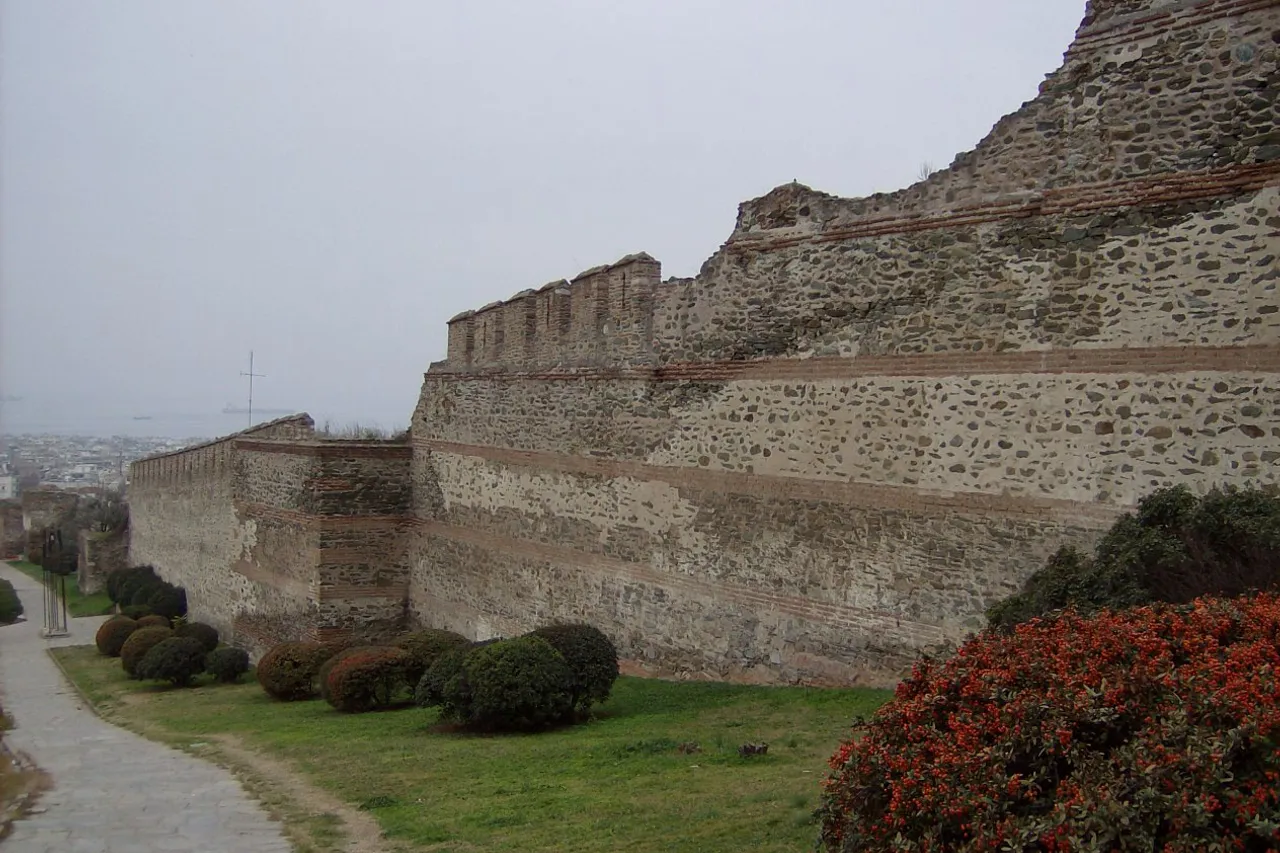
Look closely and the construction tells its own story: bands of brick alternating with rubble and cut stone, the classic late-Roman technique, reinforced by projecting rectangular and triangular towers that let defenders sweep the whole line. The seaward walls were pulled down in the 1870s to open the city to its port, but the land walls survive remarkably intact — about 4 kilometres of them, the stretch recognised in the UNESCO listing.
What to see and walk
The walls are best experienced as a hillside circuit through the upper town:
- The upper ramparts — the highest, most complete stretch runs along the top of Ano Poli, with the city falling away below and Mount Olympus on the horizon across the gulf on a clear day.
- The Trigonion Tower — the great artillery tower at the northeastern corner, and the classic viewpoint over the rooftops and sea.
- The Heptapyrgion — the "Fortress of Seven Towers" crowning the acropolis, a walled citadel built into the highest corner of the circuit.
- The gates and towers — surviving gateways and named towers punctuate the walk, each with an information plaque.
It's part of the same UNESCO ensemble as the city's great churches — see our Byzantine monuments guide for the full circuit.
Best time to visit
Go in the late afternoon. The walls face west and southwest over the gulf, so golden hour sets the stone glowing and lights up the water below — it's one of the best sunset spots in the city, and the climb is cooler than at midday. Wear proper shoes: the hillside paths beside the walls are steep and uneven in places. Pair the walls with the upper town and you have an easy half-day; it anchors the Ano Poli afternoon in our 2-day itinerary.
Frequently Asked Questions
Can you walk the Byzantine Walls of Thessaloniki?
Yes. The walls are an open, free site with no gate or ticket — you walk up to them through the Ano Poli upper town and follow the paths that run alongside the upper ramparts. The best stretch links the Trigonion Tower and the Heptapyrgion fortress, with panoramic views over the city and the Thermaic Gulf. The hillside paths are steep and uneven in places, so wear proper shoes.
How old are the walls of Thessaloniki?
The walls took their present form around 390 AD under the Roman emperor Theodosius I, incorporating parts of an earlier late-3rd-century wall, and were repaired through the Byzantine and Ottoman periods. They are part of the "Paleochristian and Byzantine Monuments of Thessaloniki," inscribed on the UNESCO World Heritage List in 1988.
How much of the walls survives?
The original Theodosian circuit was about 8 kilometres, ringing the whole city. The seaward walls were demolished in the 1870s to expand the port, but roughly 4 kilometres of the land walls survive — the well-preserved stretch around the upper town that carries the UNESCO designation.
Are the Thessaloniki walls worth visiting?
Yes, especially at golden hour. They're free, open at all hours, and combine genuine history — banded 4th-century construction, towers and gates — with the best panorama in Thessaloniki over the city, the gulf and Mount Olympus. Walking them is the natural way to explore the atmospheric Ano Poli upper town at the same time.