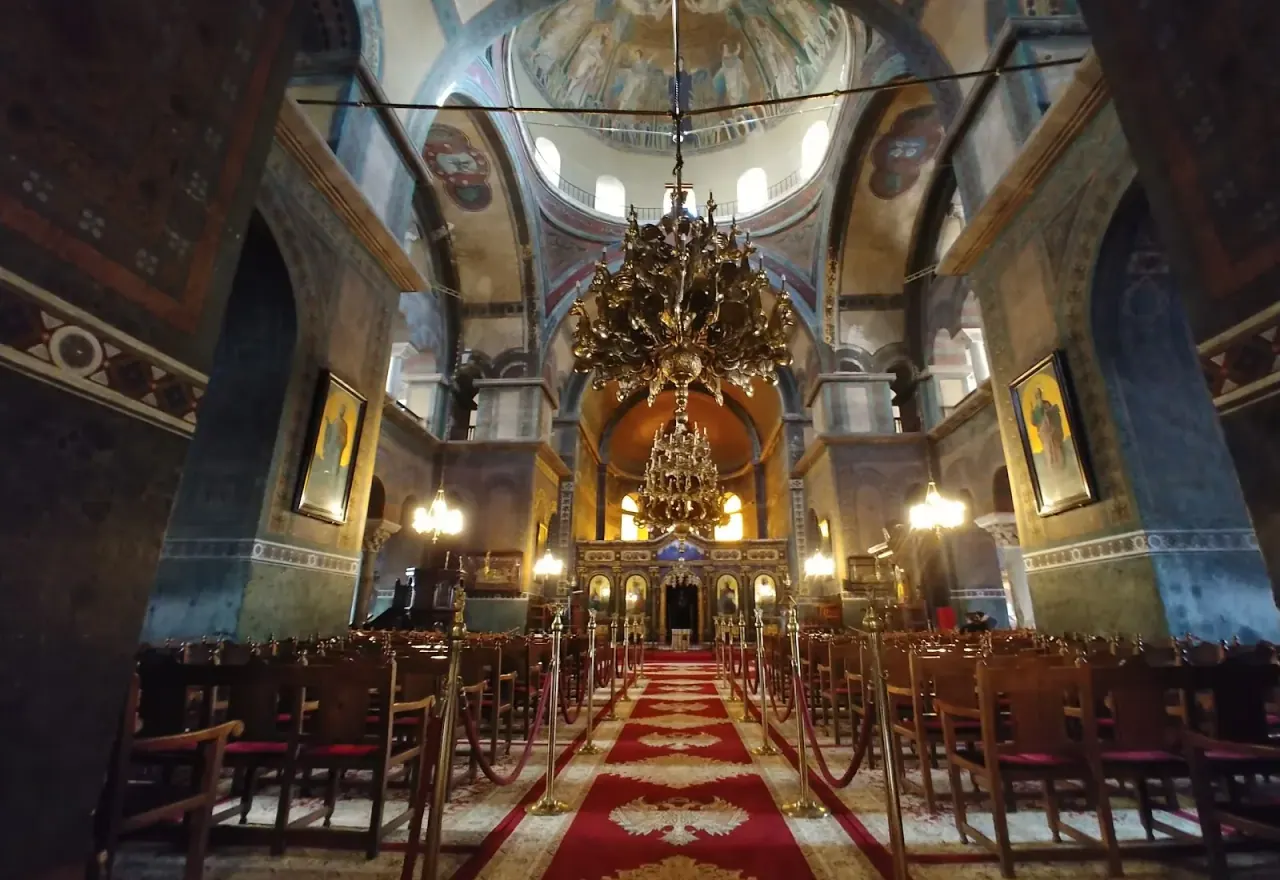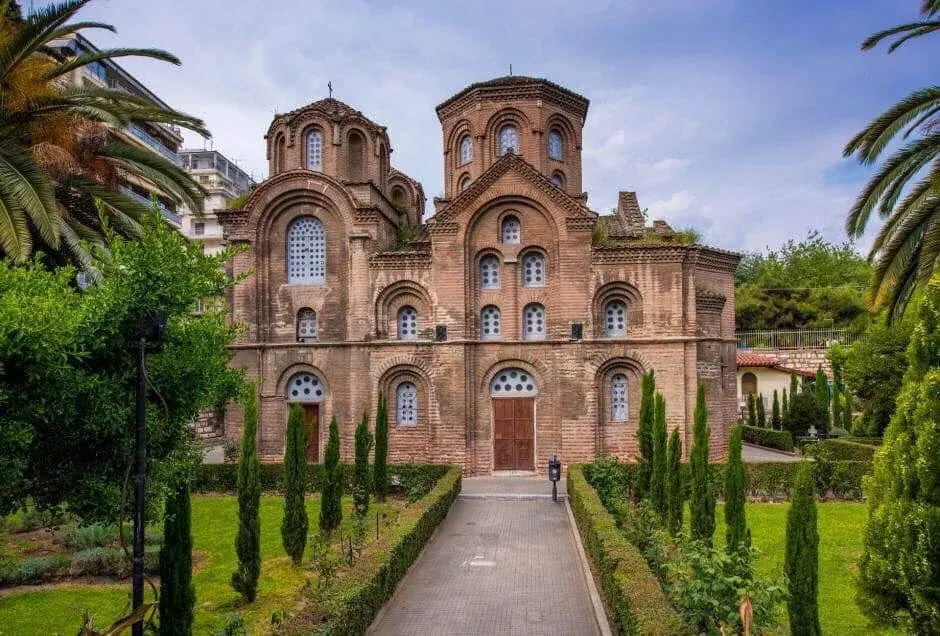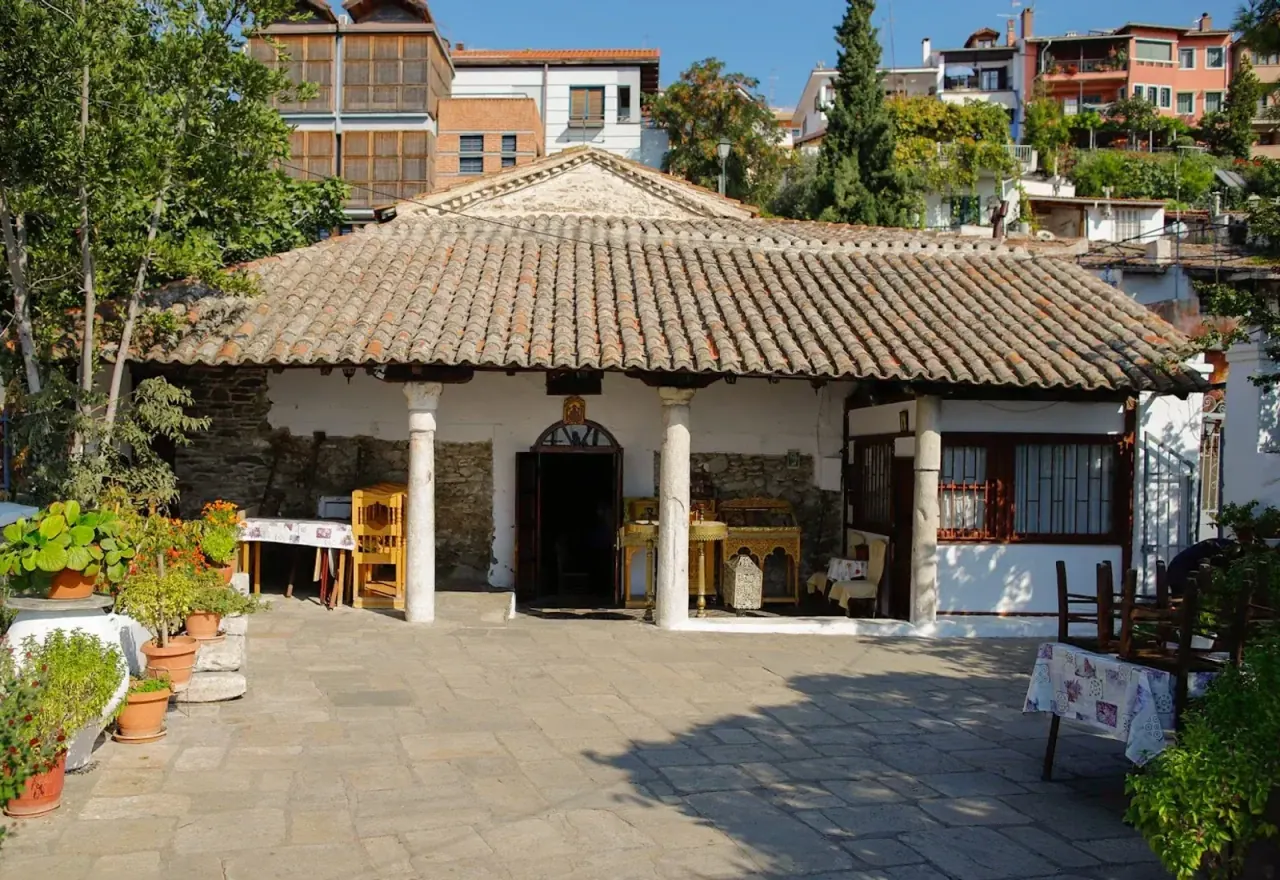
Among the many old churches of Thessaloniki, the Church of Panagia Acheiropoietos stands out for one reason: it is among the earliest surviving basilicas in the whole Christian world, built around 450 AD and in continuous use ever since. Step inside its colonnaded hall and you're standing in a room that has held services for some sixteen centuries. Here's what it is and what to look for. It's one of the city's UNESCO-listed monuments.
What it is
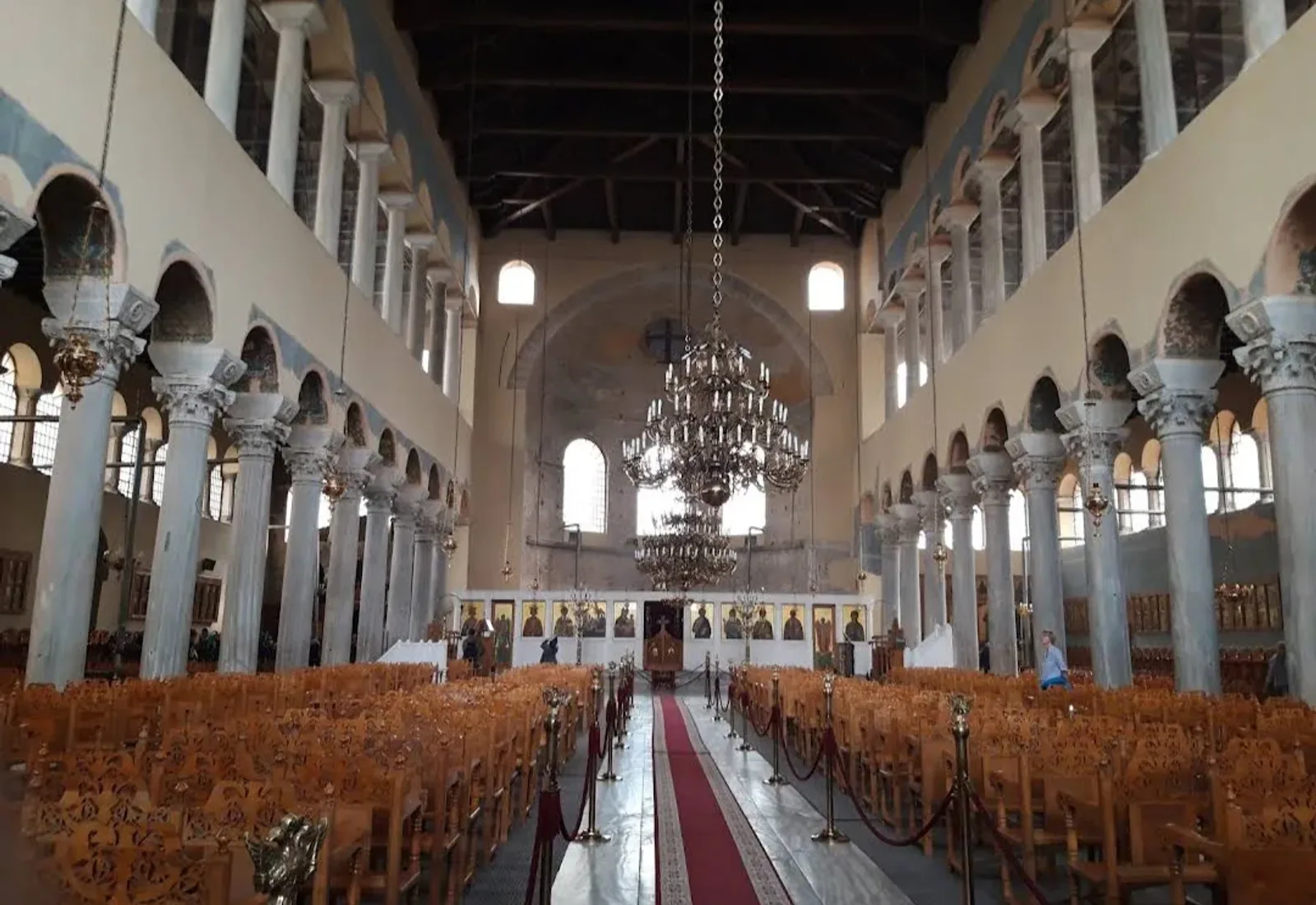
Acheiropoietos is a classic early-Christian basilica — a long, timber-roofed hall divided by rows of elegant marble columns with finely carved capitals, lit by rows of arched windows. Built in the mid-5th century, before the great age of domed Byzantine churches, it preserves the plan of the earliest Christian architecture almost intact. Its name means "made without hands" (acheiropoietos), after a venerated icon of the Virgin believed not to have been made by human hands.
A basilica built on Roman baths
Acheiropoietos went up in the mid-5th century — dated by its bricks and mosaics to roughly 450–470 AD, which makes it perhaps the earliest of the city's surviving churches — directly over a Roman public bath complex, parts of which are still visible around and beneath the building. It's a three-aisled basilica about 28 m wide and 36.5 m long under a timber roof, later modified in the 7th and again in the 14th–15th centuries but keeping its early-Christian plan intact. Known in Byzantine times as the Panagia Theotokos, it took its current name by around 1320, after a miraculous icon of the Virgin Hodegetria housed there.
After the Ottoman conquest of 1430 it was the very first church in the city converted to a mosque — by Sultan Murad II himself — and it stayed Thessaloniki's principal mosque throughout the Ottoman centuries under the name Eski Camii ("Old Mosque"). It was inscribed on the UNESCO World Heritage List in 1988 as one of the Palaeochristian and Byzantine Monuments of Thessaloniki.
What to look for
- The colonnades — the two rows of columns marching down the nave, their marble capitals carved with acanthus and eagles, are the building's glory.
- Mosaic fragments — in the soffits of the arches, patches of the original 5th-century mosaic survive: birds, fruit and geometric ornament on gold grounds.
- An Ottoman inscription — carved on one column, a Turkish inscription records the conquest of Thessaloniki in 1430, from the years the church served as a mosque. It's a stark, direct trace of the city's changing history.
Visiting
Acheiropoietos sits in the centre, a few minutes from Egnatia and close to the Hagia Sophia, so the two pair naturally on a walk through the early-Christian city. It's a working church and free to enter, but it's mainly a morning visit — roughly 07:30 to midday on weekdays and Saturdays, reopening only for evening vespers, and on Sundays it's open to worshippers rather than sightseers. Time it for the morning, and as everywhere dress modestly and be quiet inside, especially during services. It's one of the understated pleasures on our free things to do list; the landmark page has the practical details.
Frequently Asked Questions
What is the Acheiropoietos church in Thessaloniki?
It's a 5th-century early-Christian basilica (built around 450 AD), one of the oldest churches in the Christian world still in continuous use, and one of Thessaloniki's UNESCO-listed monuments. It's known for its marble colonnades, surviving mosaic fragments, and an Ottoman inscription recording the city's 1430 conquest.
What does "Acheiropoietos" mean?
It means "made without hands," from the Greek acheiropoietos. The church is named after a venerated icon of the Virgin Mary that, by tradition, was believed not to have been painted by human hands.
Is the Acheiropoietos free to visit?
Yes. It's a working Orthodox church with free entry. Dress modestly and be discreet inside, particularly during services. It's central and pairs easily with the nearby Hagia Sophia and the city's other Byzantine churches.
Was the Acheiropoietos ever a mosque?
Yes. After the Ottoman conquest of Thessaloniki in 1430 it was the first church in the city converted to a mosque, by Sultan Murad II, and it served as the city's principal mosque — the Eski Camii, or "Old Mosque" — throughout the Ottoman period. A Turkish inscription carved on one column still records the 1430 conquest. It reverted to a church in the 20th century and was UNESCO-listed in 1988.