At a glance
| Detail | |
|---|---|
| What it is | Royal tombs of ancient Aigai — a UNESCO World Heritage Site |
| From Thessaloniki | ≈80 km · ~1 h by car via the A1 and Veria |
| See | Royal Tombs Museum (Philip II's gold larnax & armour), Palace of Aigai (reopened 2024), the theatre |
| Entry | |
| Hours | 08:00–20:00 summer / 09:00–17:00 winter (closed Tue in winter) |
| Best for | UNESCO heritage, history, Macedonian gold |
| Time needed | Half-day; full day paired with Pella or Veria |
Macedonian gold beneath a hill
Vergina is the modern village that sits over Aigai, the first capital of the kingdom of Macedon and its royal burial ground. In 1977 the archaeologist Manolis Andronikos opened an unlooted tomb beneath the Great Tumulus and found the cremated remains and treasures of a Macedonian king — almost certainly Philip II, father of Alexander the Great. It is one of the most important archaeological discoveries of the 20th century, and the whole site is a UNESCO World Heritage Site.
What to see
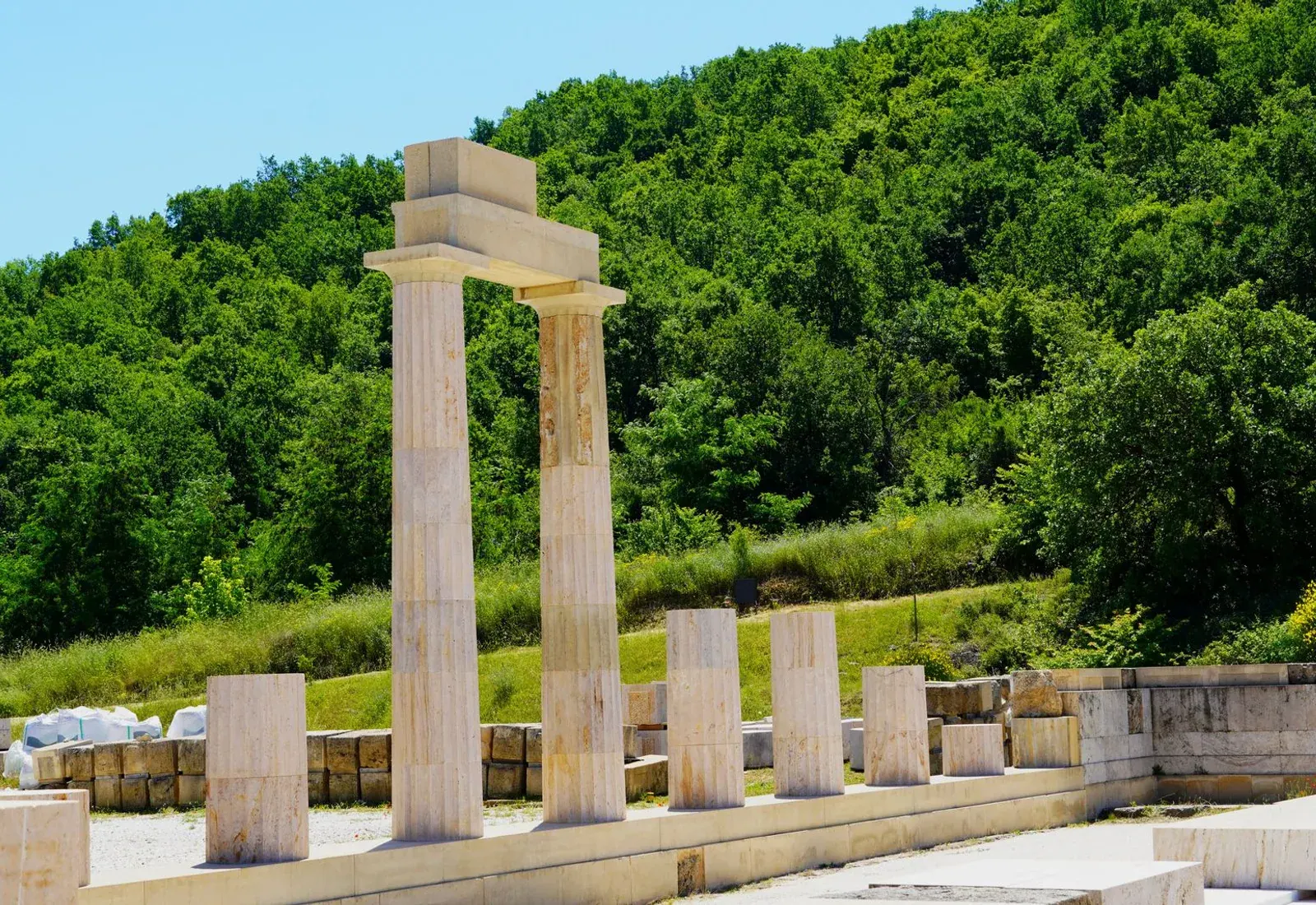
The Royal Tombs Museum is built into the mound itself, dimly lit so the gold glows: Philip's golden larnax crowned with the 16-rayed Vergina Sun, his ceremonial armour, a gold oak wreath so fine the leaves tremble, and the burial of a young royal. A short walk away, the Palace of Aigai — reopened in 2024 after long restoration and the largest classical Greek building ever built — and the theatre where Philip II was assassinated complete the picture.
How to do it from Thessaloniki
It is about 80 km / one hour by car via the A1 and Veria. By public transport, take a KTEL bus to Veria and a local connection on to Vergina. Because Vergina and Pella sit on the same plain, guided day trips often combine the two — the tombs of the dynasty at one, the city where Alexander was born at the other. Veria itself — biblical Berea, where St Paul preached — is only 12 km away and makes a natural third stop.