At a glance
| Detail | |
|---|---|
| What it is | Capital of Macedon + birthplace of Alexander the Great — famed pebble mosaics |
| From Thessaloniki | ≈40 km · ~40 min; KTEL buses toward Edessa/Giannitsa stop here |
| See | In-situ mosaics (lion-hunt, stag-hunt), the Archaeological Museum (opened 2009) |
| Entry | €10 site + €10 museum; ~€15 combined ticket (adds the Palace of Pella) |
| Hours | Summer ~08:00–20:00; winter 08:30–15:30 (closed Tue in winter) |
| Best for | Ancient history, mosaics, Macedonian heritage |
| Time needed | Half-day (often paired with Vergina) |
Where Alexander was born
Pella was the capital of the kingdom of Macedon and, in 356 BC, the birthplace of Alexander the Great. It became the royal seat around the end of the 5th century BC — replacing older Aigai (Vergina) — and grew into the wealthiest and most cultured city in the Greek world under Philip II. (Alexander's famous tutoring by Aristotle happened a little to the west, at Mieza near modern Naoussa, around 343–340 BC, not at Pella itself.)
Today it is a broad, open archaeological site on the Macedonian plain: a grid of colonnaded streets, a vast agora, and grand courtyard houses whose floors carry some of the earliest and most accomplished pebble mosaics ever made.
A capital that once had a port
It looks landlocked now, but in antiquity Pella was effectively a port city, linked to the Thermaic Gulf through the Loudias river and a shallow lagoon; centuries of silt from the rivers pushed the coastline back and left the ruins stranded inland. On the low hill just north of the houses sprawl the foundations of the enormous royal palace — a complex of colonnaded courtyards several times the size of the residential blocks below.
The mosaics
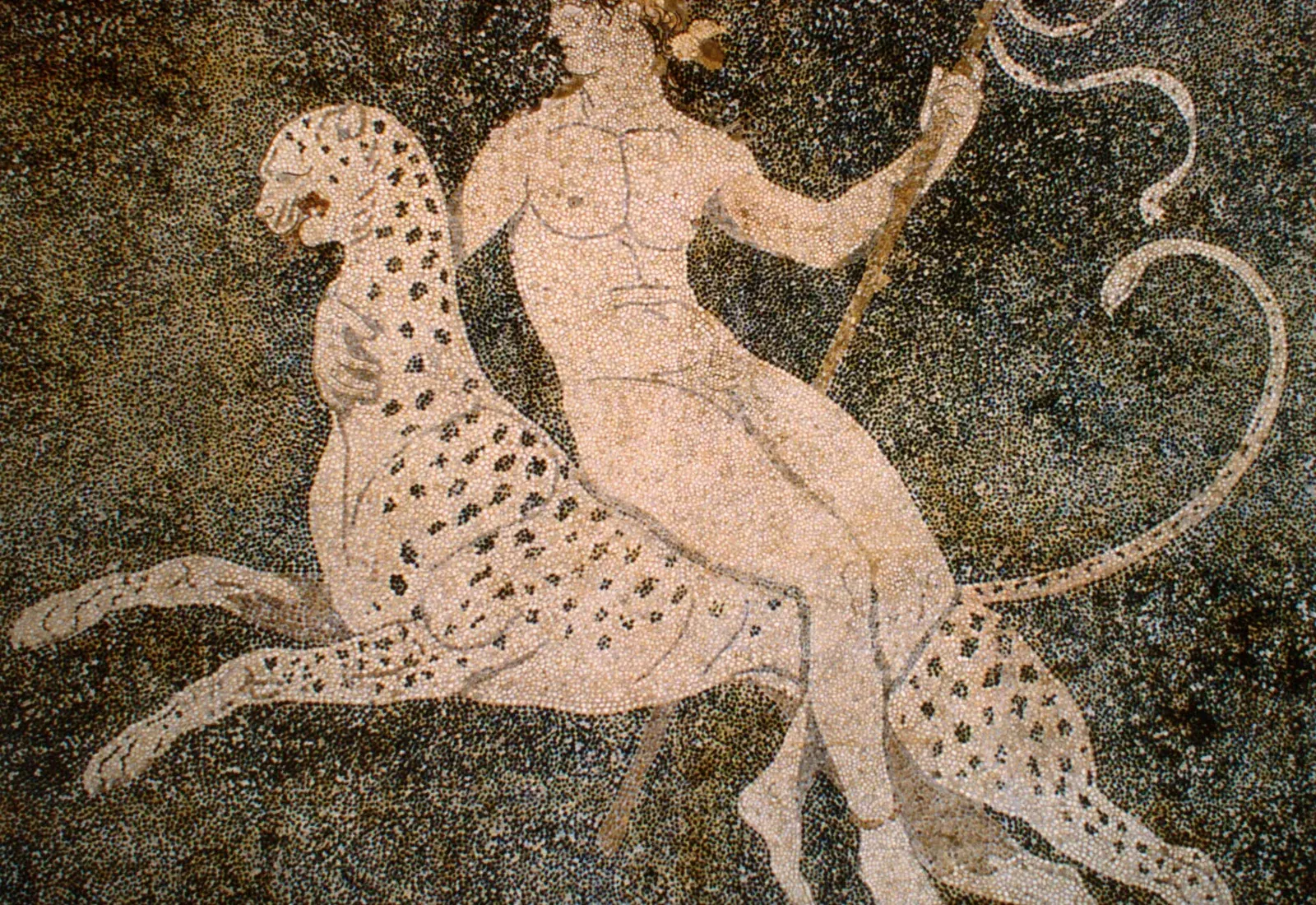
The mosaics are the reason to come. Made entirely from natural river pebbles — no cut stone — they render hunting scenes and mythological figures with astonishing movement and shading. Two came from the grand houses named for them: the House of the Abduction of Helen and the House of Dionysus. One of the finest, the stag hunt, even carries a signature — "Gnosis made it" — among the earliest known signatures of any mosaic artist. Some pieces stay on the site; the very best — the lion hunt, the stag hunt, and Dionysus riding a panther — are displayed in the Archaeological Museum of Pella (opened 2009), just north of the ruins.
The site and the museum
Give yourself time for both halves: the open-air site with mosaics set in place among the house walls, and the modern museum with the star floors, everyday finds, and a scale model of the city. The ground is largely unshaded, so spring and autumn are kindest for walking.
How to do it from Thessaloniki
Pella is one of the easiest day trips going: about 40 km / 40 minutes by car on the road toward Edessa, with KTEL buses passing the site too. Because it pairs so naturally with Vergina, many visitors do both in a single day — the city where Alexander was born and the tombs where his dynasty was buried.