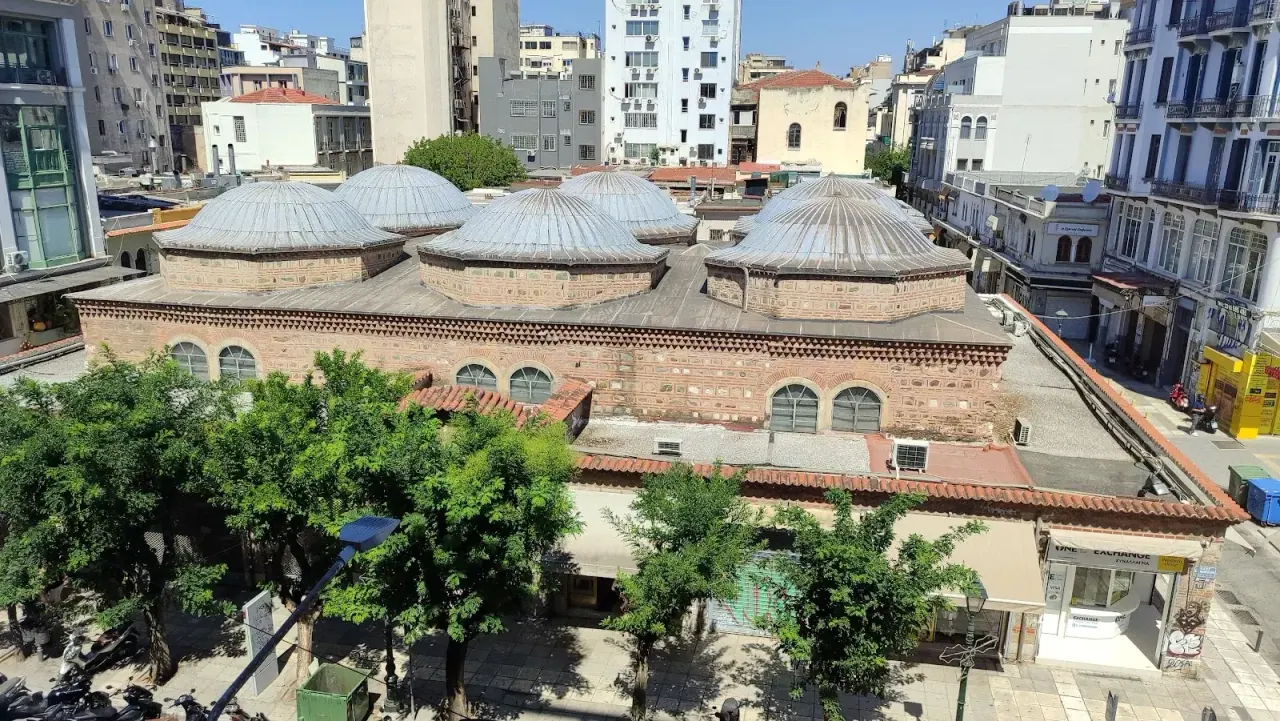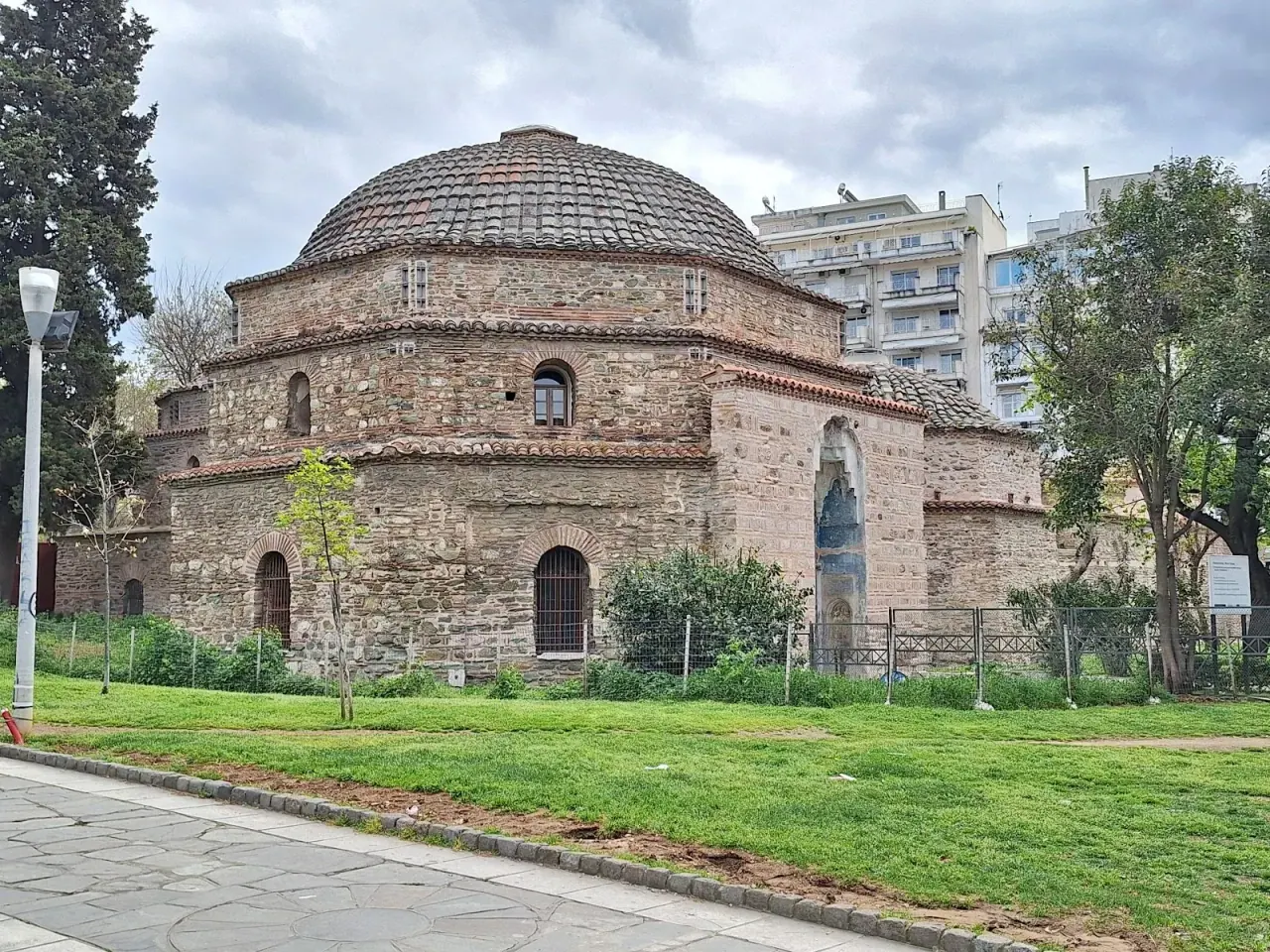
On the corner of the busy Egnatia shopping street stands a plain, domed building most people walk straight past: the Bey Hamam, the grandest Ottoman bathhouse in Greece — and the oldest in Thessaloniki — and one of the finest survivals of Ottoman Thessaloniki. Behind that unassuming stone shell are domed chambers, marble basins and painted ornament that once made it the grandest bath in the city. Here's what it is, its story, and the honest truth about getting inside.
What it is
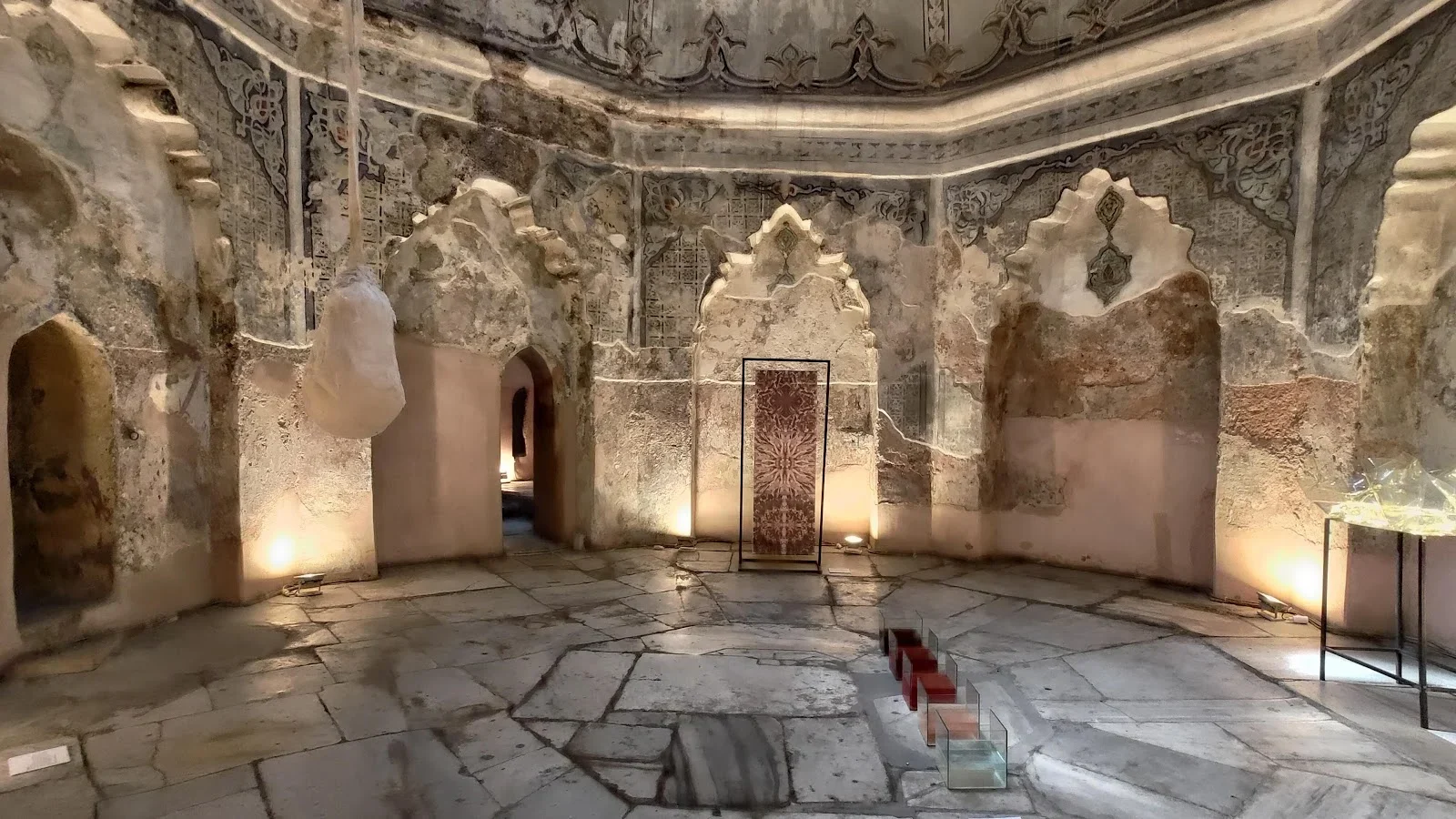
The Bey Hamam was built in 1444 by Sultan Murad II, only a few years after the Ottoman conquest of the city — making it the grandest Ottoman bath in Greece and the oldest in Thessaloniki. It's a double bath (a çifte hamam), with separate parallel wings for men and women — the men's wing the larger and richer, the women's a smaller, plainer mirror of the same plan. Each capped by a dome pierced with star-shaped skylights that threw shafts of light down through the steam. Marble basins, carved niches and surviving painted decoration — floral motifs in a dry-fresco technique, revealed again when later reinforcements were stripped out after the 1978 earthquake — still line the walls of its restored chambers.
How the bath worked
Bathing followed a fixed progression through three temperatures, the Ottoman heir to the Roman bath. You entered the tall cold hall (camekân) to undress — a social lobby with changing rooms on an upper gallery — passed into the warm room (soğukluk) to acclimatise, and finally into the domed hot room (sıcaklık), where a large heated marble slab, the göbek taşı ("navel stone"), sat at the centre for lying out, sweating and being scrubbed and massaged. Around it were small, very hot private cubicles called halvet. The whole place was warmed from below by a hypocaust — an under-floor heating system fed by a furnace and a hot-water cistern along the eastern side, the same principle the Romans used, carried on for another thousand years.
The "Baths of Paradise"
For roughly five centuries the Bey Hamam served the city as public baths — and it was so well liked that it earned the nickname the "Baths of Paradise" (Loutra Paradeisos), the name locals still use. It kept working as a functioning bathhouse right up until 1968, an astonishing run for a medieval building, before finally closing. Today it's a protected monument, restored and used as a cultural space for occasional exhibitions and events rather than a working bath.
Visiting — read this first
After a major €1.5-million restoration (funded through the EU Recovery and Resilience Facility), the Bey Hamam reopened to the public on 26 June 2026 — accessible again for the first time in decades. It's a restored monument and a venue for exhibitions and cultural events rather than a working bath, and its day-to-day visiting hours were still settling in after the reopening, so a quick check before you go is still wise:
- Entry is free.
- Check before you go — regular opening hours were still being finalised after the reopening; confirm current times via the city's culture listings, especially around exhibition changeovers.
- Even between openings, it's worth a two-minute look from the street: the cluster of lead-grey domes over the Egnatia corner is unmistakably Ottoman, and it's right on the way between Aristotelous Square and the Rotunda.
It pairs naturally with the city's other surviving bathhouse, the Byzantine Bath up in Ano Poli — the only surviving Byzantine bath in Thessaloniki — and with the rest of the Ottoman-era monuments in the centre. See the landmark page for map and details, and our things to do guide for what to string it with.
Frequently Asked Questions
What is the Bey Hamam in Thessaloniki?
It's the grandest Ottoman bathhouse in Greece — and the oldest in Thessaloniki — built in 1444 by Sultan Murad II on Egnatia street. A double bath with domed hot and cold rooms, marble basins and painted decoration, it served the city as public baths — nicknamed the "Baths of Paradise" — for about five centuries until 1968, and is now a protected monument used for exhibitions.
Can you go inside the Bey Hamam?
Yes. After a €1.5-million restoration the Bey Hamam reopened to the public on 26 June 2026, accessible again for the first time in decades. It no longer works as a bath — it's a restored monument used for exhibitions and cultural events — and its regular opening hours were still being finalised after the reopening, so it's worth checking before a special trip. Entry is free, and even between openings you can admire its distinctive Ottoman domes from the street.
How old is the Bey Hamam and who built it?
It was built in 1444 by the Ottoman Sultan Murad II, shortly after the conquest of Thessaloniki — making it the oldest surviving Ottoman bath in Thessaloniki, almost six centuries old.
What does "hamam" mean?
A hamam is a Turkish or Ottoman public bathhouse, the equivalent of a Roman bath in the Islamic world — a place to wash, steam and socialise. Bathers move through a sequence of increasingly hot rooms under domed ceilings; the Bey Hamam is the best-preserved example in Thessaloniki.
How did the Bey Hamam work inside?
Bathers moved through three temperatures: a tall cold hall (camekân) for undressing, a warm room (soğukluk), and a domed hot room (sıcaklık) centred on the göbek taşı, a heated marble "navel stone" for lying out and being scrubbed, ringed by small private cubicles (halvet). It was all heated from below by a hypocaust fed by a furnace and hot-water cistern — the Ottoman successor to the Roman bath.
Why is it a "double" bath?
Because it has two parallel sets of rooms — a larger, more richly decorated wing for men and a smaller, plainer one for women — each with its own cold, warm and hot rooms, so both could bathe at the same time in separate quarters. This çifte hamam arrangement is why the building is so large.