Thessaloniki is a photographer's city — a seafront that faces the sunset, an upper town of tiled roofs and Byzantine walls, Roman domes, and a waterfront sculpture that's become the city's emblem. Here are the spots worth pointing a camera at, and the time of day each one works best.
1. The Umbrellas, on the waterfront
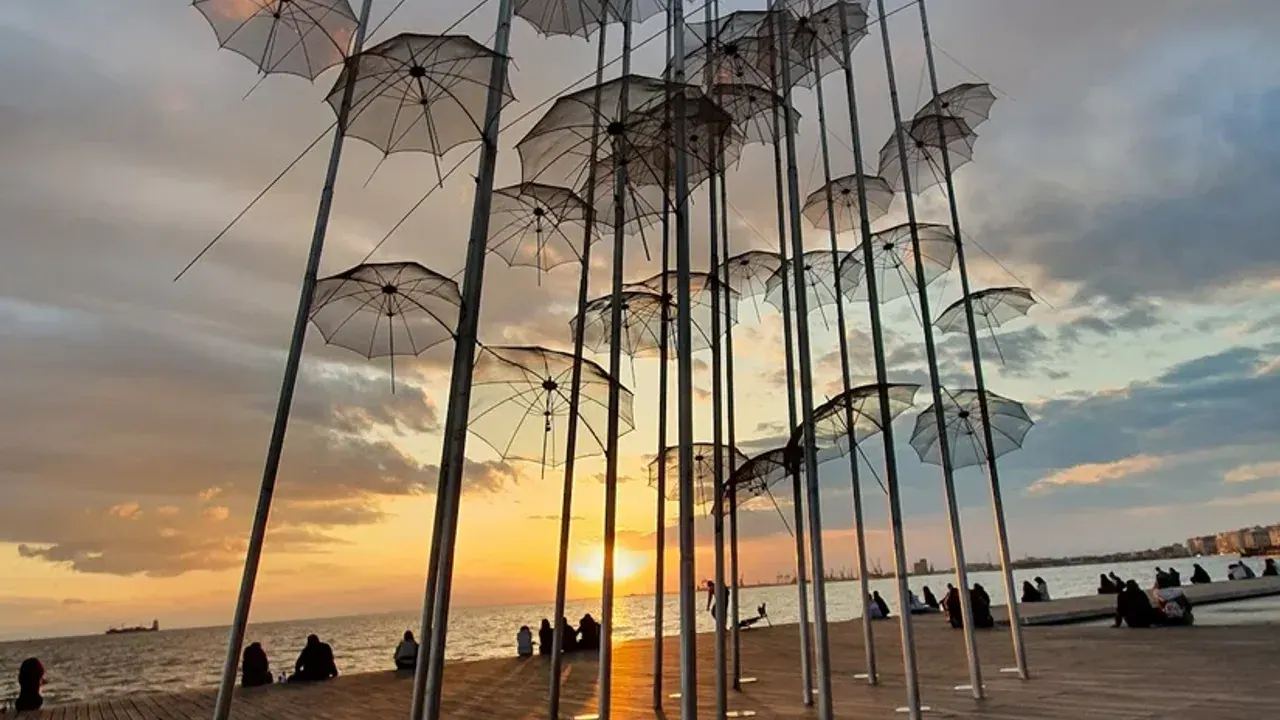
George Zongolopoulos's Umbrellas on the Nea Paralia are the Thessaloniki shot: a cluster of steel umbrellas rising over the sea, with the sun setting right through them over the Thermaic Gulf. Come at sunset — the sun drops behind the umbrellas and the water goes gold — and shoot into the light for a silhouette, or from the side for the frames-within-frames effect. It's the single most photographed object in the city, so arrive early for a clear foreground.
2. The Ano Poli walls & Trigonion Tower
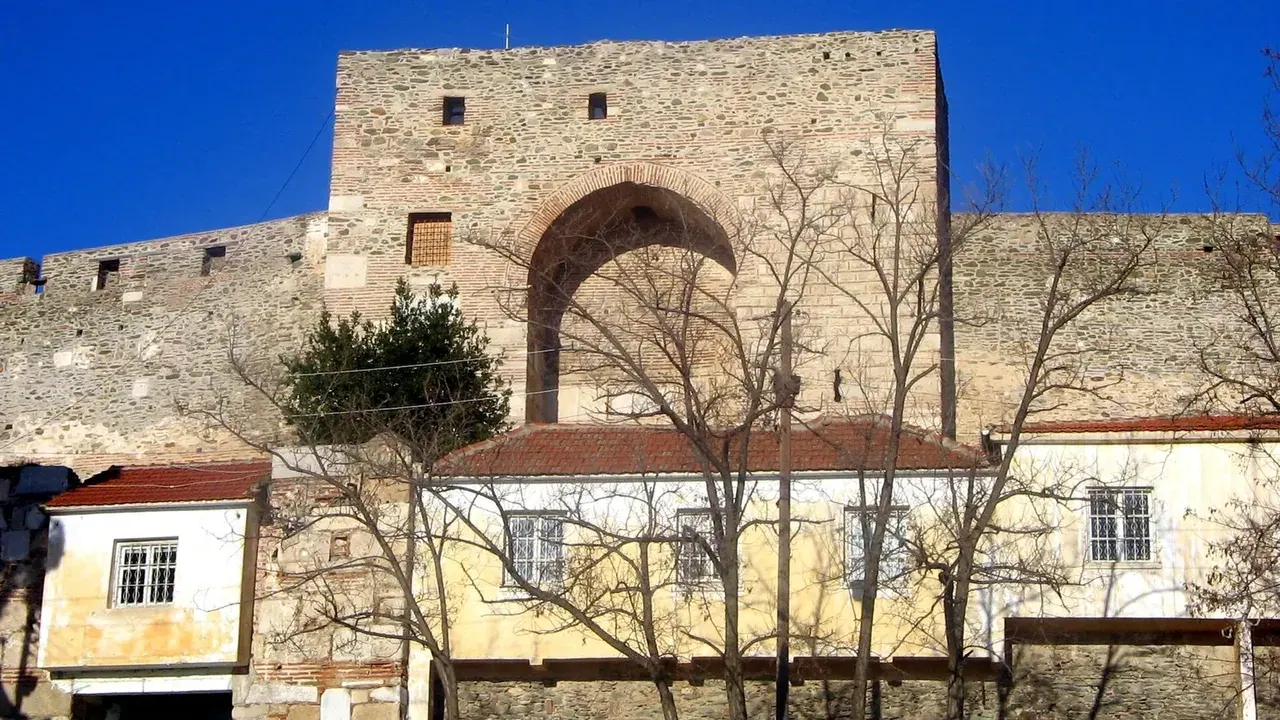
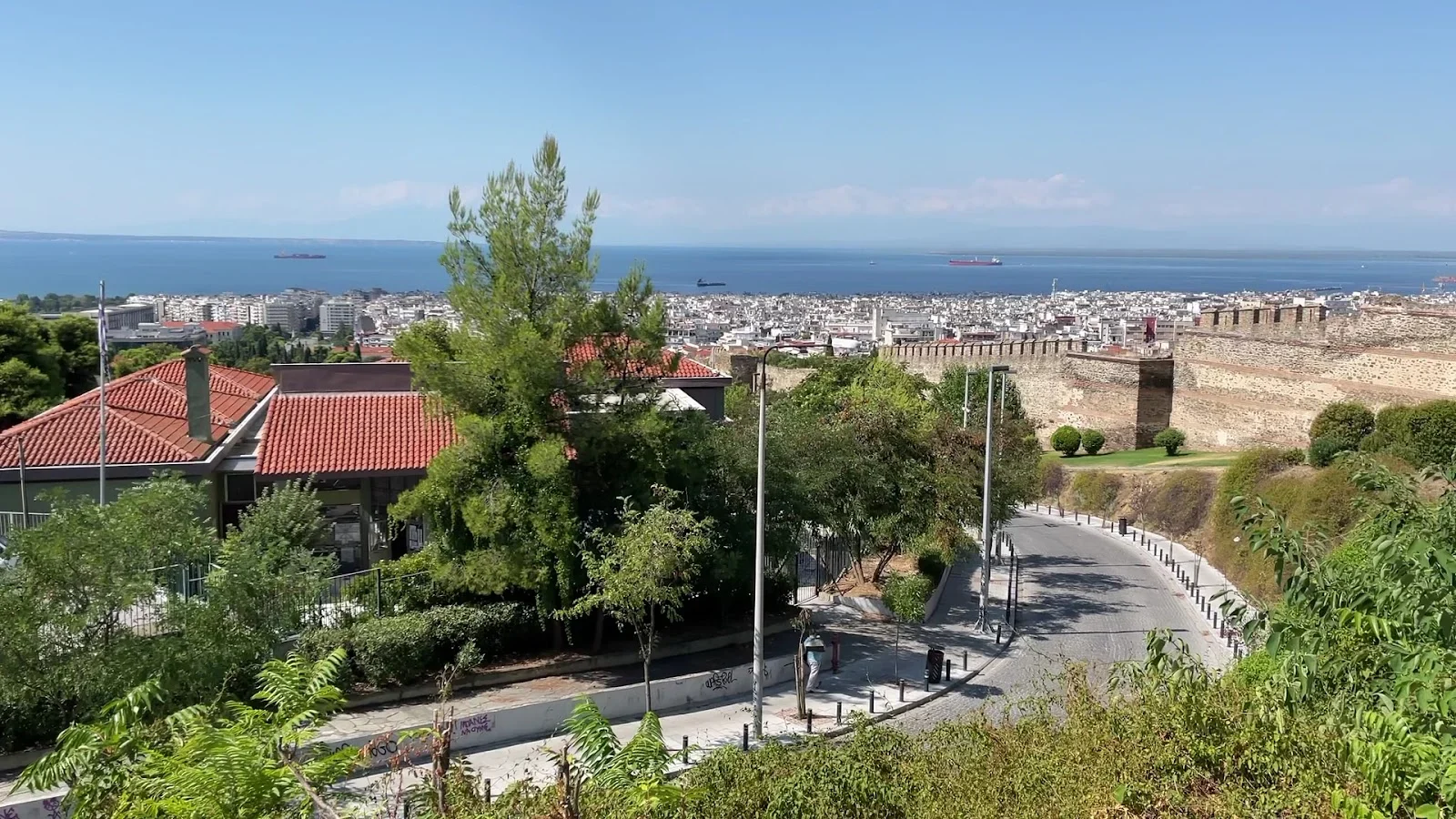
For the whole-city panorama, climb to the Trigonion Tower and the ramparts of Ano Poli: rooftops tumbling down to the gulf, the White Tower a speck on the shore, and Mount Olympus across the water on a clear day. This is the classic postcard view, and it's the city's prime sunset spot — the light rakes across the rooftops and the sea turns pink. Free, always open, benches to wait on.
3. The White Tower
The city's emblem, the White Tower, photographs well two ways: from the waterfront promenade with the sea behind it, and from the top — the open roof gives a clean sweep along the seafront and back over the city. Golden hour softens the stone; blue hour, when it's lit, is dramatic against a deep sky.
4. Aristotelous Square
The grand, curving arc of Aristotelous Square frames a clean line straight down to the sea — best shot from the top (inland) end looking toward the water, especially in the morning light or when the square is lit at night. The symmetrical arcades and the gap of blue gulf at the far end are the composition to look for.
5. The Rotunda & the Arch of Galerius
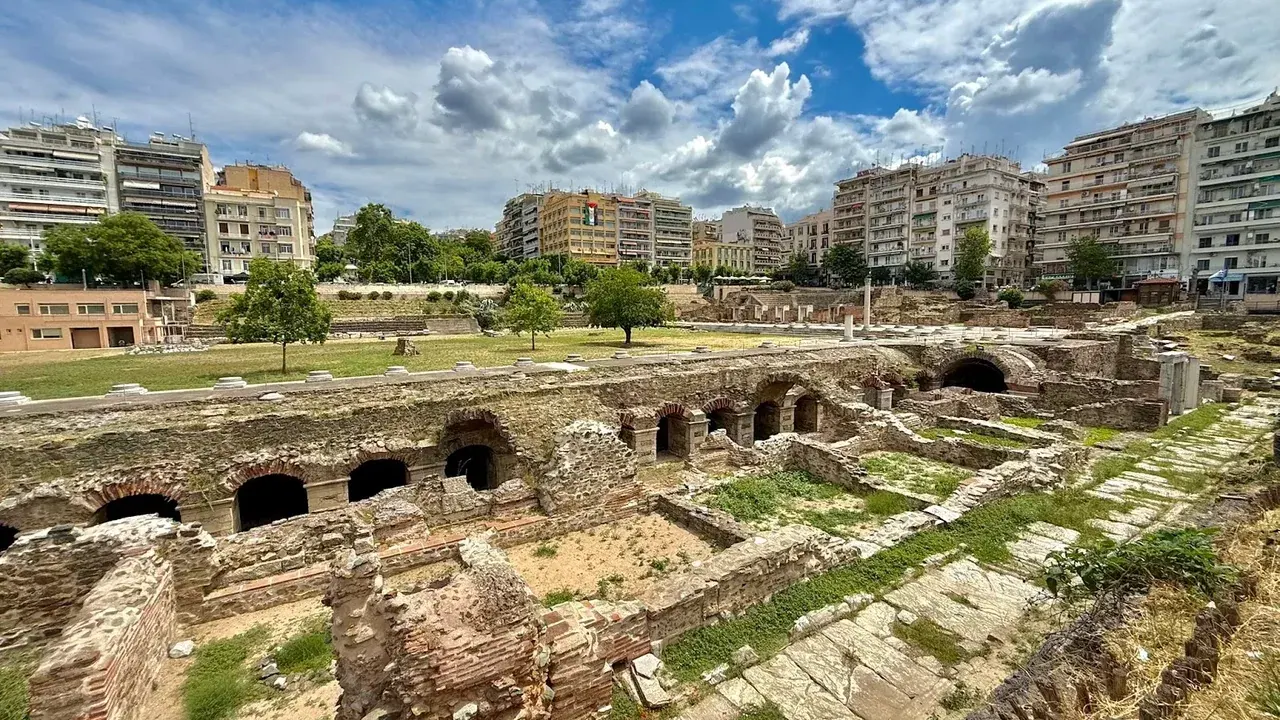
The Roman core is pure texture: the colossal brick drum of the 4th-century Rotunda (shoot it low and wide to get the dome), and the carved marble piers of the Arch of Galerius — the Kamara — a two-minute walk away. Both are lit after dark, when the crowds thin and the stone glows. See the whole Roman Thessaloniki trail for more.
6. Ladadika's coloured lanes
The restored Ladadika quarter is the city's most colourful streetscape: low nineteenth-century warehouses in ochre, red and blue, strung with lights, packed with tavernas. Best in the early evening as the lights come on and before the dinner crowds fill the lanes. Look up for painted facades and hanging signs.
7. The Ano Poli lanes
Beyond the walls, the streets of Ano Poli are the atmospheric opposite of the modern grid: timber Ottoman houses, tiny frescoed chapels, vine-shaded courtyards and cats on cobbles. Wander with no plan — the light down a stepped lane, a bougainvillea against whitewash, a sudden gap with a view of the gulf. Morning light is softest here.
8. The Nea Paralia waterfront
The redesigned waterfront promenade is a 3.5 km run of themed gardens, sculptures and open sea — reflections at dawn, joggers and cyclists in silhouette at sunset, and the statue of Alexander the Great rearing against the sky. It's the city's golden-hour catwalk; the stretch by the Umbrellas is the busiest, but the whole length rewards a slow walk with a camera.
9. The markets: Modiano & Kapani
For street life and colour, the restored Modiano food hall and the open-air Kapani market are the richest frames in the centre: stacked produce, fishmongers, hanging octopus, steam and noise. Ask before shooting people up close; shoot the stalls and the light through the roofs freely.
Photographer's practical notes
- Golden hour is on the west/southwest — the seafront faces the sunset, so the waterfront, the Umbrellas and the Ano Poli walls all light up in the evening. For the exact times, our best sunset guide has the season-by-season schedule.
- Working churches: photography is usually fine, but be discreet, avoid flash, and don't shoot during services.
- A seated aerial: for a 360° view without the climb, ride the revolving café-bar atop the OTE Tower — the whole city turns slowly past the window.
- Leave the drone packed. Between the airport's airspace, the UNESCO-listed monuments across the centre and the crowds on the seafront, nearly every shot you'd want here falls inside a restricted zone — our guide to drone laws in Greece explains where you can and can't legally fly.
- Build the spots into a day with our things to do in Thessaloniki guide, or follow the self-guided walking tour — most of these spots are on it. For the quieter corners, see our hidden gems guide.
Frequently Asked Questions
What is the most Instagrammable spot in Thessaloniki?
The Umbrellas sculpture on the Nea Paralia waterfront is the city's signature shot, especially at sunset when the sun sets through the steel umbrellas over the Thermaic Gulf. The panoramic view from the Trigonion Tower and the Ano Poli walls is a close second for the whole-city postcard.
Where is the best view of Thessaloniki?
The best panorama is from the Ano Poli (Upper Town) walls beside the Trigonion Tower, where the rooftops fall away to the sea with Mount Olympus on the horizon — it's free and the prime sunset spot. For a seated 360° view, the revolving café atop the OTE Tower turns the whole city past your table.
When is the best light for photos in Thessaloniki?
Sunset and the golden hour before it, because the seafront faces southwest — the Umbrellas, the waterfront and the Ano Poli walls all glow in the evening. Blue hour just after sunset is best for the lit monuments (the White Tower, the Rotunda, Aristotelous Square); early morning gives the softest, quietest light in the Ano Poli lanes and the markets.