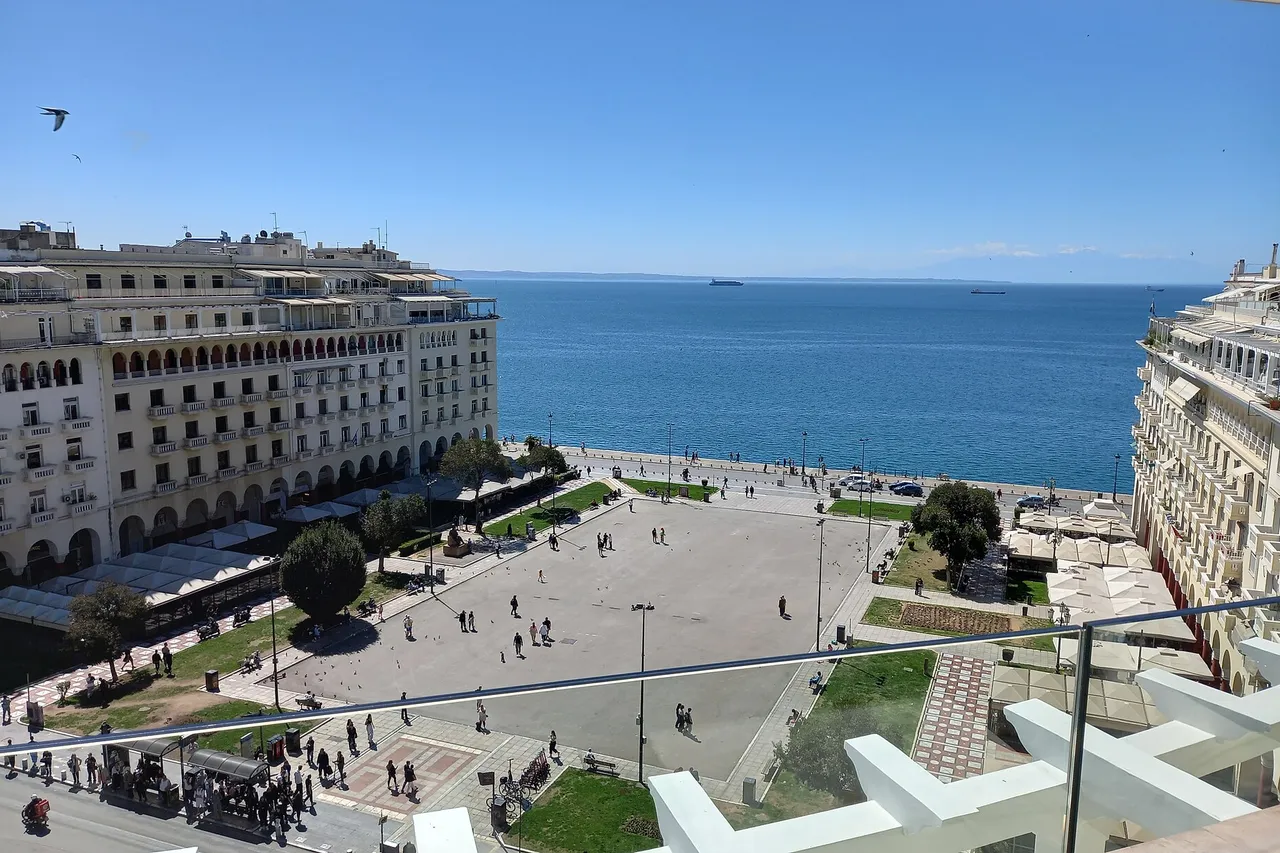
If Thessaloniki has a living room, this is it. Aristotelous Square is the city's grand civic space — a sweep of arcaded, cream-coloured facades opening straight onto the Thermaic Gulf, filled from morning coffee to midnight with people meeting, protesting, celebrating and simply passing through. It's the first place most visitors land and the last they leave, and there's more behind its symmetry than a pretty photo. Here's the square, its story, and how to make the most of it.
The quick version
You don't buy a ticket for a square — you use it. But knowing what you're looking at, and when to come, turns a crossing into a highlight.
| Detail | |
|---|---|
| What | Thessaloniki's main civic square, on the seafront |
| Entry | Free — it's a public space, always open |
| Designed | Ernest Hébrard's 1918 plan; mostly built in the 1950s |
| Rating | 4.7★ on Google (nearly 50,000 reviews) |
| Time needed | 20–30 minutes to look; longer over a coffee |
| Best time | Early evening, when the whole city passes through |
It sits at the foot of the shopping streets, a flat, step-free walk from everything central — the White Tower is a ten-minute stroll southeast along the front.
A square born from disaster
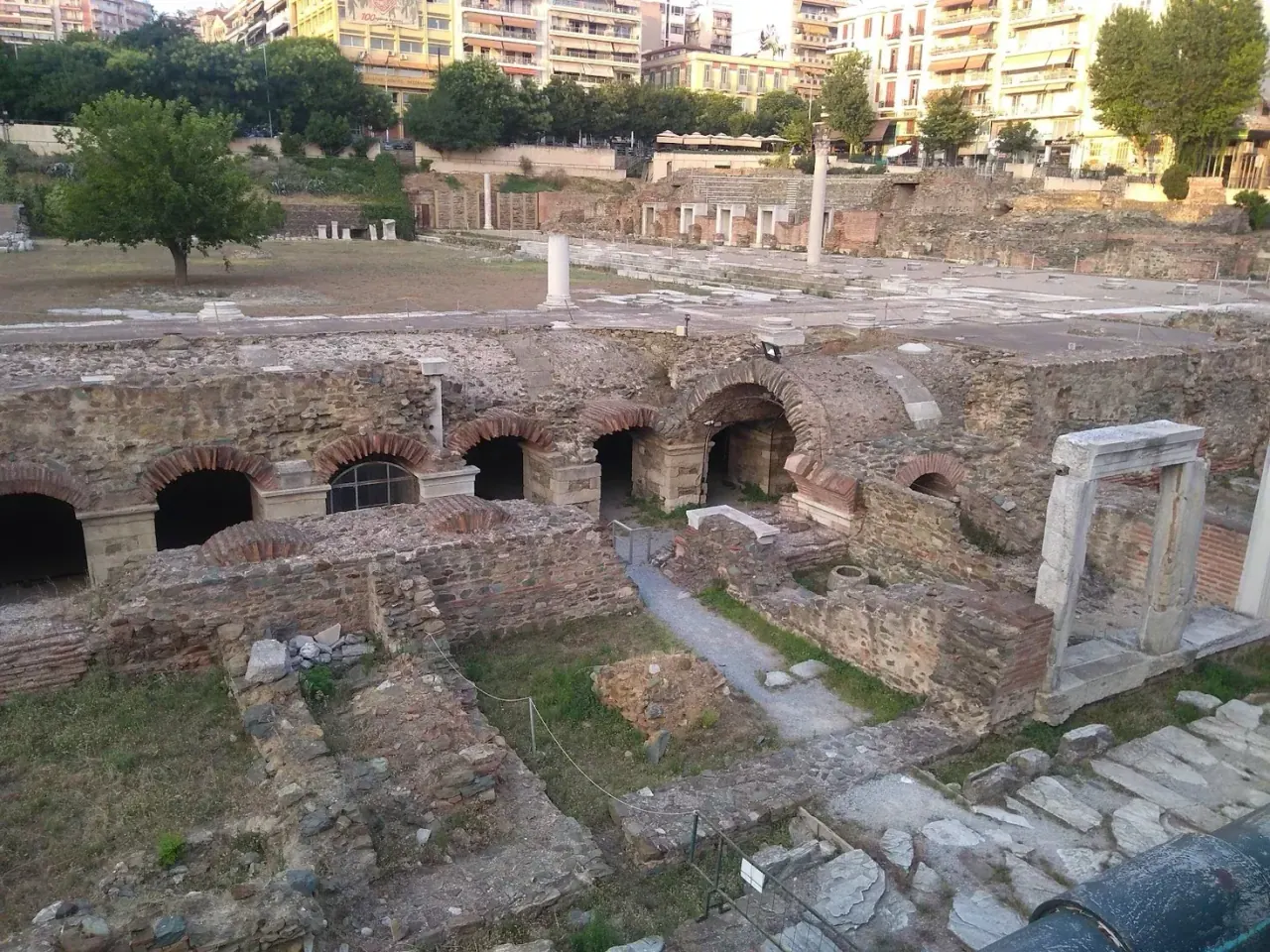
Aristotelous is younger than it looks. After the Great Fire of 1917 gutted the centre of Thessaloniki, the French architect Ernest Hébrard was commissioned to replan the city, and his 1918 scheme made this square the sea-facing anchor of a monumental axis — a grand boulevard running inland and uphill to Dikastirion Square and the Roman Forum, deliberately linking the modern city to its ancient agora.
Hébrard's choice of style was pointed: he drew on Byzantine and Western European forms rather than Ottoman ones, a statement tying the newly Greek city to its Byzantine past. His original designs were elaborate; by the time the arcaded buildings actually went up in the 1950s, the country's finances had pared them back to the more restrained facades you see today — still handsome, still unified, if simpler than he dreamed.
What to see
The square is framed by symmetrical arcaded buildings whose ground-floor colonnades shelter a line of historic cafés — this is the classic spot for a slow frappé or freddo espresso while you watch the city go by (our best coffee guide has where to go beyond the square). The landmark building is the Electra Palace Hotel, its curved facade closing the seaward side.
At the top of the square, where it meets Egnatia Street, stands the seated bronze statue of Aristotle, erected in 1974 — the philosopher the square is named for, a nod to Macedonia's intellectual heritage. Local lore says rubbing the statue's left foot brings wisdom; its toe is worn bright from the habit. The open, sea-facing end is the city's default gathering place — for the Christmas tree and New Year's countdown, for open-air concerts and festival screenings, and for the demonstrations that regularly fill it.
Best time to visit
Come at dusk. In the early evening the light softens on the pale facades, the cafés fill, and the whole promenade streams past on the volta, the traditional evening walk. It's also the prime sunset vantage in the centre, looking straight down the square and out over the gulf toward Mount Olympus on a clear day — see our best sunset spots. From here it's a natural start or finish to the waterfront walk, and it anchors day one of our 2-day itinerary.
Frequently Asked Questions
What is Aristotelous Square known for?
It's the main civic square of Thessaloniki — a grand, arcaded plaza on the seafront that serves as the city's central meeting place. Designed as part of Ernest Hébrard's plan to rebuild the city after the 1917 fire, it's lined with historic cafés, closed on the seaward side by the Electra Palace Hotel, and used for everything from the New Year's countdown to concerts and demonstrations.
Who designed Aristotelous Square and when?
The French architect Ernest Hébrard designed it in 1918 as the seafront anchor of a monumental axis running up to the Roman Forum, after the Great Fire of 1917 destroyed much of central Thessaloniki. His original elaborate designs were simplified, and most of the arcaded buildings were actually completed in the 1950s.
Is there anything to do at Aristotelous Square?
Yes — sit at one of the arcaded cafés for a frappé and people-watch, photograph the symmetrical facades and the sea view, and walk up to the seated statue of Aristotle at the top (erected 1974). It's a free public space, always open, and the natural starting point for the waterfront promenade toward the White Tower.
Why is it called Aristotelous Square?
It's named after the ancient Greek philosopher Aristotle, who was born in Stagira in the region of Macedonia, reinforcing the square's ties to the area's intellectual heritage. A bronze statue of the seated philosopher was erected at the top of the square in 1974.